Showing posts with label Kentucky. Show all posts

Sunday, May 13, 2018

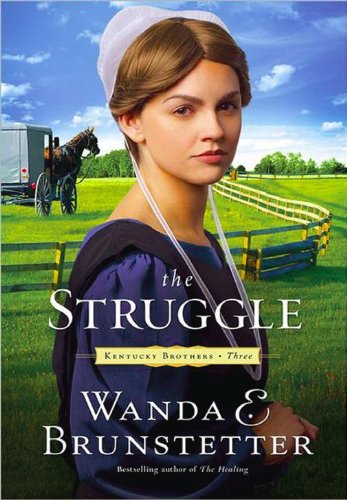
Book Review: The Struggle

A Fair Trade Book


Title: The Struggle (Kentucky Brothers, not numbered)

Author: Wanda E. Brunstetter

Author's web site: https://wandabrunstetter.com/

Date: 2012

Publisher: Barbour

ISBN: 978-1-61626-089-7

Length: 380 pages

Quote: “Save your marriage? If you ask me, taking Hannah away from her mamm is more likely to ruin your marriage than to save it!”

Amish people make mistakes too. (Christians aren’t perfect, just forgiven.) In this novel a young Amish man makes one big mistake, after which his wife makes what might arguably be an even bigger mistake, and they just sputz up their days until a real tragedy comes along.

Brunstetter, who is Mennonite not Amish, is exploiting a wave of interest in the super-conservative Amish in order to present her explanation of how Christians work through and recover from our mistakes. The story would have worked as well or better if the characters had been Mennonites, or Baptists or Lutherans or Seventh-Day Adventists; the story is not about any point of doctrine on which the major Protestant churches disagree.

My feeling is that all this interest in the Amish is justified, because in some ways they’re light-years ahead of other Christians in following the example of Jesus and the apostolic church. People tend to fixate on “Why don’t they drive cars and carry cell phones?” and the Amish, whose super-strict rule includes that English is not their first language, tend to be too modest to spell it out face to face, “Because we use our money to take care of our own, without depending on government health care or farm relief or even tax-funded schools, that’s why.” Amish people live extremely simple, frugal, low-tech lives, as close as possible to the way Germans of the laboring class were living in the eighteenth century, in order to survive as completely self-sustaining small farmers and craftsmen. And although you probably have to be born Amish to join the Amish church, as our national debt spirals toward bankruptcy it becomes clearer every day that other churches have a lot to learn from the Amish example.

I still think there’s something deeply weird about a genre of “Amish Romances” being written by non-Amish people, in English, in view of the fact that strict Amish people don’t even read romances...Brunstetter has written dozens of these stories, so she must be making money at it. I’d hope that that money is going back to the Amish church.

Anyway: Although Hannah, portrayed on the cover, and Timothy, her husband, look as if they’re reenacting a scene from the year 1750, they are modern people. They don’t watch the TV shows that popularized the clichés they’ve learned to use in English. They speak what linguists can still identify as a form of an eighteenth century working-class German dialect, as their first language; Brunstetter handles this problem by translating most of each sentence into English but throwing a Pennsylvania German word onto each page. When a character says mamm instead of Mom, that’s meant to remind us that if the scene were actually happening we would not be hearing English, or even English with a Pennsylvania accent; we would be hearing a language people in Bonn or Berlin would be just barely able to recognize as made up of German words, though spelled, pronounced, and used differently from the words in use in modern Germany. Nevertheless they have picked up some of the latest clichés from Oprah and Dr. Phil, third-hand, fourth-hand.

Hannah may be just a little bit too attached to her parents, or Timothy may be just a little bit insecure. Anyway, Timothy thinks he can save the marriage by demanding that Hannah move from Pennsylvania to Kentucky, where Timothy’s brothers live. “Leave and cleave!”

I’m disappointed; another thing I’ve long admired about the Amish is the fact that most of them seem to be free from the “nomadic” tendencies that burden so many other Americans. (My parents were nomads before they were landowners. Being landowners is better.) For me a satisfactory ending to this story would be “So that tragic accident mentioned on the back cover happens to Timothy, and the way it happens impresses firmly on his mind that if God had wanted Timothy and Hannah to be in Kentucky God would not have made them Pennsylvanians.” That’s not how the story ends. Well, I don’t usually like novels anyway...

Hannah goes into a sulk. They don’t get a divorce, or threaten one. They separate. Of course, this being a romance...

Well, I’m always cynical about a romance. You may like them.. If you like romances, you’ll probably enjoy The Struggle.

Although it's not really old or rare, Brunstetter's fans are keeping prices for used copies up on Amazon. You can buy this one as a Fair Trade Book in support of this web site, for $10 per hardcover or $15 per paperback book, $5 per package, plus $1 per online payment, or you can buy it as a new book. Either way Brunstetter will still get her payments per agreement with Barbour; if you buy The Struggle as a Fair Trade Book, she or her Amish informants will get $2 from this web site. 
Wednesday, September 13, 2017

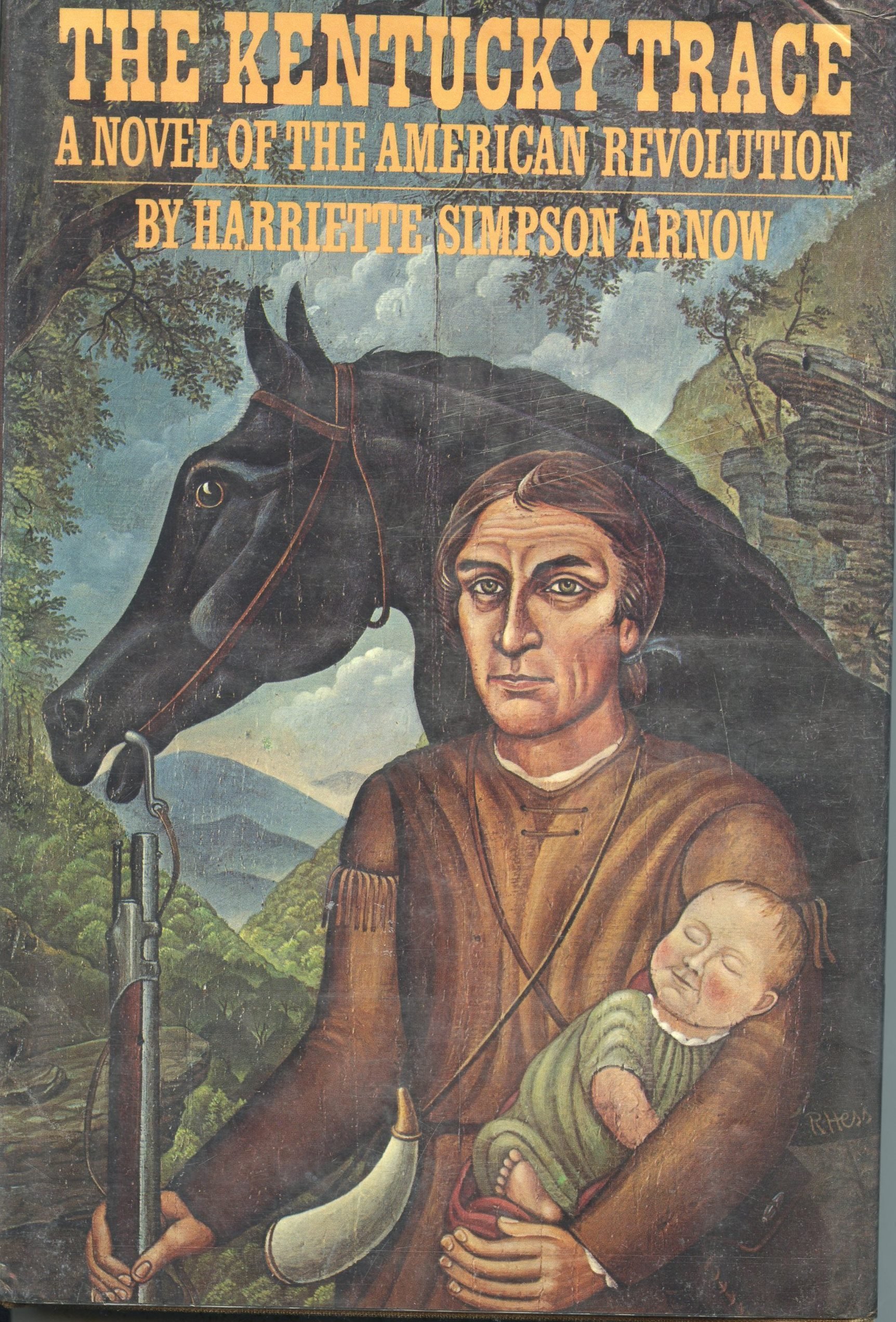
Book Review: The Kentucky Trace

Title: The Kentucky Trace


Author: Harriette Simpson Arnow

Date: 1974

Publisher; Knopf

ISBN: 0-394-48990-X

Length: 289 pages

Quote: “There were some who'd call him traitor to the cause; but then maybe he'd feel a traitor to mankind if in the woods he'd killed two men only because they'd worn the uniform of the enemy.”

Though subtitled “A Novel of the American Revolution,” The Kentucky Trace is not the usual war-period historical novel about how a fictional character might have watched or participated in a decisive battle. Leslie Collins has put in his military service back east, and is now crossing the Appalachian Mountains with an odd lot of new acquaintances who are also fleeing the horrors of war.

For those seeking alternatives to romances, Arnow was generally a good author, able to present either sexual or sex-free relationships in realistic proportion to her characters' lives. The Kentucky Trace didn't disappoint those looking for another character who is heterosexual, but not obsessed with it. Possibly it disappointed the jacket illustrator; I wondered whether that picture of Leslie on the front cover was meant to be a portrait of some tough female ancestor of tall, gaunt, competent Gertie, The Dollmaker. Leslie, like the protagonists of Mountain Path and The Weedkiller's Daughter, is more concerned with surviving a bizarre adventure and making up a believable story to cover the unbelievable truth than with romance.

Leslie tells himself there are some good women, but he has been married to one he considered bad—she wasn't very good—until, in this story, he meets a really bad one. Leslie is a Real Man, and a fine one, even when he has to tend the baby. In 1974 homosexuality was still unthinkable for fictional heroes but “androgynous qualities” were in fashion; readers were meant to read William David Leslie Collins' choosing to be called “Leslie” as evidence that his character, formed by consistently good choices, had achieved a balance between the virtues then considered manly and womanly.

We meet Leslie, as we meet other Arnow characters, in a moment of crisis; he's been taken prisoner and is working his way out of his bonds while another prisoner is being hanged. Moving quickly across the Blue Ridge Mountains along what would much later become Route 23, only while it was unpaved and full of thickets, cliffs, and shale beds, he has his adventure in what will eventually be called eastern Kentucky—across the Cumberland, where sandstone starts to replace limestone, but east of any Shawnee settlements.

Cherokee settlements were mostly in Tennessee and points south and west, with border trading posts on the edges of what became Virginia and North Carolina. Yuchi people, physically related to the Shawnee but even less organized or “civilized,” had also lived in Tennessee and had mostly fled or died before Europeans started to survey the Blue Ridge Mountains. The Native American character in The Kentucky Trace can't be identified with any recognized tribe or nation. He might be one of those prisoners of war who weren't disclosing any information about who or where their families were or where they were trying to get back to. Leslie and his friend Daniel, who is trying hard to be Cherokee (like his late lamented wife), call this younger man “Little Brother.” Is he a lost Canadian trying to get back to the north and west, or the last survivor in a Yuchi family whose home wasn't far from where he meets Leslie and Daniel? He'll never tell.

There are two women in the party: Rachel, the good one, who has been enslaved and used as a wet nurse, and Charity, the horrible one. Since the story is told from Leslie's point of view we also learn a fair bit about his unlamented wife Sadie, who threw herself at Leslie because she'd already started a baby with a less gentlemanly patron of her parents' inn; other than that she wasn't all bad, we learn, it was Sadie's mother who made Leslie feel that war could be no worse than the home life Sadie offered him. Daniel, who does miss his late wife, is continually surprised that Leslie is not mourning for Sadie.

There's also Jethro, officially Leslie's slave, in practice Leslie's foster brother, and enough others that the group can travel in separate parties through what are not yet eastern Kentucky and Ohio to the frontier settlement of Detroit. Leslie accepts slavery and will agree to work in exchange for the title to another slave, in this story, but he's not a racist; he appreciates Jethro and Rachel as individuals. Historically his attitude was not unusual in the Appalachian Mountains where, if slaves were acquired, they were more likely to be acquired individually and allowed to earn their freedom than they were in the flatland "plantations."

The baby in this story is not Sadie's baby, who died along with Sadie, nor is he Leslie's. Who he is and who adopts him, in the end, is the main plot that ties together all the minor frontier-survival adventures.

An interesting phrase that appears in the story is “rock house.” On the Virginia or limestone side of the mountains, into the nineteenth century, “rock house” or “rock hall” were expressions used to mean any big cave. A "rock house" figures in local history:


In the Kentucky sandstone country, Arnow tells us, “rock houses” came to mean a particular kind of sandstone cave, peculiar to that region, apparently numerous, shallower but therefore airier and more pleasant for camping in than limestone caves are. Throughout much of the story Leslie and his friends live in “rock house” caves.

Names in Arnow's stories of the Midwestern States tend to repeat. From the appearance of minor characters with names like “Sadie Hawkins” (in 1974 everyone remembered that character from Al Capp's fiction) readers might infer that Arnow was too busy getting the period details and action scenes right to bother about finding just the right name for each character, and carelessly recycled names. Others, noting the movements of characters through her books, have postulated that the stories are interlinked. It's possible that, in combination with Arnow's other books, The Kentucky Trace is meant to leave us convinced that Leslie and some of his friends will choose the perfect farm for Leslie's parents to retire to, will settle down there and live reasonably happy ever after. Or not.


Though not exactly a best-selling author, Arnow was a critically acclaimed one, considered historically important in Kentucky, and her books have gone into collector prices. What I physically read is a hardcover edition; interestingly, it's gained less value on Amazon than the paperback edition has. Even reprints and Kindle editions of The Kentucky Trace are pretty pricey. What you can buy here, therefore, will be the hardcover book (unless you insist on a different edition) with the jacket as shown above, and it'll cost $10 per book plus $5 per package (two copies would fit in one package) plus $1 per online payment.

Wednesday, December 21, 2016

Book Review: Trees of Heaven

Title: Trees of Heaven


[That's a new paperback reprint. What I physically own is a much older reprint, hardcover.]

Author: Jesse Stuart

Date: 1940

Publisher: University Press of Kentucky

ISBN: 0-8131-1446-2

Length: 340 pages

Quote: “I don’t like the way Pa does things and I don’t take atter Pa.”

Tarvin Bushman lives with two contrasting role models of manhood. His father, Anse Bushman, is a hardworking farmer. His neighbor, Boliver Tussie, is a lazy “squatter.” The two men have never liked each other. Their wives aren't friends either, and although only the youngest Bushman and the eldest Tussie child are close to the same age, the children have not been brought up to see each other as friend material. As the Euro-American population of Kentucky grows bigger and denser, Boliver is about to be forced off the land to which he has no registered title, and for the sake of their teenaged children, Tarvin and Subrinea Tussie, the two men will begin to work together as friends. Tarvin and Subrinea are, of course, “in love,” but the important part of their story is the progress toward friendship and compromise between the older men.

Where do the "trees of heaven" come into it? Before North Americans decided ailanthus trees were an invasive nuisance, the trees were marketed under that name. In this novel, the neighbor families who have regarded each other as nuisances come to see that each family has some desirable qualities, rather like ailanthus trees.

Of this first novel Stuart later said that a publisher had reported that he was working on a novel, so he’d thought he’d best write one. Its theme of neighborly relations across lifestyle differences would reappear in other novels he wrote, later. He admitted some points of resemblance between Anse and his own father, the Man with a Bull Tongue Plow.

The historical setting of this novel was quaint in 1940 and may be hard to imagine now. Stuart was sentimental enough to cultivate that naïve literary voice (he didn’t write as if he’d gone to university) and to make nearly all his characters nice people who liked each other when they got to know each other, but he wasn’t sentimental about the “old-time country” ways his neighbors and he were leaving behind. Anse, who wastes nothing and owes nobody a penny, gives thanks when what was making him sick was nothing worse than internal worms. Trashy Boliver wants Subrinea to marry “her own kin,” a Tussie cousin, at least until he has had an opportunity to appreciate Tarvin.

Anyway this blast through the past Stuart had at least heard about, from older people, as a child, is more pleasant to read than some of his novels were through more distant pasts he had perhaps hastily imagined; through the conflicts and even the quarrels, everybody except a few unfortunate lambs lives happily ever after.


Jesse Stuart no longer needs a dollar but this web site will still sell a copy of Trees of Heaven for the usual $5 per book, $5 per package, and $1 per online payment. 

Wednesday, September 7, 2016

Book Review: Strong Survival

Title: Strong Survival


Author: Cliffie Strong

Date: 2004

Publisher: Christian Appalachian Project

ISBN: none

Length: 100 pages plus donation forms

Illustrations: black and white photos

Quote: “My name is Cliffie Strong and I am 88 years of age…I have survived many hard times.”

She says, while readers want to give her more of a hard time. “Cliffie” is one of the most classic preppy-girl nicknames, referring of course to Radcliffe, which in Cliffie Strong’s case seems like sarcasm. Having “learned all that” the local public “school could teach” at seventeen, she married at eighteen and had three children at twenty-four.

And oh, she was poor, everybody around her home was so-o-o poor, they could hardly survi-i-ive. They all owned land. They were all natural-born citizens of the United States, with the right to travel and find jobs that paid better than farming their land. They were poor, just like incontinent young people in other parts of the country, because they had too many babies. They had the ability to say “no,” just like other young people who wanted their work to be a spiritual practice rather than a mild form of slavery. They didn’t want to think about that, though, and they were so-o-o grateful for the “angels” of the Catholic “Christian Appalachian Project,” who didn’t remind them of it.

Well…to each his or her own. Stereotypes don’t form out of thin air, and Strong has chosen to present herself as one of the most durable stereotypes of the twentieth century, the Barely Literate Hillbilly On the Take. A few of them really did exist, and if you’re from Virginia, North Carolina, Tennessee, Georgia, or for that matter Ohio or Pennsylvania, you can give thanks that this specimen was from Kentucky.


Alternatively, of course, if you live with teenagers you can use this book in the classic way literate hillbillies always used this kind of story—showing it to teenagers as an explanation of why you want them to laugh off any experience of Teen Romance they may have, and focus on qualifying for decent jobs, even if they inherit land and live on it. Flatlanders in their ignorance often think people like Strong were typical of all mountain people. They weren’t. They were typical of the ones others pointed out as bad examples.

In between writing and posting this review, I sold the copy of this book I physically owned, but as an Amazon Associate I can resell it to anyone who wants to buy it here. I'd recommend it to anyone who wants to support this web site, because the price of used copies on Amazon is so low! For processing any book sale we have to charge $5 per copy, plus $5 per package shipped, plus $1 per online payment (the Post Office collect their own surcharge for real-world payments).

Wednesday, December 30, 2015

Book Review: The Blue Grass Seminary Girls' Vacation Adventures

(Reclaimed from Blogjob: 1910’s, Blue Grass Seminary Girls series, comically bad fiction, horse stories,stories about tough girls.)

Book Review: The Blue Grass Seminary Girls’ Vacation Adventures
Author: Carolyn Judson Burnett
Date: 1916
Publisher: A.L. Burt Company
ISBN: none (click on the picture to find it on Amazon)
Length: 252 pages
Quote: “Shirley Willing, with flaming eyes and tightly clenched hands, jumped quickly forward, and with her right hand seized the bridle of a horse that was bearing a strange boy along the road, which ran near the river.”
Whoever Carolyn Judson Burnett was (this book belongs to one of the pseudonymous series for which the A.L. Burt Company was known), she (or he) understood the general idea of building suspense. Is this moral tale for little girls really going to open with its heroine stealing a horse? The answer is...yes. Shirley might have been content to send the boy into town to warn the people that the dam has broken, but when he balks she drags him out of the saddle and rides his horse into town. Then, reunited with the friends she’s visiting (it’s not even her town), she proceeds to faint. The horse will, of course, eventually be restored to its own humans.
This is only an introduction to Shirley and the real plot of the story, which begins after Shirley’s friend Mabel goes back with her to spend the second half of spring break in Kentucky.
The Blue Grass Seminary Girls represent the first wave of twentieth-century American feminism. Created to appeal to girls who liked boys’ adventure stories, most of them are generally packing pistols, which they’re willing and able to aim at Bad Men’s heads. They can also steal a horse, or a boat, whenever the plot requires it. Around the middle of the book, while dressing like a boy, Shirley gets drafted into a gang war with rough boys who throw rocks at one another’s heads. Shirley and Mabel always rise to these tests of their mettle. Then, after the crisis, they prove their femininity by crying, fainting, or both.
Nevertheless, we’re informed on page 21 that Shirley is “a typical product” of Kentucky. A motherless daughter, she provides the moral support to keep her doting father from drinking and gambling...much. Her favorite pet is a Thoroughbred stallion called Gabriel. Only Shirley and Jimmy, the orphaned stable boy who just might be an unacknowledged brother of hers, dare to enter Gabriel’s stall. The big horse can be depended on to kick and trample any man who comes near him, which is why the villainous Mr. Jones, Mr. Willing’s horse-racing rival, can’t poison Gabriel himself but tries to get Jimmy to do it. Shirley, who can borrow Jimmy’s whole identity as easily as his clothes, gets into a variety of scrapes (including the aforementioned gang war) trying to save Jimmy from temptation. We’re told that she also does well in school, though we don’t see it in this book.
The scene that will probably seem most unlikely to most readers just could have happened. Most aggressive animals aren’t really vicious; they attack only when they feel threatened. When Mr. Jones backs horse-phobic Mabel into Gabriel’s stall, we’re told, the horse takes pity on Mabel and allows her to turn him loose, so that he can give Jones the broken ribs Jones deserves. Some horses are like that. Not many, but some.
The part I find hardest to swallow may be true to the setting too. “When is any of these people going to report this Jones to the police?” I wondered as I read. They never will. It's considered a disgrace, Burnett explains, for Kentuckians to enlist help to defend themselves. Jones, being already a liar, bully, coward, traitor, and thief, is not ashamed to whine to the police when someone gives him a well-earned punch in the nose, but the Willings have reputations to maintain. Jones is Mr. Willing’s enemy, but since the Willing estate belongs in some sense to Shirley and Gabriel too, Mr. Willing is less ashamed to let a fifteen-year-old and a horse defend him against another man than to enlist men for protection. Well, if they say so, I guess...I used to doubt old-timers’ stories of what barbarian “guerrillas” Kentuckians used to be, but I’ve not read anything about this book having been denounced as slander.
This novel is recommended to all kitsch collectors, and to horse-loving, adventure-loving girls who have a solid grip on reality. Shirley may be hard to believe, but at least she doesn’t spend her days moping around in unrequited love. There is a time in a girl’s life when Shirley’s levelheaded, sisterly attitude toward boys may make up for all the other defects of the story. If you buy books for a girl of that age, you may want to collect the whole series--there were four of them.
Although they're not Fair Trade Books, the best price I can offer on any of the "Blue Grass Girls" books is $10 per book + $5 per package (+ $1 per online payment). You could probably get all four books into one package for a total of $45. Alternatively, you could fit three or more vintage books by living writers into one package along with this one; most books sold here cost only $5 per copy, and living writers receive $1 for each copy of a secondhand book this site sells.

Tuesday, October 28, 2014

Book Review: We Be Here When the Morning Comes

Book Title: We Be Here When the Morninng Comes
        
Author: Bryan Woolley
        
Date: 1975
        
Publisher: University Press of Kentucky
        
ISBN: 0-8131-1337-7
        
Length: 104 pages text plus photo insert
        
Illustrations: black-and-white photos by Ford Reid
        
Quote: “We Be Here When the Morning Comes is not a sociological study of ‘the Appalachian coal miner today’...It is intended to be simply a portrait, in words and pictures, of a community and its people art a particular instant...based al­most entirely on our own observations of persons arnd events and many hours of tape-recorded interviews.”
        
In the 1930s, Harlan County coal miners’ attempts to unionize led to a small-scale civil war. In the 1970s, the mines were still the source of “the nation’s life blood—electric power,” and the miners were on strike, demanding a few improvements that they hoped would make their job less dangerous. Reporter Woolley and photographer Reid had documented earlier phases of the story for the Louisville papers before they decided to rent rooms in Harlan and produce this short book.
       
“It is also a book about Appalachia,” a blurb writer insists on the dust jacket, as if disputing Woolley’s very words. In Virginia, “Appalachia” is the name of a specific town....and this book is about Harlan, which is a place in its own right, and entitled to its own name.
        
It is, specifically, about an incident in which a mine foreman, probably drunk, shot and killed a striking miner, and how the community reacted. The striker may have participated in some sort of demonstration that provoked the foreman, or may not; different stories were told. They were neighbors, had been friends, and may have been relatives. The long strike had been getting on everybody’s nerves. Woolley’s informants describe an episode in which strikers’ wives, thinking a court order not to harass the strike breakers was aimed at their husbands but not at them, attacked the “scabs” with “switches”—“Did you ever see a switch big around as your arm?” People were afraid the violence would get out of hand. At first they worried that Woolley might provoke violence. In the end his reportorial presence may have put a damper on the violence, although Woolley reports that the foreman was pronounced innocent of “intent to kill.” Based on Woolley’s reporting, this verdict rather obviously reflected the fact that U.S. juries are not allowed to pronounce a case “not proved,” no matter how many conflicting, unverifiable stories they’ve heard.
        
Slanted? Pro-union? Absolutely. “Impressively honest,” as Robert Coles pronounced this book? Probably. Woolley seems to be reporting what people told him; under the circumstances it’s natural, even predictable, that all his informants seem to be on the strikers’ side—knowing which side his sympathies were on, people on the other side wouldn’t have talked to Woolley. Although Woolley admits that there was no way for outsiders to tell the scabs from the strikers, that they still worked in the same mines and belonged to the same families and even continued to worship in the same churches, they were not on speaking terms at this point. The man in whose house Woolley was staying solemnly quoted Jack London, to Woolley, as having written, “Judas Iscariot was a gentleman compared with a scab,” and refused to let Woolley buy a snack at a store: “Not that store, buddy. That’s a scab store. You wouldn’t want to do any business with him.” So Woolley wouldn’t have met any equally impressive, equally forthright people who might have thought the strike was unnecessary or counterproductive. Instead he got, and he shares with us, a witty and imaginative analysis of what went wrong with certain miners to cause their “scabism.” Honest, so far as it goes, but one-sided.
        
If due allowances are made for this obvious built-in bias, We Be Here When the Morning Comes is a valuable, and very readable, bit of Kentucky history.

I was surprised to learn, online, that this book has become a bit of a collector's item. Bryan Woolley is still alive and writing in Texas. (Google searches for him will be disappointing if you don't specify a book title, like We Be Here When the Morning Comes or Home Is Where the Cat Is, since another Bryan Woolley, a chef in Utah, is getting a lot of attention.) This early book is out of print, and the best I'll be able to do as a Fair Trade Book will be $10 for the book and $5 for shipping. As always, if multiple items are shipped in the same package you pay only one shipping fee. You can get the book a little cheaper (not much) directly from Amazon, but if you buy it as a Fair Trade Book Woolley, or a charity of his choice, gets $1.50.  

Tuesday, June 18, 2013

Top Tourism Tip for Gate City, Virginia

First, let’s explain to unwary travellers: Once long ago, in the mists of urban legend, a driver used really thick, dark window coating, such that nobody could be sure whether he was even in his car while it was moving down the road, to conceal a weapon. Then he proceeded to drive like a maniac and, when a highway patrolman asked him to pull over, he out with his concealed weapon and shot the patrolman in the head.

I don’t remember reading where this actually happened, but in the 1990s Virginia police began taking the legend very very seriously. Thick black window coating is popular in several states, including the contiguous states of Tennessee and Kentucky. It is illegal in Virginia. You can get a ticket for driving a car with excessive window tinting in Virginia, even if the car passed inspection in your own state.

Now, although Virginia is known for (among other things) a tradition of hospitality, there are always a few people who want to defy tradition. Some of them happen to be police officers. They could legally just warn visitors about window tinting or ask them to peel it off, and many do, but some of them seem to like writing tickets.

Around the turn of the century Gate City had a policeman who got into trouble for admitting publicly, “When I see a Tennessee license plate, I start writing a ticket.”Although he is no longer on the force, his memory survives in Tennessee, such that Tennessee residents whose family live in Virginia, or who used to live here themselves, are now wary about shopping and dining in Gate City.

On Wednesday, June 5, Kingsport Times-News columnist Jim Welch wrote about his “legal transgression.” He hadn’t presumed to go into Abingdon, Virginia, just to shop or visit a park or go to a music festival or anything. He had been invited there, by his daughter who lives there, who had just adopted a child. According to him, “I knew my mind was emotionally rac­ing, so I attempted to add additional focus to my driving.” Nevertheless, he was fined $91 for having tinted windows.

This kind of local issue (as distinct from local business promotions, of which they couldn’t get enough) used to be discouraged by Associated Content, and we’ve tried to minimize it at this web site. However, in response to the demands of our sponsors, this web site finds it necessary to take a stand. As Grandma Bonnie observes: this is not right.

We do think the safety concerns about heavy window coating are valid. Most cars come with enough window tinting to make driving in the sun bearable. Individuals who need more shade should wear sunglasses.

We think the laws in Tennessee, Kentucky, and other states should reflect these safety concerns about heavy window coating. Enough to make it hard for passers-by to see that you're going to the lawn mower repair shop in an old work shirt with grass stuck to it is one thing. Enough to conceal how many passengers are in the car is, well, more than enough.

We also think that it will be difficult for any amount of sales, music festivals, horse shows, historical reenactments, or free promotional hotel nights, to bring tourist revenue into Gate City when people are afraid to drive into town.

From a relatively small sample of local voters, taxpayers, and business owners, we have heard quite a solid consensus about the need to ease up on this practice of writing tickets for visitors whose cars are legal at home. We also note that, of the people who have suggested that this web site discuss this topic, about half have proposed the topic immediately upon learning that one of us was associated with this web site.

A business owner said, “Even if you own a building in Weber City, you would make more money renting one in Lynn Garden. Most of your customers will be in Kingsport and they don’t come into Gate City. They are afraid they’ll get a ticket just for being from Tennessee.”

Another business owner said, “Visitors come to our town to spend money. Giving them tickets when they’re not really endangering anybody may get more money out of their pockets faster, but it also makes them less likely to come back and spend more.”

A gas station employee said, “People from Tennessee go to the hospital in Pikeville, or people from Kentucky go to the ones in Kingsport or Knoxville, on Route 23, and they hurry around the bypass. Ask them why they don’t stop in town, they’ll tell you they have heard that they’ll get a ticket if they’re seen in Gate City, for things like window coating. Some of them don’t even have any extra window coating. They have just heard that they’re not welcome in Gate City.”

Many times when I’ve been in Kingsport, someone has said, “I’ll drive you as far as the state line but you’ll have to walk from there. If those Virginia police see me, they’ll give me a hard time.” (Sometimes I’ve asked, “What for?” when someone doesn’t have heavy window tinting. Some people have called my attention to other defects of their vehicle, or admitted that they were trying to avoid some person in Virginia...but in the last year three or four people have told me,“Virginia police just like to write tickets.”)

This web site will not discuss the question of whether we have too many police officers. Gate City, Weber City, Scott County, and the Virginia Highway Patrol all have police cruisers that may be found on Route 23. This makes it easy to find an officer when you need one, and the way they all work together can also be considered a good thing. Nobody would collapse from the heat or cold while waiting for help inside a stranded car around here! However, there is a widespread perception that officers are struggling to justify their employment by writing too many tickets when they ought to issue warnings.

A Kingsport business owner said, “As I was driving home late at night, a light burned out. Within a mile a Virginia cop had pulled me over. I told him the light had just burned out and I’d take it in for repairs in the morning. That did no good. I said that this would be my first ticket in thirty years. He said,‘Then it’s time you paid your share.’”

A Kingsport retiree said, “There is a grocery store across the Virginia border that has better prices as well as a lower sales tax on food, but I’ve heard that Virginia will take it out of Tennessee drivers, so I don’t drive out there. I have to wait for someone from Virginia to come out and get me.”

Jim Welch’s column ended with a question whether Tennessee could start issuing traffic tickets to visitors for having “anything they didn’t like,” such as the colors of a team Tennessee residents love to hate. Welch prudently mentioned Chicago, but in view of the passionate intensity with which Gate City and Sullivan South High School students, parents, and alumni follow football...I wouldn’t think there’d be any serious safety concern that would justify legislation. Nothing comparable to the fear of violent criminals hiding behind blacked-out windows, anyway. But in view of the number of Gate City residents who commute to work in Kingsport, not to mention shopping in Kingsport, it might behoove Gate City to show more hospitality to visitors from Tennessee.

Thursday, February 28, 2013

Kentucky Senate Stands Up to Agenda 21

Thanks to Karen Bracken for sharing James Bruggers' report:

http://blogs.courier-journal.com/watchdogearth/2013/02/27/anti-un-agenda-21-bill-passes-kentucky-senate/

This web site hasn't had a separate label for Kentucky news. This web site now recognizes that we have enough kindred spirits in Kentucky to need one.

Mr. Bruggers sounds like a True Green who doesn't realize the extent to which the Green Party has been hijacked by anti-American interests (that aren't really concerned about the earth). Readers who've been receiving Karen Bracken's research and/or observing that "Agenda 21" is the only reasonable explanation for some of the legislative craziness we've been watching, please be especially gentle with him. Remember cognitive dissonance...