Monday, September 5, 2016

Book Review: How to Talk to Your Cat

Happy Labor Day, U.S. readers...I hope all of you are blessed with cats with whom you can talk today! Long, long review, written and scheduled to post in advance. 

Title: How to Talk to Your Cat
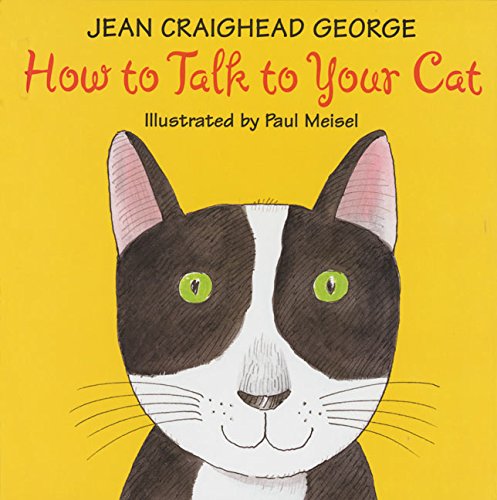

Author: Jean Craighead George

Date: 1985

Publisher: Warner

ISBN: 0-446-39150-6

Length: 99 pages

Quote: “Will Cramer not only altered his own behavior when the animals spoke to him, he altered theirs by speaking to them in their own language…he told me…that he just watched what the naimals were doing…then observed what happened next.”

First, Jean George was “scientifically” trained to resist attributing human thoughts to animals. Then, she scientifically observed that, although it’s difficult to do large-scale studies, communication with animals is often possible by acting on the premise that something resembling human thoughts may take place in other animals’ brains. Then she was able to write books like How to Talk to Your Animals, of which How to Talk to Your Cat is a three-chapter excerpt. They’re not cut and dried enough to read like “hard science.” They’re “anecdotal observations.” But they work.

Being by nature whimsical, I’ve whimsically expressed some of what I’ve learned about animals—cats most recently, and before that chickens—as “interviews.” People have legitimately complained that the idea of interviews with animals, other than Koko the gorilla and Alex the parrot and a few other animals who have learned some sort of “rigorously constructed” sign language, seems like fiction. Well, it is. Even the “rigorously constructed” sign language is subject to interpretation; what “Fine animal gorilla” says to me may be different from what it says to you. It’s definitely translation, and it may be inaccurate translation, when we interpret animals’ nonverbal communication…but it works.

How does it work? If we have time we can go back and analyze it, which is what George does in some parts of this book. In some ways her analysis seems almost oldfashioned: “We no doubt send out odors that announce our sex,” George says tentatively. When the Highly Sensory-Perceptive nose isn’t clogged up by reactions to more toxic chemicals in the environment, it recognizes them, though only in the 1990s was scientific research able to “prove” that humans exude recognizable sex pheromones that not only announce our sex but also our state of health, fertility, and receptivity. 

George quotes Will Cramer, a self-taught animal whisperer, saying, “The cat smells that you think people are the only critters who can talk.” Do cats pick up a pheromone that communicates that much? Human science has yet to identify that pheromone. The cat may be going by body language, instead. George cites research documenting that, although cats probably see less (or notice less of what they see) than we do, they hear much more. Cats make relatively few distinct vowel and consonant sounds, and rely more on pitch to express meaning; they hear, and use, pitches humans don’t hear—which they’re probably making during some, not all, “Silent Miaow” scenes.

Does your cat know you’ve given it a name? You can test this. Has your cat given you a name? George found a study documenting that some domestic cats make a distinct sound that refers in some way to their humans, use it when communicating with other cats, and try to use it when communicating with their humans, although most cats who’ve been smart enough to do this have probably given up hope that their humans have enough intelligence to learn to respond to their names. It remains to be learned how cats name humans, or whether their names for their humans relate to other concepts in their minds. One novelist imagined a cat calling her own human “Warm” and her human’s mate “Pest,” which seems to work for the way some cats relate to two halves of a human couple…but is that really the thought process at work? We may never know…

It is, nevertheless, possible to learn at least a pidgin “cat language,” and use it. Cats who bond with humans who try to learn “cat language” are likely to be courteous enough to learn bits of “human language” and become Listening Pets…so one human’s ability to communicate with one cat may reach phenomenal heights, unlikely to be matched even in that human’s relationships with other cats or that cat’s relationships with other humans.

One major difference between George’s observations and the ones I’ve reported is that George observed normal cats, whereas I’ve been blessed with an opportunity to study social cats. Normal “cats despise each other” and want to be alone. Social cats bond—and their primary relationships are with one another, rather than with even their favorite humans. (This does not keep them from being affectionate pets, or even competing amiably for human attention, although I question George’s assertion that “all cats would prefer to be alone with you.” One of the pleasures of living with social cats is seeing them take turns for petting/grooming sessions with me, yet despite occasional token invitations to humans they definitely prefer to hunt, cuddle, and share mothering responsibilities with other cats.) Although their ability to hunt as teams and rear young as families gives social cats a tremendous survival advantage, and although the social cats I’ve observed seemed to dominate and “socialize” normal cats and other animals, social cats are still a minority of catkind.

Social cats who are sexually active do tell same-sex cats to back off, and some of them even pair-bond and tell other cats of the opposite sex to back off—though social cats who don’t pair-bond can be promiscuous and may encourage prospective mates to fight for their attention. At other times in their lives, social cats are hospitable and seem to seek dominance based on their ability to protect and nurture others, rather than beat others up. This means that a lot of the meaningful nonverbal communication (and behavior) that’s easiest for George and apparently other researchers to document is the kind that doesn’t go on at the Cat Sanctuary, except occasionally among the rival suitors of one female.

Other observations in this book do apply to social cats. The variations on the “meow” are one of them. (If you want to make friends with a shy or wild cat, or make peace with a cat you’ve displeased, “mee-o-ow (with a falling cadence)” is what you say—I hear and say it as more of a “me-ew-ee?”on a pitch humans call falsetto. Note, however, that if you use this pleading “meow” and then do something inconsistent with its “please be my friend” meaning, depending on the cat’s initial view of you, you’re either saying “I’m a liar who should never be trusted” or “I was trying to be funny and need a good lesson.”)

If you want to say “no,” the “mer ROW!” growl on a low tone is also one humans can successfully imitate. Some humans, hearing mainly the “ROW!” note, hear it as more like “Huh-uh” or “Grrrh.” If you match the mother cat’s pitch, almost any cat will react to the “no” tone, not being particular about the human vowels and consonants we use… though some cats will shift quickly from the instant pause in what they’re doing to a defiant response, either repeating what they were doing or growling and glaring back at you.

“[W]hen was the last time a cat growled at you?” George asks readers. At the time of typing, that would’ve been yesterday, when I was clipping a cat’s claws. Some cats use a soft continuing growl note to say something like “Watch out, be careful, I’m warning you.” Vets and groomers hear a lot of this one. Some cats supplement or replace the growl with incessant hand-licking; there are layers of possible meaning in hand-licking but part of the meaning indisputably is “I don’t want to bite you, but if you hurt me I will.”

Play-hunting is all cats’ favorite game; George doesn’t discuss its use as a way to identify minority cat personalities, although I’ve found it to be a reliable one. Cats use different grabbing technqiues, which, George explains, are best suited to grabbing mice, insects, birds, or fish. The “fishing” grab with one curled paw calls for better than average coordination and identifies a clever cat, who may also use its curled paw to scoop the last bits of food out of a tin, work a simple latch on a cage door, and affectionately enfold your fingertip, among other things. (Clever cats are not necessarily social, nor are all social cats intelligent; most of my resident cat family are both.) The “bugging” grab is typical of cats who may be great bird watchers, but are unlikely to be successful bird killers. The “birding” move identifies a cat who may become a “bird specialist” and should be sterilized and confined—the sort of cat I’d recommend to city people who intend to keep their pet indoors, which is not much of a life for a cat and tends to produce neurotic behavior, but at least protects the rare cat who is a real danger to birds.

One thing I particularly like about How to Talk to Your Cat is its levelheaded freedom from the “cats kill birds so let’s lock up or kill all the cats” mania that breaks out occasionally, usually among socialists and almost always among borderline sociopaths, who tend to practice cruelty on cats before graduating to humans. Some humans hate this set of parallel statistics, but because the numbers match so well I like it:

* About 15%--one out of six, not evenly distributed, concentrated in some genetic types within some location—of all cats chase birds. About 15% of all humans are sexually attracted to the same sex. (Approximately another 15% of cats can occasionally be persuaded to chase birds, and another 15% of humans may occasionally be enticed into a homosexual relationship, in situations where their natural instincts are thwarted.)

* Within this 15% minority of aerial-hunting cats, about 10% of cats sometimes succeed in catching a bird, usually at a feeder that’s too close to the ground. Within the 15% minority of homosexual humans, about 10% of men sometimes pursue little boys rather than other men.

So, locking up all the cats to protect the birds makes about as much sense as locking up all the men to protect little boys from child molesters. The fact is that North American birds have coexisted with wild cats, which were stronger, hungrier, and more efficient hunters, for thousands of years before they needed to coexist with domestic cats. If you want to protect birds in North America, ignore the squealing about cats—which is trotted out as a distraction—and pay more attention to the damage poisoned insects do to our most valuable insect-eating birds.

(In Hawaii and New Zealand, the situation is different. Island-specific bird populations have evolved in cat-free environments and do need to be protected from cats.)

George, however, accepts that most cats are—and should be—natural animals who live, hunt, and mate outdoors, as nature intended, despite the centuries of selective breeding that have made most of them smaller and more human-dependent than nature originally intended. How to Talk to Your Cat does not focus primarily on the sterile, confined, unnatural cat-as-pillow-substitute that some writers in this field seem to want to imagine that all domestic cats are or should be. I concede the benefits of making a disabled cat, a bird hunter, or a cat that’s been bred for a lethal or dysfunctional gene, into an indoor pillow substitute, and am not morally opposed to meeting that kind of cat owner’s needs when I meet a cat who’s really unsuited for a natural life. I also think we as a society need to recognize the dysfunctional tendencies within the Humane Society of the United States, and address them by, among other things, adopting the following slogan:

HAVE YOU EVER HAD SEPTICEMIA? THANK A FREE-RANGE CAT.

And, if you spend an afternoon outdoors in a residential neighborhood and don’t see a cat prowling about…don’t move into that neighborhood. It may not look like a slum, but if a neighborhood doesn’t protect (and thank) cats at the top of its ecological ladder, in a few years big aggressive rats will be there.

One thing I don’t particularly like about How to Talk to Your Cat is George’s bemused acceptance of unaltered female cats making sexual displays to humans. I’m bemused when both male and female cats signal the early stage of a fertile phase, or a hormone surge in adolescence, by acting especially affectionate toward me or toward “their” human. Lying on one side and gazing up through slitted eyes is a general invitation to cuddle, used by mother cats to kittens and by social cats to close friends, as well as by cats in a mildly sexy mood. Slithering along the ground on one side seems to be a more specific female display, which young kittens sometimes use to invite grooming and petting. All cats also like to rub their flanks and the bases of their tails against things—scent-marking, as well as enjoying a good scratch or massage. When a cat’s nonverbal message goes beyond that and becomes unequivocally sexual, I think humans should back off, and some of my cats have very emphatically agreed. For normal cats, as for normal humans, sex is private.

George discusses some of the things cats “say” with their tails…only some. The tail tip twitches nervously, apparently uncontrollably since it sometimes warns off prey, when a solitary hunting cat is closing in on its prey. That twitch, while the tail is close to the ground, warns everyone else to back off; the cat is tense and, if distracted, is likely to slap or pounce on the one who distracts it. However, a different twitch, done while the tail is held up in the air, slightly to one side, or waving from side to side, says “Do follow me.” Some cats positively twirl the tips of their tails when leading their human to where the food is stored!

Social cats, and courting couples of cats, occasionally entwine their tails while standing side by side; this display is rarely seen, and George doesn’t discuss it. It seems to express affection and intimacy. I’ve had cats who did it wrap their tails around my arms and legs, too, like possums…but one reason why more cats don’t do this may be that not all cats have enough flexibility and coordination to do it.

George does not discuss the minority of cats who are born with permanently crooked tails, in which the bones and muscles may be so deformed that the tail can’t straighten out even between your fingers, or only deformed enough that the tail resumes its crooked position immediately after it’s been straightened and released. This trait runs in families, may correlate in some way with polydactylism, and seems uncomfortable for cats. My cats Heather and Iris were granddaughters, and Ivy was a daughter, of a polydactyl feral tom I called Pitt (as in “black as”). Heather inherited Pitt’s impressively long, agile tail; she can wrap it around my wrist or leg, or around Irene’s tail. Pitt has an almost identical brother, Damian, with large but not polydactyl paws and a short tail. Damian’s human thought he might have been abused because “When he came to us, the end of his tail was bleeding as if it had been chopped off.” That may have happened…but Ivy had a misaligned bone at the very end of her long tail, and Iris was born with a permanent kink two or three vertebrae above the end of the tail. When Iris was about six months old, and had met Damian (Damian is semi-social and still a neighbor's pet, Pitt was antisocial), Iris started biting and scratching at the kink in her tail in a determined manner, and after about a week she had a short tail with a neat little wound where she had amputated that useless end. Possibly she shortened her own tail because the spastic, crooked end embarrassed her, or interfered with communication with other cats, as well as interfering with her climbing trees.

(One of Pitt’s other kittens learned to answer to the name “Nixon,” because his tail had got a crook. He didn’t live with it for very long.)

With its focus on normal cats, How to Talk to Your Cat gives more attention to nonverbal communication that’s rarely observed at the Cat Sanctuary, while overlooking behavior that’s commonly observed. There’s no discussion of the way social cats use tail-waving to indicate when they want other cats to go around and catch something they intend to trap between two or three cats, for instance—or when they want to be left alone as they close in on something they feel able to catch all by themselves, thank you. Social cats also use a long, loud, growling call to invite everyone to see when they’ve caught something they’re willing to share; the growl says “It’s mine, all mine! You can’t touch this until I say you can!” but it also calls everyone, “See how I caught it!” After reenacting the hunt and tasting its prize, the successful hunter retires and lets the others share the rabbit. And rarely, on very special occasions (I’ve witnessed two), they caterwaul at great length, all up and down a scale that uses the “quarter tones” that make some exotic kinds of folk music sound dissonant or alien to most humans, in a celebratory behavior I can only call singing. I’ve heard only two cat songs of joy, but that’s one more than I’ve heard of normal cats’ calls to fight, at the Cat Sanctuary.

Other developments in “cat whispering” have taken place since How to Talk to Your Cat was written. A book called Good Kitty (which I reviewed at Associated Content, which the author subsequently joined, but I'm not seeing either book or writer at Amazon today) discusses, primarily, the behavior problems of neurotic indoor cats. If you’re able to live in a healthy environment for humans you may agree with me that this focus is irrelevant. However, Good Kitty also discusses newer chemical studies that have uncovered more information about pheromones, which can be used to shape even natural outdoor cats’ behavior. 

There’s also Super Cat, a book the Humane Cat Genocide Society types seem to want to bury, which primarily discusses the fun that can be had if you’re blessed with an especially clever cat…it’s a parlor trick, since no cat will ever really learn to speak English, but it’s possible to teach a cat to recognize black-and-white patterns well enough to “read” a few specific words in English, such as “Food” and “Dirt,” which you can paint on two otherwise identical cans.


I still think How to Talk to Your Cat may be the best first book about human-cat communication, and the book on this topic with the broadest appeal. 

Jean George no longer needs a dollar, so this is not a Fair Trade Book. To buy it here, you still send US$5 per copy + $5 per package + $1 per online payment, for a total of $11 if this is the only book in the package, to this web site; or send $5 per copy + $5 per package, for a total of $10 if this is the only book in the package, to P.O. Box 322 (addresses are at the very bottom of the screen). Postal payments, for which the Post Office collects its own surcharge so we don't collect one, are safer for us and for you, and recommended for that reason. E-payments are easier; you use the published e-mail address below to verify that you're an actual book buyer and receive our Paypal address.

Sunday, September 4, 2016

Controversial Book Review: The Clear Word for Kids

A Fair Trade Book


Title: The Clear Word for Kids

Author: Jack J. Blanco

Date: 2008

Publisher: Review & Herald

ISBN: 0-9748894-3-1

Length: 1042 pages with several four-page full-color inserts

Quote: “And the things that Samuel had told him happened to Saul that same day. He met two men, then three men, and when he got close to home he met a group of ministerial students…and he joined them in singing.”

The first I heard about The Clear Word was when a Daily News columnist referred to it scornfully as “the Seventh-Day Adventists’ own Bible.” Say whaaat? All the years I went to that church, we used the KJV, NKJV, RSV, NIV, NASB, such that most Adventists I knew were familiar with those initials. (They're less familiar with the Douai and Geneva translations.) In “Sabbath School” classes (since they don’t actually meet on Sundays) Adventists often look for illumination of the Bible in the Seventh-Day Adventist Bible Commentary, in (some of the favorite) writings of Ellen White and other founding members of the church, and in popular books by non-Adventist authors. Seventh-Day Adventists are proud of being part of the Protestant tradition; their study groups refer to Luther, Wesley, Foxe, Knox, Moody, C.S. Lewis, Fanny Crosby, or Max Lucado as well as Ellen White and Arthur Maxwell. None of these books is regarded as part of, or equal with, the Bible.

But then I found a copy of The Clear Word on sale for a dime, so I bought it to see what the man was talking about. The Clear Word is not a Bible. It is a paraphrase—the sort of exercise students write to show that they’ve read something from their required reading list. It has more in common with The Message than with any of the new “copyright Bibles.” It’s not a new effort to translate the original Greek or Hebrew or Aramaic texts into modern English. It’s an exposition of what the modern English suggests to Jack Blanco’s mind.

If you know your Bible well, very often, as in the paraphrase of 1 Samuel 10:9-10 quoted above, the disparities are hilarious. What Saul met were “sons of the prophets.” These young men filled a role similar to that of ministerial students, but the mental pictures…The “sons of the prophets” wore robes (which they might have hiked up or thrown aside in the heat of “prophesying”) and sandals and head scarves. They spoke ancient Hebrew. During religious services they, like other people, offered food to become “a sweet smell unto the Lord” in the perpetual barbecue on the altar. Some of this food, especially blood and fat from butchered animals, was dropped down into the fire; most of it was grilled and eaten by the worshippers. Wine offerings were also important. What was offered was considered “wine” from the time of pressing, but in a hot climate it became alcoholic fast. Worship services did not involve sitting still and listening to a lesson; they involved milling around, probably dancing, and chanting and singing. The prophets chanted and sang the Scriptures too; they were the teachers of the Scriptures, and their job also involved "prophesying" to the people which courses of action would lead to blessings or curses according to Moses. The ancient Hebrews also apparently had faith in divination—after praying, people would draw straws, stones, etc., and consider the results as God’s guidance—as well as in signs, dreams, and visions. The prophets certainly practiced divination, and some of them even reported visions, but they apparently spent a large part of their time telling less scholarly people, “If you do good, good will result. If you do evil, you can’t expect good to result.” We're not told in which of these prophetic functions Saul joined. "Singing" is strictly an educated guess about which of them Saul might have been able to do.

The Clear Word abounds with this kind of intriguing incongruities. In Genesis 19 the evil men of Sodom demand that Lot release the two new young men, his visitors, “that we may know them” in the biblical sense—apparently they were one of a minority of primitive groups that practice gang rape as an initiation ritual—but in The Clear Word their demand morphs into an ordinary invitation: “Bring your guests and come with us, and we’ll all have a good time.” When Lot demurs, what the visitors actually say is often translated as “We shall serve you worse than them,” but in The Clear Word it becomes “We’re coming in and taking your guests with us whether they want to go or not.” This is a little closer to the original story than the Veggie Tales version of the Purim story, where Haman gets “banished to the Island of Perpetual Tickling,” but not much. Arthur S. Maxwell retold this story for children (with the gang wanting “to hurt” the angels in the form of young men, as if the men of Sodom were the sort of street bullies with which most children are familiar) much better than Blanco does.

In Genesis 30, the original text does make it clear that Jacob is…groping toward a modern understanding of livestock breeding. People didn’t fully understand how selective breeding worked, before Mendel’s time, but people around the world managed to practice it. Jacob was promised all the spotted goats born in the flock as wages. Not sure just how to increase the incidence of a minority gene, he tried prayer, he tried cutting spots of bark off green branches to give the goats the right idea, and he tried encouraging the spotted goats in the flock to mate with the solid-colored ones. God heard Jacob’s prayers, the spotted goats mated successfully with the solid-colored goats at the right times, and Jacob walked away with lots of spotted goat kids. The Bible explains this fairly explicitly. The Clear Word is coy: “So when Laban’s animals had babies, many of them were spotted. This was because the Lord was blessing Jacob, not because of the spotted branches.”

Inevitably the poetic books are mangled by Blanco’s tone-deaf urge to shorten, familiarize, and simplify the Bible’s ideas. “Blessed is the man that walketh not in the counsel of the ungodly, nor standeth in the way of sinners, nor sitteth in the seat of the scornful,” says Psalm 1, “but his delight is in the law of the Lord, and in His law doth he meditate day and night.” In The Clear Word this flattens down to “Happy is the man who doesn’t listen to those who are evil or go where they go. Happy is the man who delights in God’s law and thinks about what God said.” Further along, “He leadeth me in the paths of righteousness for His Name’s sake” becomes “He helps me do what is right.”

Although S.D.A.s historically denounced the Spiritualist movement, in the early 1980s some enthusiastic evangelists told people the church was “New Age” and “positive-thinking.” Later in the 1980s, when Dave Hunt and other disillusioned Protestants led the movement to purge “magical thinking” out of the churches, some Adventists of Blanco’s and my generation still clung to the “positive thinkers’” tendency to focus on emotional moods, to pursue an emotional sense of happiness in the absence of real good to feel happy about. Psalm 42 was originally a sensitive, realistic poem about a man who, like the future King David in his wilderness years, has been cut off from the pleasure of communal worship due to the whims of feudal rulers, or poverty, scandal, unpopularity, or other reasons; while mourning for the present loss of this pleasure, the speaker hopes to be able to enjoy it again. “I had gone with the multitude to the house of God…Why art thou cast down, O my soul, why art thou disquieted within me? Hope thou in God, for I shall yet praise Him.” Blanco’s ideology perverts this understanding into something Blanco apparently (and mistakenly) considers more relevant. “I used to lead people to Your Temple, singing praises all the way. What a spiritual feast we had! But why am I so sad now? My hope is in the Lord. I will keep praising You no matter how discouraged I feel.” The Psalmist was anticipating, and probably rallying support for, a change in the real world around him. Blanco’s speaker is self-bound, trying to talk himself out of a bad mood. If you’ve ever tried to talk yourself out of a bad mood while keeping the focus on yourself and your mood, you know how futile this is, and how deeply wrong the paraphrase is.

Substantial chunks of meaning as well as poetry are also lacking from the Proverbs. Among other resounding clunkers, Proverbs 31 specifies the attributes of a good wife as including the kind of physical strength and financial acumen that the French Romanticists, Rousseau, Comte, and Saint-Simon, considered unladylike and undesirable. “Like the merchant ships, she bringeth her food from afar…With the strength of her hand she planteth a vineyard.” In the United States an ideal of a “nuclear family” where the wife never “had to work” at anything useful, after the children ceased to be babies, was introduced from French philosophy to substitute for the biblical ideal, in which women actively contributed to maintaining the strength of the extended family. Blanco’s paraphrase seems to reflect an early attachment to the Socialist, anti-biblical vision: “She shops for food…and plants a vineyard.”

Passing quickly over the prophetic books, which are a source of confusion at their clearest, we find other things that are blatantly Blanco’s and not the Bible writers' thoughts. In Matthew 13, people murmuring about Jesus say, “Are not His brothers, James, Joses, Juda, and Simon, and his sisters with us?” These were people who used their words for “brothers” and “sisters” in an exceedingly loose, liberal way. The use of these words here offers no basis whatsoever for doubting any of the possibilities...

* that Mary and Joseph might have had six ordinary natural children of their own after Jesus was born; 

* that Joseph might have had those six children from a previous marriage, and Mary might have become somehow “too holy” to have children in the ordinary human way; 

* that all six (or more) of those people were actually foster siblings, cousins, or close friends whom Jesus was known to call “brother” and “sister” in an adoptive sense, whether all or any or none of them had been brought up by His human parents. 

A paraphraser who didn’t want to impose his or her own ideas on this text might have left it as it is, since it’s easy to read in all the classic translations, or just skipped the four brothers’ names…but Blanco has a preference. “We know His stepbrothers and stepsisters.”

Turn the page, and the eye immediately lights on another authorial, or paraphraser-ial, intrusion. The original text of Matthew 15 does not spell out why Jesus at first ignored a Syro-Phoenician woman who asked him to heal her daughter, then haughtily told her, “I am not come but unto the lost sheep of the house of Israel…It is not right to take bread from the children and cast it to dogs.” Most readers have inferred that He was testing her in some way, and possibly also making a point to His disciples. What we know is that, when the woman replied, “Yes, milord, but the dogs eat the crumbs that fall from the children’s table,” she did use a different word for a different kind of dog. Judaism discouraged intimacy with dogs; Jesus used a word that meant wild dogs. Some other ethnic groups had started keeping dogs as house pets; the Syro-Phoenician woman used a word that meant pet dogs. Anyway, Jesus apparently liked her answer and promised that her daughter was (already) healed—which opens the possible interpretation that an hysterical mother might have been sicker than her daughter, all along. Blanco, however, insists on only one possible reading: “Jesus paid no attention to her. He did this to show the disciples how it looked when they treated foreign people that way. Jesus said to the mother, ‘They tell Me I’m not supposed to help you because you’re a foreigner’…Jesus said…‘Your daughter is healed.’ Then the disciples realized that Jesus was telling them to be kind to everyone and help them, no matter where they come from.”

Seventh-Day Adventists have always been partial to that reading, too, and it’s obvious throughout The Clear Word that the church as a whole has tried to be kind to Blanco. It’s not that the psalmist hoping to rally a minyan for group worship might not have felt weighed down by discouraged emotions, or that Jesus might not have been telling the disciples to be kind to foreigners. It’s just that the Bible as written is…well…so much bigger and better than this silly paraphrase.

But how could it be otherwise? Could any mortal be expected to improve the Bible? I’ve read other individuals’ paraphrases of the Bible, including The Message and a committee-authored “Readers Digest Bible” that claims to have merely shortened the text but has, of course, done violence to it. No paraphrase ever was or will be an improvement on the Bible as it stands. The primary benefit of a paraphrase is to the student. The purpose of publishing one is not to improve on the original text but to encourage the student, and other students, to study the original text. What the Adventist church is saying with The Clear Word is not “This is the word of God” but “This is the result of Jack Blanco’s disciplined and thorough study of the word of God; let us commend his efforts.”

If you can read it that way, then The Clear Word may appeal to you. It is truer to the original text than The Message, although some think that makes The Message more interesting as commentary; it's truer to the original text than the "Readers Digest Bible."

I don’t particularly recommend The Clear Word for Kids to children. Yes, it is closer to being a child’s-eye view of the Bible than The Bible Story, which looks and sounds like a picture book of stories. Yes, Blanco does at least try to explain those intriguing ancient laws and prophecies to kids—at the expense of much of their sense and almost all their literary beauty—and some kids may like that. I’d rather let children look at the pretty pictures in The Bible Story, which is a classic in its own right, until they’re ready to dig into the Bible itself.

Children have an ear for language; they appreciate “a bell and a pomegranate, a bell and a pomegranate” and don’t need to hear that phrase flattened out into “balls that look like pomegranate fruit, with a golden bell between each one.” They are capable of learning the difference between “Thou leadest” and “He leadeth,” and other points of earlier English grammar that have faded out of modern use, from the KJV—and learning those points will serve them well at any university they may one day attend. Children hear the parallelism in Psalm 1:1, in translations that use “walketh not…nor standeth…nor sitteth” or in those that use “neither walks…nor stands…nor sits,” and they should at least be able to notice that it’s one of the things that are missing from “Happy is the man who doesn’t listen to those who are evil or go where they go.”

We’ve all heard from people whose memory of their first exposure to the Bible is “I didn’t understand all those strange words, and it scared me.” We’ve not heard enough from people who were, perhaps, more emotionally secure in childhood, whose memory is “I didn’t understand a lot of what I was reading, but it was awesome.”

I’ll even go on record as speaking for those who, as children, had some appreciation of the classic KJV. Our number included the late writer known as Ozarque, and also the late Art Linkletter, Jessamyn West…and a whole school of writers, beginning perhaps with G.K. Chesterton, certainly including George Bernard Shaw and Mark Twain, and Dorothy Sayers, and C.S. Lewis, and J.R.R. Tolkien and Charles Williams, and P.G. Wodehouse, and Farley Mowat, whose English was plain, down-to-earth, conversational, and at the same time memorable and quotable, because their writing, speech, and thought were formed by exposure to the KJV; Cynthia Voigt may have been the last of the true breed. 

My Drill Sergeant Dad first brought me the sort of picture books four-year-olds normally like, which I liked, and approved of my reading them, and then started pushing: “Once you know how to read, those little picture books have served their purpose. You ought to be reading the Bible.” So I tackled the Bible, at different times, beginning at different places. Of course, at first a lot of it didn’t make sense to me; much that did seem to make sense was still very confusing. Of course, some of the Bible’s original images are anything but warm’n’fuzzy, although I could, by age five, feel confident about which side I was on and appreciate the blood-and-thunder quality of God’s cleansing wrath as portrayed in the Psalms and the Revelation. Very few five-year-olds, even if Highly Sensory-Perceptive, have developed the neurological structure by which an adult brain would process a spiritual experience; but five-year-old HSPs do feel awe, and when the spring rains smashed through the ice and roared down the mountain, when the lightning flashed and the thunder boomed, I remember returning to the Revelation and wondering whether this was what the writer was talking about. Children do not actually need for adults to pretend that everything is warm’n’fuzzy. Children appreciate knowing that some adults understand that some things are awesome.

Do you have or lack “an ear for music,” “a sense of pitch”? Often the difference between someone who develops “absolute pitch” and someone who can be taught to tune his or her own instrument, given A-440, is that one grew up listening to live professional-quality musicians and the other grew up listening to the radio. Likewise children develop their ear for language by hearing and reading things they don’t understand. Eighteenth century writers in English were educated on Latin, French, and Greek, and read English as a guilty pleasure—and their stilted, affected English writing shows it. Toward the end of the nineteenth century English-speaking adults started educating English-speaking children on the Bible, typically the KJV, backed up by Milton and Shakespeare—and their fluent, lucid, quotable English writing shows it. Some of the worst passages in writers like Twain or Mencken or Lewis sound better than some of the best in writers like Swift or Madison…or like the more recent writers who grew up deprived of the literary “ear training” of reading the Bible aloud.

So I recommend reading the Bible itself with children. Of course you, the adult, should know before you begin reading which parts are going to be difficult to explain to the children. Their literary ears won’t miss Genesis 19, particularly, but they need to hear the difference between “Children are an heritage from the Lord” and “Children are a gift from the Lord. They’re like a reward from Him” (Blanco’s version, which makes me react, “Like really?”).The mind, also, has a need for awe and wonder; no child deserves to have its capacity for awe stunted by being fed on movies and picture books alone.

If, however, one of the children in your life is an ambitious reader, who gets far enough in the Old Testament to start asking adults in its life what all that stuff about the sheaf offering and the wave offering and so on mean, then I would recommend giving that child The Clear Word for Kids and explaining that, although it’s only one man’s best effort at retelling the story, Blanco has studied about the different offering rituals and provided a simple explanation of what they probably meant.

And, if there are no children in your life…you might get some use out of The Clear Word as an exercise in humility. Read Blanco’s clunkers. Laugh out loud—if you’re a Bible Maven you will, and laughing is good for the body. Then try to paraphrase the whole Bible in your own words, not copying the original words and not copying Blanco’s. Yes, publishing a paraphrase of the Bible is a bit hubristic, but...maybe you can do a better job than Blanco has done? I can't. I both write and edit, and therefore have an especially great need for humility. Once, over a few weeks, I managed paraphrases of eight Psalms; I was not, however, humble enough to be willing to expose those efforts to posterity, so I burned them long ago.

To buy The Clear Word here, based on its going rate on Amazon, send $35 per copy + $5 per package to either address at the bottom of the screen. It's only one volume, but it's a substantial volume; adding any other books to the package might put it over the weight limit for the $5 rate. I'll know for sure when you order a copy. 

Friday, September 2, 2016

Book Review: Uprooting Racism

Title: Uprooting Racism


Author:  Paul Kivel

Date: 1995

Publisher: New Society

ISBN: 0-86571-338-3

Length: 243 pages

Quote: “This is a book about racism for [W]hite people…what it means to those of us who are [W]hite, and how we can make a difference…White racism is the uneven and unfair distribution of power, privilege, land and material goods favoring [W]hite people.”

On page one, Kivel says it all about this book.

A few years ago I read Uprooting Racism, thoroughly. I worked through it, writing out essays to Kivel’s questions. It was a good thought exercise. It would be interesting for a study group.

In the end it’s unsatisfactory, because Kivel’s underlying assumption, throughout, is that a “fair” distribution of power, privilege, land, and material goods would be a mathematically “equal” distribution carried out by an all-powerful central government, rather than a system that offers opportunities to earn those things for individuals, impartially. He thinks fairness can be measured by whether people who fit into different demographic categories have equal amounts of this and of that, rather than whether people who have agreed to do or provide X in exchange for Y have received Y upon the provision of X. He seems not to have noticed, while he was writing this book, that the kinds of government he thought he wanted were crumbling around the world. (He's still alive and, according to some grumpy reviewers, he still hasn't noticed.)

Basically, then, when Kivel asks readers to think about the images of people different from ourselves we observed early in life, the extent to which we may still be reacting to those images when we meet brand-new individual acquaintances who may have little in common with the images, he’s helpful; when he claims that the only improvement possible is to move to the Extreme Political Left and join those squawking about absurdities like “restitution for slavery” long after the last slave died, he’s not helpful.

Are there ways to overcome racism and build social relationships with people different from us, without joining the Extreme Left? There certainly are. This web site has frequently highlighted ways to do that within the allegedly racist Tea Party movement. Color in no way determines whether people are able to notice that they’re Taxed Enough Already. Tea Parties have emerged from all parts of America (including the moderate Left) and built alliances across all the barriers of subculture, even, to some extent, politics. (A majority of Tea Parties were and remain Republicans. Do not be deceived. Policies that worked for FDR, JFK, and even Bill Clinton are acceptable to some Tea Parties.) 

If you are White, or partly White, or part of a minority group that tends to be seen as White during color wars, and you think a bigger federal government, a global government, and/or more regulations and taxes, are not what your country needs…first of all, even before you read this book, I recommend reading something recently written by Thomas Sowell, something by Larry Elder, and something by Ben Carson. Those are three completely different writers. None of them says the same things the others say; none of them says the same things any White, female, or young writer says, so far as I know; if you’ve read several of their books you’ll find that the bits you remember definitely come from one of their books and not another, too. When you’re an older Black male conservative writer you sort of have to make each book unique and fit it into a precise market niche, just to get a publisher to print it. Left-wing Black writers are allowed to sound exactly alike, and often they do, because publishers assume that they have a choir to whom they are preaching. Conservatives who are not White, male, and old have a wide-open space in which to cultivate their ideas, and if they’re not careful, they may let the lefties convince them that they’re all alone in it.

If you really enjoy reading, feel free to repeat this exercise with non-socialist writers from other demographic blocs, as time and money permit. Karibu Books used to do an excellent job of stocking books by multiethnic and multilingual authors; Ishmael Reed has done an excellent job of finding and publishing them. But let’s save the discussion of young and other minority-type writers, even women writers, for another day, for purposes of space. In fact I’d even suggest that you print out or “bookmark” this review, if you’ve not already had the pleasure, and go and read at least one thing by each of Sowell, Elder, and Carson. For people who are fiscally conservative enough to tolerate this web site, that is homework. Know their voices, their differences, the sources of their authority. Know why we can take their word that they know racism, they hate it, and they’ve not allowed it to consume them; they don’t hate White people.

Now it is helpful to think how slavery and segregation may have affected your individual ancestors and what may have been passed down to you—after you’ve read firsthand testimony from people who are old enough to have seen at least segregation, and opposed it. Note the complexities of the problems, of the solutions, and of the failed solutions.

Part of the civil rights story that today’s Left prefers to forget is how racial segregation came to exist in the first place. After slavery ended, young Black people wanted education; they wanted well-paid white-collar jobs. They complained to local officials when their diplomas didn’t get them hired. At least one of those local officials said, on the record, “I’ll get you jobs for young Black doctors and nurses, but you’re not going to like it.” Then he went on the stump and preached to the White majority how horrible it would be if their loved ones had to depend on some filthy disease-infested Black nurse, etc., etc. He was fighting cognitive dissonance since the more affluent voters in his district had been brought up by Black wet nurses, but epidemics of tuberculosis and other diseases were sweeping through slum areas and even nice, clean-living poor people often were plague carriers…and the people voted to fund separate schools and hospitals for Black people in the hope that exposure to fewer bacteria would give them more chance not to come down with those diseases. After a whole demographic generation, or two, had grown up constantly hearing “clean and white” treated as synonyms, in districts like that one there were those pathetic women screaming hate at tiny innocent children who they may have sincerely believed to be disease carriers. And all the while, in places where Big Government had not been systematically preaching hate and prejudice at people, there were also places like Berea College where Black, White, Red, and other types, from North and South, were willing to consider each other as equals, part of their own minority group of gifted and talented students…

Conservatives should most definitely listen to the ethnic minorities in North America today. All of them. The best thinkers, writers, and speakers in a group will not necessarily be the most “conservative”…but, as American thought digests the reality that the socialist experiments of other countries have failed, there will be a correlation between intelligence and movement away from the whole socialist philosophy. It may look “conservative.” Do not be deceived. A movement back toward respecting the primacy of the individual may be to the right side of the Extreme Left, but it won’t mean that the real progressive thinkers of the twenty-first century will think like Archie Bunker.

As a White ally to Black men, since we’re talking about them here, you naturally want to show all due respect and courtesy to any and all Black men you meet, and their wives and children too—but as a fiscal conservative you’ll probably most particularly respect the work of the ones who think like Sowell, Elder, and Carson. That won’t interfere with your enjoyment of Harry Belafonte’s music, Reuben Jackson’s poems, or Morgan Freeman’s movies, of course…but it will remind you to look for Denzel Washington’s movies, Ishmael Reed’s poems, and Lloyd Marcus’s music, too.

Paul Kivel’s main shortcoming is that he’s listened only to the left-wingers in each of the minority groups with which he consulted while writing this book. To some extent the people in those groups who are closer to contemporary reality share the ethnic, racial, cultural, linguistic, etc. etc., minority experience…but they have different ideas, often better ones, about improving it.

Paul Kivel is still alive; therefore Uprooting Racism is a Fair Trade Book. When you send $5 per copy + $5 per package (which covers as many copies of as many books, or other things, as will fit into the package) + $1 per online payment to either address below, we send $1 to Kivel or a charity of his choice. (If you pay by U.S. postal money order, you don't pay that $1 surcharge to us; the Post Office collects its own surcharge. The total amount is thus $11 for online payment, $10 for postal payment. If you throw in two more copies, or two other books that cost $5 each, the total would be $21 online or $20 via the Post Office.)

Thursday, September 1, 2016

September 1 Link Log

Well, this is sort of a sad day. After stewing over it all summer...I liked Blogjob. A lot. I hoped that leaving good content up at that site would help the site recover from its financial distress and pay the eighty-seven dollars it owed me, and then I'd resume posting there, maybe even under a new temporary contract for lower pay. But no. The advertisers have got the bit into their teeth and want to go on jamming obnoxious ads into the middles of articles for which I have yet to receive the Penny One. So, sadly, I'm transferring articles posted on Blogjob since December onto the Blogspot, where readers will see only the Amazon ads that are supposed to generate payments on commission, plus links to e-friends' best things of course. Meanwhile, links as they come in fit into the Categories: Animals, Business, Censorship, Food, Free Money!, Health News, Introverts, New York City, Nice, Topophilia, Writing...and can I squeeze in Amazon?

Amazon Link 

Yes! Since I just transferred a review of another of her early books, I checked, and Meghan Daum has a new one. Buy it new to show respect:


Animals 

Update! The lovable puppy mentioned yesterday is in Ohio:

http://www.blogbourne.com/hi-i-am-jill-the-doberman/

And here's a chicken story:

http://rusty2rustyschatter.blogspot.com/2016/09/how-did-chicken-get-in-my-backyard.html

Business 

"Do you have what it takes to succeed as an entrepreneur?" asks Larry Kim. Like I wouldn't know...I only did that for about twenty years. But check out his list of the job skills he believes are now essential. What do you think? Is he right?

https://readthink.com/do-you-have-these-14-traits-of-successful-entrepreneurs-206756876bfd#.lk69p6w80

Censorship 

I've never liked the walking stereotype of anti-Greek hate mentioned here, and had been leaving his story alone because who wants to read about an idiot who's more annoying even than Spiro Agnew used to be, but in view of this morning's op-ed post...Here's where I think the line should be drawn: Sending images of animals to someone on Twitter should be legal and protected, unless of course they're proved to be live unfaked images of animals being tortured. Hacking someone's Twitter account should get the participants, and the devices they've used, banned from Twitter for life. (No, that doesn't mean Twitter should demand proof of identity from participants; it means that these individuals, if they want to use Twitter again, should have to buy completely new devices and set up completely new accounts that never repeat, or make any reference to, the sins of their ignorant youth. And Twitter should stand witness in their prosecution for criminal harassment.)

https://thinkprogress.org/after-racists-harass-leslie-jones-off-twitter-the-site-finally-acts-992692c33a36#.ez7od7u64

Food (Yum) 

If you like vegan food, this issue of the McDougall newsletter, containing budget-conscious vegan recipes, is not to be missed:

http://us4.campaign-archive2.com/?u=5e58f59d97611f910916b6276&id=b22e498ade&e=4d57a9fdfb

Free Money 

Once again...thanks to whichever local lurker dug this one up! Yes, it's been three months since I last saw young people trudging around with a sack, and yes, I've left lots of top-popped cans for those young people to find along Route 23, and no, they're not picking them up. I hope that means those two have found a better-paid job! I'm almost desperate enough to haul a sack of cans to the state line, on foot, myself...but it really is a job for someone who has a truck that can haul heavy-duty sacks. There's more than a shopping-bag-size load out there.

http://priscillaking.blogspot.com/2015/04/free-money-in-scott-county-virginia.html

Health News 

Here's a petition I signed; some readers may want to sign it too:

https://www.change.org/p/heather-bresch-call-on-mylan-pharmaceuticals-to-reduce-price-of-life-saving-epipen

Few people would be tempted to get into the situation where they'd really need the information Dan Lewis shares here, but it just might save another person's life, somewhere...

http://nowiknow.com/the-pool-party-that-wasnt-a-gas/

Here's another old one of mine that may become relevant, again, to someone out there who has a child in school. If this sounds like your child, your child is not autistic, or even shy, no matter how much s/he resists making eye contact or how slowly s/he learns to recognize facial expressions. Some otherwise normal people were just born to communicate without pulling faces at each other. School staff who don't recognize this fact need to be told to deal with it and learn to speak like human beings.

http://priscillaking.blogspot.com/2011/11/looking-through-eyes-with-astigmatism.html

Introverts 

Notice how defensive they get at the first hint that extroverts don't have everything all their way all the time these days, that literate society is finally ceasing to function as one big support group for extroverts? I love it. I don't hate extroverts, or anyone else, in any serious way, but I think the evidence is mounting that their unfortunate condition is the result of brain damage.

https://medium.com/the-mission/5-reasons-you-should-be-proud-youre-an-extrovert-29c869f1a48e#.hxhd7ww6q

New York City 

Dan Lewis's e-mail warned that this post is a bit of a gross-out. Since when has any Washingtonian balked at any opportunity to laugh about how gross New York City is? I chortled.

http://nowiknow.com/a-token-effort/

Nice 

Regular readers know what to do here! Remember, you can cast another vote for #NovaSkye daily...actually, the site may let you vote more than once during a calendar day if you're online long enough. The site will tell you how many hours to wait between votes in this cute-picture contest. We can help the child of a cancer survivor, and a writer who's actively contributed (money!) to the cause of fair payments for other online writers, by voting for this terribly cute picture:

http://www.thecutekid.com/photo-contests/20160825/cute-kid-1472145666

Topophilia 

Serendipitously, these two posts turned up in Google Chrome at the same time...I don't believe nature intended humans to be nomads. As a child I sojourned in lots of different places and actively hated most of them for not being home; that's why I was surprised, and disappointed with myself, to find that I couldn't feel much empathy toward the city where I was born when it was terrorized by mass murders. (It took me a long time, and a lot of jokes about Hell, to get over an emotional feeling that Michigan, where I became ill from state-mandated vaccines against a disease I'd already had, should sink in a pit.) During my youth I did manage to live with two conflicting loves-of-place (Washington and my home town), and I'm really glad that, as the sex hormones settled down after age forty, so too has the urge to go back to Washington. I'll always love the city but I'll never live there again.

http://priscillaking.blogspot.com/2015/12/book-review-this-place-has-no-atmosphere.html

http://www.dailygood.org/story/1372/the-loneliness-of-the-modern-nomad-kira-m-newman/

Writing 

This post needs some explaining. It's about a writing site that initially tried to pay for blog posts, the way Blogjob did, but then advertisers told the site manager they'd only pay for real articles. At the rates Blogjob was paying for blog posts? I don't think so! Writers need to hold out for real payment for real work. If we do research, even opening a web page, we should be paid for it. One dollar per web site consulted, minimum; less than that, the sponsors should be grateful for permission to post a link on a blog post, and we should monitor the site to make sure we're getting a commission on any revenue that link generates.

https://blogjob.com/conversations/2016/08/21/when-you-are-denied-to-be-you/

Should Anyone Tolerate Annoying Online Ads?

Following up on some things linked earlier in these two weeks, I think annoying ads (including the ones that are trying to catch a free ride on my still unpaid Blogjob posts!) cost advertisers more than they realize.

Recently, I've seen some very encouraging ads for online writers, from U.S. companies that want to work directly with U.S. writers and pay decent wages...for motorist blogs and zines. Since they've all specified "car/truck/racing enthusiastwith degree" they obviously were looking for someone different from me, but for someone Out There, these might be excellent jobs. The way to advertise motor vehicles to Americans, in this post-Advertising Age, is to pay Americans to write honest blog posts about being motorists. Yes. This is a good trend.

Now, suppose these companies want to indulge in a little A/B testing with ads that carry the "negative reaction lingers in memory" idea to the next level. They can use the Internet to be so much more annoying than a screaming TV commercial people can simply mute, these days. They start e-stalking an Internet reader like you, let's call him Joe Jones, with a steady stream of "ads" that Joe Jones absolutely hates--maybe the images aren't even cars, but are gross-outs, and the words consist of things like "Joe Jones is a jerk, Joe Jones is an idiot, nobody likes Joe Jones," etc. etc. ad nauseam. They succeed in turning Joe Jones against his favorite sports-related web sites. Will they succeed in persuading Joe Jones to buy, let's call it a Yuckmobile truck?

What if, before Joe Jones starts thinking about his next truck, at all, the ads succeed in making him so angry that he starts driving recklessly and ploughs into a school bus full of children?

What if they raise his blood pressure to the point where he has a heart attack, and since he's only thirty-five years old and hasn't even started worrying about that possibility, he doesn't go to the hospital in time and dies?

What if the nagging sense that nobody likes him causes him to talk to a psychologist, who complies with insurance regulations by getting him a prescription for antidepressants, and he's one of those people who react to antidepressants by becoming violently insane, and he runs into the nearest "gun-free zone" with his pockets full of bullets and shoots forty-nine other people before killing his now crazy self?

The position of this web site is that we should all think long and think hard before tolerating any kind of annoying ad--even if it annoys people only by putting the cute picture in the wrong place, or by hogging memory and causing the content people want to see to load slowly...


Rant About Censorship

I posted this rant in a discussion at a small-group forum, then decided it was long enough to belong here. The context is the too-common plea for social web sites to "keep us safe" from oh-dear-that's-so-huuurtful comments. A specific type of comments mentioned are the ones posted to celebrities, on social and blog sites, like "Eww, what UGLY pictures, your music STINKS, maybe because your LIVER LIPS are too FAT to pronounce the words..." (Actually that's more literate and relevant than a lot of the stuff Michelle Malkin has shared with her e-friends as "Hate Tweet of the Day" examples.) I don't like that kind of comments. I don't think anyone does. I do think they have their place, in a free and democratic society, and Malkin is one of my blog heroes because she's not only tolerated them but shared them. Go Girl! She rules!

What I really hate, and want my Constitution to protect me from, is any effort to "make the world safe" through CENSORSHIP. Censorship is a subtler, classier form of hate than idiotic posts of nasty words, and therefore much more dangerous, more likely to lead to prison camps and mass murders.

Someone else had just said something like, "You can't shout 'fire' in a crowded theatre, for one example, but others might be hard to define." So I added a few:

"
Some examples I support, by way of guidelines: 

You can't (legally) make a threat of violence that any reasonable person could take seriously. 

You can't (legally or ethically) publish private information that could be used to harm a person, which would include the real name of any private citizen of the United States. 

You *can* legally publish hatespews like "I hate this post, this idea is idiotic, this person is a jerk"--if you *want* people to think of *you* as a mean-spirited, bad-tempered grouch, and want your business to suffer accordingly. 

You have a moral right, and you should have a specifically protected legal right, to out yourself as a hater. Go ahead and talk like Archie Bunker if you feel that way! See what it does for your business and social life! In real life, when people heard the real-life models for the character of Archie Bunker calling their in-laws "(blasphemous word) (ethnic hate word)" all the time, they shamed those people out of talking that way. 

You have a moral right, and you should have a specifically protected legal right, to be wrong. If you want to join the Flat Earth Society and post claims that Earth is flat, that should be your privilege. And social web sites I respect will protect your privilege...while, at the same time, offering other people the opportunity to post evidence that Earth is round. 

You have a moral obligation to correct errors you've made when you recognize them as such. One of the best things I remember about the Washington Post, when I read the printed paper every day, was the "Corrections" column. Of course most of the corrections were typographical and were useless to most readers, but it's good for anybody who talks/writes a lot to publish those self-corrections regularly. 

You have no right, and no *ability*, to "keep people safe" from things that might hurt their little feelings. Reasonable adults have lived through a few days when someone else's saying "I love my children/parents/brother/sister/dog" made us want to scream out loud with pain, and we've learned not to bore other people with our "hurt feelings." Same way with hate speech. Men don't have the right to threaten violence against women or against a woman, but they do have the right to make arrogant, hateful, sexist-jerk comments like "She is stupid" (where the "because she's female" is clearly "heard" even if some pretense of a logical refutation is offered). Let'em go ahead and out themselves. Reasonable women don't get angry about things like that...we get even.
"

As regular readers know, this web site has some additional policies that are part of our contract. In exchange for Google doing a lot of the boring maintenance work for us, we promise no hatespews, no explicit sex or violence, no nude pictures, none of the traditionally unprintable words, and--as a general rule, although we've broken it in a few discussions of medical news--no mentions of body parts. (As a general rule, if we say "hand" we need to add a word like "woven" or "writing" or "shake," fast.) But that's a private editorial policy, suitable for a personal blog for middle-aged Christians, not suitable for a web site that reports world news to, from, and for everybody. The position of this web site is that the world needs for quite a lot of things to be published elsewhere that couldn't be published here...and every few weeks we even endorse some of them.

To those who want to be "kept safe" from other people's hostile moods, we recommend a nice, safe padded cell, which youall can easily construct in your own basements. Just stay there until you feel able to venture out into the real world. And to those who worry about the people who need to stay in their own private safe spaces...September is here, the first few red buckeye leaves and purple asters were out on the road to prove it, but Hell, Michigan, has not yet frozen over. You can still get there. 

(Update: Yes, this post needed an Amazon book link. Buy it new to show respect if you can afford to--say, if buying it new merely means taking the bus or walking instead of driving to work for a week.)

Book Review: Arabel's Raven

Title: Arabel’s Raven


(That's the new edition, not the one I've dressed the doll to match.)

Author: Joan Aiken

Date: 1975

Publisher: Dell

ISBN: none

Length: 118 pages

Illustrations: Quentin Blake

Quote: “‘That bird gets more attention than the Lord Mayer of Hyderabad.’ ‘He doesn’t know that,’ said Arabel. ‘He hasn’t been to Hyderabad.’”

Here are the first three preposterous adventures of preschooler Arabel and her pet raven, Mortimer. In the first of these longish short stories Arabel’s father, London taxi driver Ebenezer Jones, finds Mortimer in the street, stunned by a reckless motorcyclist, and takes the bird home. Arabel, who was promised a hamster when she’s five or a puppy or kitten when she’s six, bonds with Mortimer the next morning.

Arabel is a thoroughly working-class child, with a hardworking father who’s usually on the job and a rather ditzy mother. Part of the charm of the four books about her and Mortimer is that, although nobody seems ever to have fussed over Arabel or tried to teach her anything, she’s usually figured things out quite well. Her consciousness seems like what you remember of being her age—no time for a lot of thought or “feelings” about circumstances, just add up the data supplied and get a workable answer. People who notice her think she’s too little to be out on her own. Nevertheless she gets herself through situations, and out of them, with aplomb and with a sort of precociously consistent responsibility for Mortimer’s well-being.

Mortimer is not an especially clever raven (or even a believable one, when you think about him) but almost instantly he becomes what Arabel has for a friend. In Joan Aiken’s full-length novels a sort of signature motif is a pair of gifted children; in the stories about Arabel and Mortimer, Mortimer seems to move into the brother’s position, although the only word he says is “Nevermore.” He says “Nevermore” often, usually to comic effect. He is able to fly, but usually prefers to walk—when he can’t get someone to carry him, or tow him on a wagon as Arabel often does.Like real birds, he doesn’t often show affection in ways humans recognize, but he does make an effort to visit Arabel when she’s ill with measles.

This is the background for stories that are more coherent, but no less ridiculous, than the ones four-year-olds make up for themselves. Mortimer foils jewel thieves who’ve committed unsolved burglaries with the help of a squirrel (the squirrel is trained, but its character is apparently evil); he gets sucked into a professional chimney sweep’s industrial-force vacuum cleaner; he learns to operate vending machines during a relatively tame excursion around the city at night, while police are catching another criminal and the adults Arabel knows, drinking Adult Beverages at a party, scramble every report of what’s happening into something sillier than what they’ve heard.

The adventures Arabel and Mortimer share will get even goofier in subsequent books, but readers really ought to read their stories in sequence, because later stories refer back to earlier ones. In this book we learn where Mortimer got his obsession with hunting for diamonds, and meet some of Arabel’s relatives who will be mentioned in later books. The later books would be laugh-out-loud funny if you didn’t have this background information. My experience has been that they’re even funnier if you do.

Another word of experience…Many of Joan Aiken’s short stories are only moderately funny; some are meant to evoke senses of nostalgia, wonder, or spookiness rather than laughter. When I discovered this writer in high school I read Not What You Expected and The Faithless Lollybird, of course, and reading those left me unprepared for this series, which is meant to be hilarious. Adults (and teenagers) should preview these stories, privately, before reading them aloud to children. They are that funny.

How impossible is Mortimer, exactly? Bernd Heinrich’s raven studies are a good follow-up after reading these silly raven stories. Mortimer is a cartoon character, but real ravens really are built and “wired” differently from other birds; they really can do a lot of things other birds either aren’t able to do, or don’t enjoy doing, apparently just for fun. They are wild birds and don’t normally like humans much (although they recognize humans as one kind of predator whom it may be profitable for a wild raven to lead to a freshly killed animal). They can, however, bond with humans. Many birds mimic sounds other creatures make, with varying degrees of skill. Ravens, like crows and parrots, are relatively intelligent birds and can learn enough words to make rational, though limited, conversation with humans if they feel like it.

They can roll over and lie on their backs, too…and although they’re not as bothersome as parrots are about it, they can and do amuse themselves by biting pieces out of things they don’t want to eat, possibly just to see how something that formerlyhad a straight  edge will look with a jagged one. As a joke Mortimer’s taste for “eating stairs” seems to me even funnier if you’ve watched a real large bird shaping its beak on the edge of a real shelf, stair, or windowsill.

What about Arabel? The clichĂ© about choosing books for children is that they like to read about characters their own ages or older. In practice, funny stories seem to relax this rule. Middle schoolers my age laughed at Ramona as much as Henry Huggins, at Linus and Sally as much as Lucy and Charlie Brown, and those of us who discovered Arabel in the 1970s laughed at her adventures too.  Arabel is a bit like Linus, actually—a very small child whose mind sometimes seems ageless, an “old soul.” If you’re shopping for the rare four-year-old whose eyes focus at close range long enough to read a book, that child might enjoy this series too. Arabel’s adventures are perhaps ideal for teenagers to read aloud to four-year-olds.

Joan Aiken, unfortunately, no longer has any use for a dollar...and, because Paypal has been forced to start dipping into small payments to survive, this web site now has to add a surcharge to our fee schedule. The cost is now $5 per copy of this book (and of most other books), plus $5 per package (covering as many books as I can squeeze into the box, if you order multiple books), plus $1 if you pay online. Since the Post Office collects its own fees, the surcharge does not apply if you send a U.S. postal order to the address shown below. (The surcharge will apply if we ever accept other forms of online payment; currently we accept only Paypal.)