Friday, March 8, 2024

Friday's Bad Poetry: Your New Fashion Fad, the Cotton Tabard Sweater

(Notes below.)

Since every knitter always ought
to own the perfect sweater,
I thought about some ways to knit
a sweater that was better
than those I've worn in other years.
This one's for growing old
and sweating out a fever in 
a room that might feel cold
or really be cold, as I grow
more stubborn, each year older,
and seek to lower heating bills
by leaving the house colder.
Well. If you want to read or knit
while ice forms on your drink
and say "Of course I'm cozy in
my hand knit! What d'you think?"
then pull down vanity about
yarn that began as oil
and wear Red Heart acrylic, for
all weather it can foil..
But when you want to show a bit
of fashion sense remaining,
then choose a cozy cotton knit
requiring less explaining.
Being worked from side to side, it forms
stripes subtly up and down,
or they can be less subtly worked,
bright, cheerful as a clown.
And it can have a hood, a cowl,
or open boatneck top
for those who tend to overheat
and out of it will pop.
And seams are laced instead of sewn
so that you can decide
each time you put it on, how much
stays open at the side.
And front and back don't have to match
so it can form a blanket
down front alone, or back alone,
without a need to yank it
up on the other side. And it
can form a trendy, arty
diagonal line at waist and hip
if you think that looks smarty
or leaves space for a purse, a pocket,
a tv-remote,
a wheelchair brake, a service bell,
whatever floats your boat.
Mine is designed for typing even
if screen porch grows ice,
and having put it on, I thought,
"Though I knit nothing twice,
the 'sampler stitch stripes' could go on
for years without repeating,
and all who sit, at work, in bed,
one of them will be needing.
Oh, that was an imperfect rhyme!
My verse trademark is "Bad,"
so I'll compound my lit'ry crime
and publish this--an ad!"

Because my muse is snarky, it was hard to decide whom to add to the list of Bad Poetry I've already written about people who've influenced my life. I didn't particularly like the "Papa Don't Preach" one last year. I did like the one about my fourth grade math teacher, "Ode to Mr. Ed. --." 


So maybe posting that link will get it off my mind and I'll think of another one. Anyway, a poem about sensuous clothing is right up a knitter's alley, especially this winter as I've been designing and knitting the prototype Tabard Sweater. There ought to be a picture of it but I don't have even a bad digital camera...woe, wail...maybe I can knit and sell enough of these sweaters to buy one...

The poem jingled out naturally to about 350 words, Putting notes above the poem, I've been warned, messes up the word counter at the Poets & Storytellers United web site. This Blogspot page doesn't even have a word counter. Anyway, to stay inside the official word limit, I moved the notes to the bottom.

They cost $40 for a short shrug or bed jacket style, $60 for a tunic style, or $80 for a robe style, or half the price indicated if you already have the yarn. If I buy the yarn, acrylic is cheaper and other natural fibres are more expensive. If you have the yarn, the cost of knitting is the same--a little higher for lightweight yarn. Each tabard will be unique.

Link Log for 3.7.24

Another short one...

Animals 

Sussex, England, apparently had more Thaw than February too. Spring moth pictures to prove it:


Censorship 


Is that not the coolest hoodie in America? I'm no fan of large-scale "marches on Washington" where, if there's enough of a turnout to be noticed, that's enough to be a major nuisance to people living and working in Washington, but I do like the shirt. There are other shirt styles and hats to match, too:


Book Review: Never Trust the Rain

Title: Never Trust the Rain 

Author: Laura D. Bastian

Publisher: Laura D. Bastian

Quote: "He didn't know how much time Chris and Jessie would need, and he had to keep her busy until after the baby came."

It's the ultimate pretty-face job. Not quite a professional "escort," Duncan is the guy people ask to guide their visitors around Edinburgh when they're not doing it themselves. This means, of course, that he's too handsome and popular for Ami to take her attraction to him seriously. 

So Ami doesn't try too hard to attract Duncan. They can just relax and enjoy seeing the sights when Ami's not actually helping her sister with the new baby. As so often happens when people try just hanging out and being friends instead of trying to rush into "love," they find themselves enjoying each other's company more than that of anyone else either of them has ever dated. But is that only because they've tried being friends first? Can long-distance romance work? Should either of them consider immigrating to a different country so they can be together? 

Is this a Christian Romance? I'm not sure...characters do refer to God where, if they were Jewish, they'd be more likely to refer more "modestly" to life, love, or providence, and Duncan does invite Ami to go with him to a friend's wedding, which is unconventional but still presided over by a minister. No moralizing, though. Just a simple Sweet Romance where two twenty-somethings give an attraction time to build up, as it does in real life, at the pace that's realistic for many women of any religious tradition or none. 

Women can, of course, decide at first glance whether a man looks handsome or not. But, as Ami keeps reminding herself in this book, women don't necessarily want a man whose looks and popularity might turn out to be more of a liability than an asset. Who wants to watch other women throwing themselves at her date? An ordinary-looking man might react to a woman in a way that's far more attractive than a mere accident of physical conformation. How interested in us a man looks to be, especially after realizing that we don't flop into bed on the first date, is a much bigger part of his attractiveness than a mere photograph could capture. So, instinctively and automatically and without any conscious effort, many--perhaps most--of us don't start to feel a strong physical attraction to one man more than others the first half-dozen, or dozen, or hundred times we see him. There are a lot of bodies in the world. The way a man behaves toward us, over time, is what makes him attractive. 

This pattern of feeling (and behavior) is common to women around the world, and frequently develops with a little life experience even in girls who formed intense "first crush" reactions to boys who weren't pursuing them. Most religious traditions encourage caution about acting on physical attractions, but women's tendency to wait and see how men behave toward us is instinctive, not produced by religious teaching. If we kept a level head about the fact that we felt attracted to these boys, and waited for them to notice and pursue us, and noticed instead that they were asking other girls for dates or just acting so silly and juvenile as to squelch our attractions, as high school boys so often do...each month's secret attraction felt less intense until we reached a stage of maturity where our emotional feelings just naturally waited to be evoked by the way men pursued us. It's part of our sexual identities. It is not to be confused with asexuality, in which blood hormone levels physically don't produce the biochemical reactions associated with physical attraction, at all, ever, for anybody. Women for whom physical attractions develop slowly often, like Ami in this short novel, feel a general interest in sex and motherhood. Around the midpoint of their hormone cycles this interest may feel quite intense, but still, attractions to one man more than others take time to form.

Nothing kills this slow-building, stable attraction that allows women to be monogamous faster than a man's rushing ahead to ask "Do you want me? Answer yes or no!" Phew. Even Jim Reeves' "velvet" voice couldn't make that kind of question less fatal. The answer is always no, because the question was asked too soon. 

When the question is not asked too soon, as in this novel, the answer may depend on other factors besides hormones. For a considerable part of this novel Ami knows she's attracted to Duncan but doubts his willingness to commit to the monogamous marriage she wants. It's a Sweet Romance, so according to the current rules for the genre he'll have to find a way to convince her before the last page, but this couple will spend a lot of time enjoying the special pleasure of a frustrated attraction. Which makes this book a good choice for women who want to remember what having to wait felt like.  

Some may feel that I should have saved this review for a Sunday. I just don't feel that way. Neither "Christian" nor "Presbyterian," which is the default affiliation for Scots, appears in the text. The characters probably are Presbyterians but they don't talk about it. 

Thursday, March 7, 2024

Book Review: The Homecoming

Title: The Homecoming 

Author: Sienna Knight

Publisher: Sienna Knight

Quote: "Nice to know I was still a point of gossip, I supposed."

Growing up in a small town (presumably in Canada, though she doesn't say exactly where), Penelope didn't feel like the queen bee of high school even before she got drunk and left a party with the boy of her dreams. She doesn't remember exactly what happened. She thinks she may have "slept with" him, but what he remembers was more gossip-worthy than that. Penelope's mother made explicit porn videos in which she apparently had sex with lots of different men. During their drunken evening together they watched those videos. And Seb, although he liked Penelope and didn't consciously want to hurt her, was so shocked and thrilled that he shared this tidbit with everyone at school.

Is this the same mother who's grown old, fat, and prosperous so contentedly with the same old, fat father Penelope's come home to? Penelope tells us she doesn't look like either of them. Was she adopted? She doesn't say. She's too busy spelling out her emotions to be clear about the facts here. Do men grow old, fat, and prosperous with wives who prostitute themselves on live video? 

Or do they modify digital images so that it looks as if their faithful wives are doing all kinds of things ("I never knew your mother could bend that way," a schoolmate sweetly sneered to Penelope. Isn't that likely to mean that in real life she never did?) that never really happen? Did the couple amuse themselves by faking videos where they apparently did everything they could think of with anyone whose digital photo they fancied, and laugh all the way to the bank? That was certainly a fantasy many late baby boomers shared, though I never personally knew anyone who got rich with it.

Anyway Penelope is too mortified to explain these things. She just works diligently on reporting missing livestock and Girl Scout cookie sales for the small-town newspaper until she's promoted to reporting "bigger" stories and travelling to other small towns. (Penelope was fired from her job at a big city newspaper after complaining about office sexual harassment. She doesn't want to believe that there are men who want to prove themselves as decent as other men are sleazy, but she's working for one of them.) Will Seb prove himself worthy of a second chance, seeing as how she's liked him all these years anyway? Or will she meet someone else in the next small town?

What's not to like? There are too many novels called Homecoming already; both the one that grew into television's "Waltons" and the one that grew into the Tillerman Family Saga deserve to stay in print. A second edition titled Penelope's Homecoming could fix that. 

The actual novella certainly leaves a lot of the story to the reader's imagination. If that's your idea of what makes a short, sweet romance fun to read, this Homecoming may be for you.

Hemileuca Hualapai

There are no truly pink butterflies. There are just a few pink moths. Hemileuca hualapai, the Hualapai Buck Moth, flies in the daytime and can be mistaken for a pink butterfly. Actually it has a reddish body and thinly scaled, white or transparent wings. The edge of the forewings is yellow, and there can be a yellow spot in the middle of the wing.


Photo by Jimeckert49.

Sometimes pink spreads along its wing veins--the color coming from the moth's chitin; its blood, or haemolymph, is clear.


Photo by Jmbearce. This one seems to be just emerging from pupation, crawling up through loose soil, spreading her wings as she goes. Newly eclosed Hemileucas look like grubs. At this stage their genders are obvious: females are egg-stuffed, males look skinny. Neither sex carries much fat; when the eggs have been laid females look thin too. 

For "giant silk moths" they're small. Some people think they're cute. The wingspan is usually between two and three inches but the moths often fold their wings and try to look like smaller, harmless species. 


Photo by Pierre Martin.

The moths are found in southern Arizona and northern Mexico, wherever they find dry grassland as distinct from desert. Most of these photos came from Mexican sites although the photos were reportedly snapped in Arizona and web links, when provided, were in English. Most other clear photos of H. hualapai online were at Bugguide.net, which is managed by Real Entomologists but identifies specimens from photos alone.

There's a dismissive quality in the online literature about this species. They're not as big or as showy as some other Hemileucas, so to some people they're less interesting. They look a bit like the White Tiger moths we have on the East Coast, but are bigger and less pleasant to know--White Tiger caterpillars are furry but don't sting. Apart from that little disappointment I think hualapai's main image problem is that they don't live in California. The caterpillars seem about as nasty as other stingingworms; the moths are about as pretty and as empathy-worthy as other Hemileucas. People seem, however, to have photographed them more than formally studied them. More photos have been posted to nature sites asking for a species identification than have been posted in reports about studying or cage-rearing the animals. And a few people have offered close-up photos of this moth's wings as wall art, or pictures of the moths as bumper stickers.

Nevertheless, a few academic studies have been done: 


One interesting study, more relevant to the more "gigantic" silk moths, determined that the fancier wing tips of moths in genera like Actias helps to blur their sonar profiles and make them harder for bats to locate, relative to plainer-shaped, smaller moths like the Hemileucas. 

One source mentions that another genus name was proposed for this species in the nineteenth century. They're not hemi leuca--half white. One naturalist wanted to call this white moth Euleucophaeus, Good White with a Dark Shadow. Leucophaeus was in use as a name for a kind of seagull, and perhaps this naturalist thought that moths were nicer animals than seagulls? Anyway that name's not really accurate either, so the consensus of scientific opinion has been to classify this moth as a Hemileuca.

This European, for whom Hemileuca hualapai is exotic and rearing one has been a triumph, captured an interesting fact about hualapai while bewailing the fact that his film set-up doesn't capture its pink-white color. Something under that smooth, even, pale pink surface gives the moth the standard Hemileuca color bands--even if human eyes don't see them in natural light! 


Adult hualapai fly in April and May. They neither eat nor drink, but live entirely on that body fat of which they have stored so little. Giant silk moths can live for a week after eclosion but, realistically, most live for one or two days. 


First this young moth stretched her legs, climbing up and away from her pupal shell. Then she stretched her wings. Then, immediately after or even during the unfolding of her wings, she started stretching and twitching her tail segment. The tail tail end of a moth is generally called the abdomen but. during pupation, the moth literally digested and excreted its digestive system; the abdominal segments are now used for reproduction only. The moth has reached the stage of gestation where her eggs need to be fertilized, and the twitching behavior pumps out a scent that humans don't recognize, summoning male moths from all over the neighborhood. It may take an hour or two for prospective caterpillar-daddies to arrive, after which the couple spend a half-hour or an hour together, and the female spends up to another half-hour flitting around, apparently just to enjoy the use of her wings even if a suitable host plant is nearby. 

After those few hours, she may spend the entire rest of her short life laying eggs. She has no real defense against predators and little stored-up energy. If she survives after laying her first and biggest batch of eggs, she'll be "old" in moth society, less interesting to males. Nevertheless, many female Hemileucas lay two or three batches of eggs. Later broods will be less fertile whether or not they are freshly fertilized by a second or third mating, which the moth will do if possible. The rate of reproductive success declines steadily as the moth ages through her last days--if she has days to live as an adult moth. Still, some eggs from second and third broods do hatch. The odds are always against any moth egg ever becoming an adult moth next year, yet a few of them always do.

Moths find mates as quickly as possible, then lay eggs on grass stems. Caterpillars will hatch in July or August and eat grass. 

When a genus of moths or butterflies is described, species descriptions often identify exceptions to the rules of the way the genus generally look and behave. Swallowtail butterflies have little tails on their hind wings, except for some species that don't.  Tiger moths are generally about one inch long with a two-inch wingspan, except for Giant Leopard Moths, which are almost twice the size. Wouldn't it be pleasant if this series on the Hemileucas were to come to an exception to the rule that the caterpillars have sharp, stiff, venom-filled stinging hairs? Well, there's not one. If there were, hualapai wouldn't be it. Baby Hemileuca hualapai can look pink or purple, and they're one of the species of "stingingworms" whose bristles form rosettes with all the stinging hairs of about the same length, producing a more painful sting than the ones whose bristles form branches like little trees.

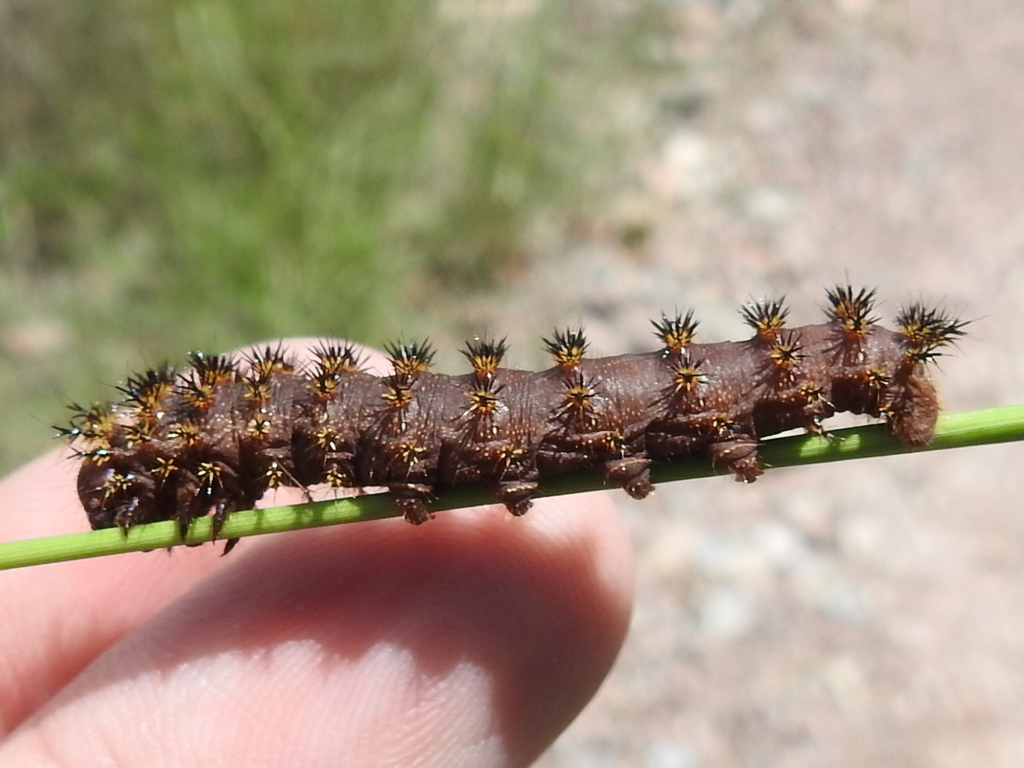
Young, small caterpillars are reddish. Like other Hemileucas, they stay in a cluster until they grow big enough that each one needs its own leaf to eat. Then they separate. 


Photo by James Wolf.

The red color can be very striking in the older caterpillar.


Photo by Rbehrstock.

Or they can look more like other Hemileucas:


Photo by Sambiologist.

While some caterpillars change colors with each molt, and Hemileuca hualapai are variable, this photo shows how their coloration depends more on diet and heredity than on age. With that underlying red color they can be a reddish gray that can even look purple, a reddish tan that can look orange, or a dull yellowy brown...and this individual's brand-new skin seems to be the same shade of brown that its old skin was. 


Photo by Charles Melton.

By October they're ready to pupate. This is done by crawling under some sort of shelter, a few inches of loose sand or some such thing, and waiting for the last caterpillar skin to fall off. Then they spend the winter trying to look like pebbles, and if all goes well they climb up into the light and spread their wings next spring.

Wednesday, March 6, 2024

Some Nonfiction I've Read Recently

What I've been reading frantically, and reviewing here, is of course that virtual ton of fiction e-books that came in during the Booktober Blitz. Y'know, "Booktober Blitz" was an intentional misnomer. It implied that this bombardment of books was meant to last one month. The participants clearly have no such intention; I'm still getting over 100 e-mails, most containing offers of another dozen or so free e-books, most of them genre fiction, every single day. This is why it's very likely that if you've been trying to communicate with me, I've not found your e-mail yet. It's dead easy for e-mails to get lost in my in-box these days. Keep trying, is all I can say.

Nevertheless I've squeezed in time to reread three nonfiction books lately...well, one while knitting my way through all those e-books, and two during a power outage...

The Country Diary Book of Knitting by Annette Mitchell

This book was part of a 1980s fad. (It reflects one aspect of Eighties Sweaters that I didn't get around to in my series of posts about Eighties Sweaters: the more fashion-conscious the designer was, the bulkier the sweaters. 1980s fashion was not flattering to normal-shaped women at all, but bulky sweaters fitted into it in a special way. The top-heavy "peg" look Diana Spencer wore so much better than other people--padded shoulders, quilted coats and jackets, bulky sweaters, horizontal stripes across the shoulders sometimes offset by vertical or diagonal stripes below, those dowdy straight-cut skirts and instant-fat-look pleated trousers--was least unflattering in the form of a bulky sweater, jacket, or coat that covered the little puff-out pleats around the waist and showed either thin legs below a skirt, or thin legs in trousers that fitted like a second skin from the knees down. So even popcorn stitch--all over, not only for an accent on a shoulder or collar--and blackberry stitch were used, in sweaters made with fairly bulky yarns. The bogus Edwardian look in the soft-focus photos in this pattern book mandated skirts for all women, and hurrah, they weren't boxy, but they were being marketed to Eighties women who would wear those puffy-top sweaters with tight-legged, waist-pleated jeans...

Apart from that "fashion" influence the other patterns are still wearable and, ahead of her time, Mitchell included several patterns for things that weren't sweaters. Lots of matching hats, a few bags, even some toys were included along with about eighty Eighties sweater patterns. This was one big coffee-table knitting book that delivered the buyer's money's worth. Mitchell's guiding principle seems to have been "modernize traditional English patterns, most of which were traditional for doilies not sweaters, by knitting them in sweaters that may not be super-bulky but are certainly thicker than traditional sweaters were," because traditional sweaters were underwear while Eighties sweaters were alternatives to overcoats. Several sweaters are designed with more wearable medium-weight yarn and not intended to make the wearer look top-heavy.

Age and Guile (Beat Youth, Innocence, and a Bad Haircut) by P.J. O'Rourke

This is one of the late great satirist's books with which I'm not yet ready to part. When I am, I'll post a review here.

The Virgin of Bennington by Kathleen Norris

I've reviewed this one here. It's not, as might have been hoped, a memoir about staying a virgin at a hip and swinging school in the 1960s. Nor is it, as others might have hoped, a memoir about the author's loss of virginity at the said school, although that is mentioned. It is primarily a memoir about the author's first career-type job working for an unforgettable boss on a job that deserves to be carried on. If that's the kind of memoir you want to read, you'll love it.

Link Log for 3.5.24

Books 

Laura McKowen's latest sobriety book is out in paperback. For some addicts reading a book is enough to help them "stay busy" and stay sober. They probably have all discovered McKowen already. If they've not, they should.


Politics (Election 2024) 

We all know what this week's Big News Story was. But I don't know whether to be disappointed that censorship may have made it possible for poor, clueless Jena Griswold to believe that Trump is an oath-breaking insurrectionist--he's a lot of other bad things but as documented at this web site he's not THAT--or that personal character defects may make it possible for her to believe that she can get away with repeating an outright lie. 


We need to stop letting the party bosses repeat issues from 1974, or 1964. Abortion is best left a state or, better yet, local or, best of all, individual issue. Gun bans don't work. Socialism doesn't work. We need to move on: Support or even tolerance for those who babble about "global governance" is treason. Privacy is a right that needs to be enumerated in the Constitution, and people who don't understand why need to be recognized as having a mental disability that could reasonably be used to prevent them from voting or holding office. And CENSORSHIP, not Trump, is what TURNED A RALLY INTO A RIOT in 2021. Censorship is evil. We need to grind that into the faces of the Eurotrash pushing for it.

"All truth is safe and nothing else is safe; and [one who wants to suppress truth] is either a coward or a criminal or both."--quoted, from memory, from John A. Stormer

Book Review: The Gem of Tagath

This review is late because some other books needed to be read and reviewed according to their publication schedules. They're worth waiting for. Now, better late than never...

Title: The Gem of Tagath 

Author: Jason Dorough

Date: 2021

Publisher: 908 Press

ISBN: 978-1-7366140-2-0

Quote: "She shoved him back onto the stool, a little rougher than necessary. That's the only way they'd know you were serious."

In the gritty urban fantasy world of Teshowar, teen gangster Pria is on her way up. If you enjoy stories of how a clever little thief outsmarts bigger, tougher, meaner thieves, Pria's adventures are a hoot and a half. No girl power fantasies here; we see Pria working her way up with plenty of sweat and danger. 

This book was published in the traditional way before the series moved to Amazon, so you'd expect it to be a more polished piece of work than many Amazon-only e-books are. You'd be right about that. 

New Book Review: Secrets of a Vintage Vendetta

Title: Secrets of a Vintage Vendetta  

Author: Cassidy Harlow

Date: 2023

Publisher: Cassidy Harlow

Quote: "This place hasn't been opened in decades, alright."

Lucy and Brandy think they're describing the building they've bought to use as an antique store, but they're also describing the town of fictional Ellijay, Georgia. Trigger warnings: this is a novel about sexual abuse in the workplace.

This novel really needs a disclaimer, because there is a real town called Ellijay (population, according to Google this week, 1847) and a real family there are called Harrington. It would have been very imprudent to publish a book where a Harrington family owned the town of Ellijay and used their social status to conceal the crimes of an influential member of the family, without such a disclaimer, if the real Harringtons had not agreed to let their name be used for fictional characters in a work of fiction. So I'll work from the assumption that they have. 

In the novel, then, the housemates find a note that they think was written by the last occupant of the house, saying "He is going to kill me." When they take the note to the police to ask whether it meant anything, they're told that the last occupant of the house was certified insane because of her obsession with her supevisor at work, and left town suddenly just before she would have been hospitalized. But one police detective, who seems to Brandy to be interested in Lucy, tells them his sister was harassed and abused by the same man--Judge Harrington--and he wants to investigate the case. 

No points for guessing that Judge Harrington will be found guilty; the pleasure of the story is in finding out how his guilt can be proved. For those who don't find it too upsetting, I should add, the pleasure is considerable. Though short, the story is told with a sly, dry humor that will leave you eager to see what Harlow will do in a full-length novel, and if you enjoy watching detectives close in on a thoroughly deserving criminal you'll enjoy this short novel.

Tuesday, March 5, 2024

Petfinder Post: 2023 in Review, Part 5

...

Jake from Brooklyn has been adopted.

Denim from Mattinsburg has been adopted.

Booboo and Lulu are still up for adoption, possibly because the shelter is too picky about whom they allow to adopt dogs...

On careful reading, these dogs' updated web page sounds as if "the ranch" is looking for funding to keep these dogs rather than a decent home to place them in. Petfinder should probably be more vigilant about this. There's nothing wrong with wanting to rescue a dog yourself, as long as you don't advertise that the dog is available for adoption. On a more pleasant note, if that's their situation, then Booboo and Lulu may have been adopted after all. Dogs don't care how beggarly their humans are.

Monica has been adopted.

Bush and her brother may have been adopted.

Chester may have been adopted.

Paula has positively been adopted.

Chico may have been adopted.

Andy has definitely been adopted.

Brandon and Megan were adopted.

Triplet and Trilogy may have been adopted.

Lentil and Crumpet may have been adopted.

Chip and Cocoa may have been adopted.

Popsicle may have been adopted. 

Scrappy the beagle from Alabama is still looking for a good home. Possibly that's because he's in Alabama. 

He's been known to yap for attention, but in theory the right human family could help him overcome that. He's described as friendly, playful, brave, and protective. 

Mabel, Moon, and Morning were adopted.

Terp may have been adopted.

Athena was adopted.

Stella may have been adopted.

Luau may have been adopted.

Maggie Mae was definitely adopted.

Alice has been adopted.

Zoey may have been adopted.

Nina has been adopted.

Ollie, the albino Australian Shepherd, is still looking for a home.


He seems to see and hear only some things, but he's described as snuggly and loving. If you have a lot of attention and energy to invest in am Australian Shepherd pup with some disabilities, Ollie is said to have a lot to give back. 

You're doing well, Gentle Readers. Animals whose photos you've shared are making it out of the shelters at a better rate than the other animals at Petfinder! 

Monday, March 4, 2024

Link Log for 3.1-3.24

(Why do a few link logs start with "the"? When formatting posts in Blogger I type something like "a" or "the" just to test that the format has been set up. If I make the time to edit a Link Log before it's scheduled to become visible to you, I take out the placeholder word. Once or twice in the history of this web site I've neglected to do that.)

Poetry 

Thoughts of  hope from a cancer patient's caretaker/spouse:


Politics 

What Trump Derangement Syndrome is really all about: an overwhelming fear of actually being one of those ordinary working people the Left always raves about wanting to help. I think this poet is young and has written more insightfully than he knows. Nevertheless.

I'm not saying that there aren't people who deserve our votes more than Trump does, or that I'd be less than dismayed if two or more of them aren't on the ballot in November. I'm saying, whether you think we could do with four years of Trumponomics to recover from the Biden disaster or see the opportunity to vote for one of those better people, there's no rational base for Trump Derangement Syndrome. If you really hate and fear the former President all that much, you might want to ask yourself why.


Book Review: Needing a Savior

Title: Needing a Savior Prequel

Author: Sienna Knight

Publisher: Sienna Knight

Quote: "Why are grownups like that? Do they like arguing with each other?"

This is an unusual "prequel" mini-book. It's neither Christian nor a romance; it's a grimly realistic story about two teenagers from unhappy homes. Nate and Sophia like each other, but as each is hiding per own sad situation from per friends, their one date doesn't go well. Taking Sophia home early, by her request, is Nate's first step on the road to addiction. 

There will be a "Support Group Series" of longer novels about the role love and marriage play in the way Christian couples confront Serious Problems. The story of Nate's and Sophia's "second chance romance" will be told in one of those novels. 

At this point, however, the story contains no Christian content. 

If you like a romance with a happy ending, you'll have to pay for a longer book with Christian content to get one. What do you think of this marketing technique? It's allowable under the rules of the genres: romances don't have to have a happy ending even though some lines of paperback romance novels do, and Christian literature can be about the damage sin does to people. Whether you'll like this interpretation of the rules, I don't know. I can tell you that Knight uses good writing skills to portray lifelike characters with real-world problems.

Butterfly of the Week: Mansfield's Three-Tailed Swallowtail

This week's butterfly is such a rarity that its Latin and English names make sense. It is one of the four recognized species of Bhutanitis, which literally means "from Bhutan" but is properly translated by "three-tailed swallowtail," and it's named after a naturalist called Mansfield. In Latin, Bhutanitis mansfieldi.  


Photo by Catfish1987, who said it was taken high in the mountains in Sichuan.

It lives in China. Not much information about it has been posted online, and much of what's been written about it was written in (no points for guessing) Chinese. A very detailed description of this species has been preserved online at


In summary, mansfieldi does too look different from other species in this genus if you can get close enough to look at the claws on its little feet.. 

The upper side is vividly colored, perhaps especially in males but also in females.


The underside shows the same color pattern, but is pale and reflective, making the butterflies hard to spot from below.


Photos from Lepidoptera.eu.

Wingspans average three or four inches, making these butterflies easily four times the size of more typical butterflies. Museum specimens displayed alongside other butterflies found in cool mountain regions look immense.

B. mansfieldi looks somewhat similar to lidderdalei and ludlowi. Although their food plant is a vine in the genus Aristolochia, they are classified as Parnassinae rather than Troidini because scientists classify butterflies according to the structure of their wings, first. Within the Swallowtail family, the pattern of wing venation in Bhutanitis' big black wings is more similar to the pattern in the little white Archons' and Allancastrias' wings than in the Atrophaneuras' and Papilios' big black wings.

All the Bhutanitis are rare and in the mid-twentieth century, when chemical "pesticides" were used most recklessly and many species went into deep declines, mansfieldi entered the realm of legend. Some entomologists dropped it from their lists, on the reasoning that, if it had ever existed as a distinct species, it no longer did. Like ludlowi, mansfieldi was rediscovered--in 1981. It was rediscoveed by two Japanese naturalists, one of whom died of a fall on the journey, so this species, too, can be said to have "blood on its wings." The other naturalist, a Mr. Umesawa, died more recently at a relatively reasonable age. For several years Umesawa was known as the only living man who had seen a living mansfieldi. He probably never really deserved this title, and gave it up as other naturalists confirmed his discovery of this species. Still, a great deal remains to be learned about these high-altitude butterflies.

It is, of course, protected by law in China. The Chinese government has had to be brutally practical about other things in order to get away with bitterly clinging to socialism, however, and several of the available studies of mansfieldi are analyses of the biochemicals found in their dead bodies. rather than pretty little articles about the rare butterflies as tourist attractions. Well, to be fair, they fly higher than the average tourist cares to hike.

A similar butterfly with slight color variation was named B. pulchristriata (Latin for "pretty striped") and later classified as a subspecies of mansfieldi. The subspecies name often appears as pulchristata.

B. mansfieldi is found in the same mountain ranges as B. thaidina, the Chinese Three-Tailed Swallowtail, but it flies earlier. Specimens were "collected" while snow was on the ground, proving that these cold-blooded animals absorb heat from sunshine very efficiently.

Male and female mansfieldi look about the same in flight. Some differences were consistently observed between male and female specimens pinned in a laboratory. At close range both sexes have quite a lot of hair, even on the face; furriness may help insulate them against cold weather, and may also help hold and concentrate the scents butterflies use to recognize one another. 

After mating the female mansfieldi, unlike other Bhutanitis, displays a sphragis. In mansfieldi the sphragis is a small white spot or stripe, not the elaborate mess formed by the clear-winged swallowtails. A document about this species that is available for sale online examines the reproductive system of this species in an attempt to understand how and why the sphragis may work. The sphragis is formed by the chemical interaction between male and female butterflies when they mate; it makes it easy for males who are looking for virgin brides, which is most male butterflies, to ignore females who have already mated, and makes second matings take longer, but it does not actually prevent the female mating again if she and her second mate are determined. The secretions that dry out and form the sphragis can also soak and dissolve it. On close examination, the other species in this genus tend to form something like a sphragis, but theirs are smaller, less conspicuous, and often seemingly "incomplete." 

The habits and life cycle of mansfieldi remain to be documented.

Sunday, March 3, 2024

Sunday Post: Don't You Even Caaare...?

Actually, as regular readers know, I do care passionately about what happens to the rest of the world, but this week I read another activist's poem that contained the kind of vague generalized guilt trip, especially with the (probably unintended) echoes of left-wingnut rhetoric, that makes me feel just as complacent as a particularly hypothyroid cow. Moo moo, whatever they're on about this time, I'm quite sure I didn't do it and it's not my problem! "Don't you even caaare that...?" "No, actually I don't!"

In support of her position that what makes the special Verbal Attack Patterns so hateful is the way their spoken intonation adds a layer of unspoken, deniable hostility, the late Suzette Haden Elgin observed that it's possible to say "Don't you even care that..." in a tone of bemused bewilderment that sounds less hostile than "Don't you even caaare that..." This is true but, since the tone of bemused bewilderment still presupposes that YOUR NOT BEING AS AGITATED ABOUT THIS AS I AM IS BIZARRE, I think it's still a good pattern of rhetoric for activists to avoid.

It's easy for people working on things like Glyphosate Awareness to see that verbal attack (I think the poem was about water pollution; it was, like the polluted water, not very clear) and raise it a few levels. Don't you even caaare that anybody can still spray this POISON that is KILLING people who are and are not even of Irish descent BY TORTURE and you just SIT there acting as if wretched COVID were an issue of comparable...We need not to go there. 

COVID is real too. Most of us may not have noticed when we had it the first time, and the people who died may have been old and/or sick anyway, but people did die and they were missed. I am convinced that glyphosate not only has done more harm to humankind than COVID but also was involved in many, if not most, if not all, COVID vaccine fatalities. I feel ready to let COVID blow over like the nothingburger it was, because my mother died of glyphosate-aggravated liver cancer before COVID reached our part of the world. But some people's parents died of COVID...and/or vaccine reactions. 

Now it's true that, due to a couldn't-have-made-it-up combination of greed and shortsightedness, the commercial media whipped everyone into a state of frantic hypersensitivity to COVID, practically forced doctors to treat everything as COVID-related if they treated it at all, while simultaneously denying, denying, denying glyphosate reactions as an issue of medical concern. The numbers scream off the page. The blood howls from the ground. The commercial media have lost all credibility and deserve a painful corporate death-of-a-thousand-snubs. The fact remains that unless Joe Sixpack happens not only to be a "Spoonie" with an unpredictable and verifiably glyphosate-triggered chronic disease, but also able to avoid glyphosate enough of the time to know when he has and hasn't been exposed, he does not even yet physically realize that he's having glyphosate reactions--although he probably is. It's not that, like COVID, glyphosate reactions are something a person is likely to have and not notice. It's that glyphosate reactions tend to be aggravations of conditions that existed before glyphosate did, which makes it so diabolically easy for the corporate shills to bamboozle people about what's actually going on in their bodies. 

Yes, for all the celiacs I know and for huge numbers of non-celiacs, glyphosate reactions are just like celiac reactions only moreso. For thousands of years celiacs who ate unsprayed wheat didn't develop sprue before age 60. Glyphosate has been known to produce sprue reactions in children. When I read that at least one celiac support group (in Canada) did not believe they had celiac reactions to glyphosate, my first reaction was "Well they've drunk the Kool-Aid," but for all I know there may be celiacs who don't have celiac-type reactions to glyphosate. Maybe they have some other pattern of reactions. Some people of southern European descent, and some animals, don't show immediate reactions themselves, but give birth to physically damaged offspring after exposure to glyphosate. A human who has that reaction might easily not be trying to have babies, and thus really not have a reaction to glyphosate. I'm not sure how or whether it's possible for a celiac not to have a reaction to glyphosate, but it might be. We've all seen that this unnatural molecule has several properties that were previously unknown, if not impossible. Medical science needs to study people who claim not to react to glyphosate. We can't just write them off as liars.

Joe Sixpack has heard that glyphosate caused cancer in a few people who were exposed to unusually high amounts of it. Well, he doesn't have cancer, he wasn't exposed to unusually high amounts of it, and while he knows his old weakness--coughing or irregular digestion or dyslexia or whatever--worsened between 1980 and 2009, worsened a lot between 2009 and 2018, went into remission in late 2020, and has been bothering him again since 2021, he did have it before 1980. Meanwhile people who sound very sciencey have told him that it's just an hereditary condition that was bound to worsen with age whatever he did. You have to have observed your own symptoms pretty rigorously to be able not to fall for it. 

So if we grab him by the collar and scream "DON'T you even CAAARE?" Joe Sixpack is quite likely to say, "No, actually I don't. I'm not sure you even know what you're talking about. No matter how much people like Priscilla King may say about not supporting a globalust takeover by weakening American businesses, that's exactly what other people in Glyphosate Awareness have always wanted. I think you're being exploited by George Soros and his minions. In any case I don't have non-Hodgkins lymphoma so what I have is probably hereditary and going to kill me, and I don't feel healthy enough to do anything about it, because I had the COVID vaccine..." 

Being patient with Joe Sixpack's intellectual squishiness does call for those special Irish celiac super-powers (some of us) have. But do it. Empathize with his concerns, and insist that he and his doctor test samples for correlations between glyphosate exposure and any chronic internal bleeding condition, independent of COVID vaccine exposure. If such a correlation is found, that will make it easier to verify the role of contaminated vaccines in the reactions people have had, and collect due compensation for those who were disabled or whose family members were killed by contaminated vaccines. 

Of course a lot of people in Glyphosate Awareness were wary about taking a new vaccine for a non-fatal disease, so getting settlements for vaccine-related injuries is of no personal interest to us. My personal feeling about the vaccine lawsuits is "Another smokescreen! How long dear Savior O how long...and can a piece of Bayer be saved for those of us who've been trying to conceal and suppress symptoms SINCE THE 1980S?!" And it is hard to maintain any respect for the poor dweebs who think some new theory about "global climate change"...no, really, local warming and air pollution are real too. Even in CHD I'm sure there are people whose focus of attention was guided by meretricious and even exploitative considerations, but most of us tend to focus on what we personally see as the biggest physical danger to ourselves and our families. 

I will say this, though. Some people don't realize how totally any echo of "global climate change"  or "social justice" rhetoric shuts down any sympathy among large sectors of the US population. Not because they are mean people or racists or whatever; because they think you are. Language Soros-funded groups would reward tends to generate a reaction, in the rest of the population, like "So you want me dead and my grandchildren living in slums eating mealworms, right? I still don't know exactly what you're blathering about, but if it hurts you it can't be all bad!" 

To the poets reading this web site, some of whom may have won grants or fellowships by using Progspeak, I say: Global socialism may still generate warm fuzzy feelings in some circles, but since it's been associated with the COVID vaccine fiasco, you should be aware that using Progspeak is, I don't know, maybe more likely to be taken seriously than waving a Nazi flag? Do not mistake the censored media's reportage for an accurate view of contemporary reality. MSNBC may have a few billions left to burn through, and elected officials may have a few voters hog-tied by the handout check, but independent writers cannot afford to say to a lot of very disenchanted Americans "Yes, I'm one of the people who killed your father." 

One PSU poet has been annoying me regularly this winter. (Person knows who person is.) I feel good will toward this poet. I actually think per free verse poems make some good points. But in such a doomed way. How is it possible, I ask myself, for person not to be aware of the backlash against WHO and their scheme to use the now discredited COVID vaccine to take over the world? You want utility companies to invest in more household solar collectors, or private people to think of walking to the store as something beautiful people do because we can, you do not cite the World Bank as an authority.  If someone at the World Bank says it's raining outside, that does not automatically cause the rain to stop, but even so, if you have not personally verified that it's raining outside it would be a good idea to report that you believe it's raining outside because someone more trustworthy than the World Bank said it was.

Do I care about pollution? Child. I was born and raised caring about pollution. I may be the last living non-Amish American who was taught to drive a horse before I learned to drive a car. I own a truck, have never driven it, and I still walk or wait for a car pool to the grocery store because I never formed the habit of driving. (The truck was for the purpose of transporting my late lamented Significant Other; making it roadworthy was his responsibility. So it's not roadworthy.) I never formed the habit of watching television, either. Using a water-flush toilet doesn't really call for a change of habits, but I have formed the habit of using a solar-powered dry-flush toilet and burning the output. 

I do not, however, care about the latest World Bank claim that the world needs global tyranny to reduce pollution. The events of the past hundred years or so have shown that, while government bloat does reduce the profitability of many things including pollution, government bloat has no effect whatsoever on the actual pollution. 

We do live on a round planet where everything is likely to blow or flow to any and every place, eventually. We do need to think globally about the effects of what we see as personal choices. For example, when Americans send electronics to be "recycled," the toxic chemicals that make electronics work do not seep slowly into the ground around the local landfill. They are directly handled and reprocessed by poor people in what was reportedly a rather pretty little town in China, with a scenic river, until the Chinese government decided to make it a toxic waste dump. Reportedly those people don't speak English so they don't blog about the effects this policy is having on them, while they live and raise children amidst the toxic electronic waste. If you think about it you'll understand why I react so unfavorably to the idea of replacing computers every few years. I've accumulated several computers, and yes, each one does have a few useful features the others lack, but I don't really care about their clever little features. I'm just doing my bit to keep them out of landfills, or out of formerly pretty little towns in China. Because I care.

And? So? What have you done about glyphosate lately?

We need to respect and support one another's efforts to clean up our world and make it possible for our one child apiece to grow up/ Nobody can work on all the issues; most of us will focus on one or two. In the nature of being active and educating people about our issues we will inevitably confront one another's lifestyle choices. 

Verbal abuse may come easily to mind when we think about the harm the various toxins we're trying to clean up have done to human beings. Glyphosate sprayers killed my mother. Maybe COVID vaccine killed yours. Maybe someone close to you never smoked, but died of lung cancer associated with motor vehicle exhaust fumes. Or brain damage associated with spray paint. Or cancer associated with radiation from experiments with nuclear energy. We no longer believe we have a duty to kill people we blame for any of these causes of death, but it can be easy to feel that doing so would be a pleasure. Dog people everywhere have fantasized about doing to Dr. Fauci what he did to those beagles, and some of them would probably enjoy doing that, if it were declared legal. 

Verbal abuse, however, is not usually the most effective teaching method. (Some baby-boomers remember teachers who spent their careers proving this.) Verbal abuse tends to make people feel defensive and bitterly cling to their ignorance. Or laziness. Or miserliness. Or fear that, e.g., more sophisticated uses of solar power than simply putting the water heater in front of a southwest window might present fire hazards. Or feeling that if we make Green choices A, B, C, and D, people should keep their bleep mouths shut about our not making Green choice E. 

I use layers of disposable plastic bags to keep frozen food frozen while carrying it, because I walk, and then while it's in the cooler bin, because I don't run an electric refrigerator, and then later to collect the toilet output and get it burning, because I don't flush bodywastes into other people's drinking water, and if anybody has any concerns about the filtration system they're more than welcome to pay for a properly vented and filtered, mostly-underground furnace that would be much more efficient than just burning all the garbage in a barrel. I do what I can with what I have. Very likely to be more than you do...

You, perhaps, raise all your own vegetables so you don't think you need to worry so much about pesticide residues in commercially grown food. Well, you do, because pesticide residues get into the air and water too, but raising your own vegetables is excellent. I'm delighted. My land is naturally suited to be an orchard not a vegetable garden, and for me living entirely on what grows on my land feels like a hardship, but if that's not the case for you, well, blessed be. So you feel less of a burden for people who don't have land or the ability to raise vegetables on it, and you have energy to focus on coal-burning power plants/ You knew someone who lived next to one and died of lung cancer at age 58. You taught a class at the school near one, and noticed the way some of the children were coughing...

We can and should debate about strategy. Some people working on air pollution just want to trust big government to fix it. I don't have much faith that big government will. Talk about better filtration on the existing plant, and phasing it out by reducing electricity consumption and getting more of the electricity from private solar collection systems, sounds more credible to me than talk about how Candidate A would solve the problem and Candidate B wouldn't. I can believe that both candidates might want to be able to solve that problem and any number of others too, but history has shown that often A's claiming to be able to solve that problem shows that A is either less realistic, or less honest, or both than B is. There are things a presidential executive order can do, but one of the best and truest things a President of the United States ever said was, "Ask not what your country can do for you; ask what you can do for your country." In the US it seems to be most noticeably the Republican Party, but all political parties always need to put their backs where their mouths are. 

And so ad infinitum. We don't need in-fighting, in any case; the greedheads are doing us enough damage without in-fighting. We need to respect each other's work and support it when we can.

(Sunday posts at this web site are supposed to be where the Christian content goes. Do you believe, Gentle Readers, that for me this post is Christian content? It was provoked by someone whose religious affiliation I don't know but whose name comes from a non-Christian culture, so it was written, without conscious thought, in neutral language. This web site officially blesses all sincere compassion for the Earth and those who live on it, in whatever name people know.)

Friday's Book Review: Lunch Time Murder

Title: Lunch Time Murder 

Author: Sydney Tate

Publisher: CAR

Quote: "People who might normally pass through a small, insignificant town like Little Brook now stopped specifically for their Food Truck Circle treats."

This cozy-mystery-meets-sweet-romantic-comedy is as overloaded with "everything" as the outrageous novelty recipes the Food Truck Circle vendors inspire one another to concoct. (If you're a creative cook, this book is for you--no recipes but lots of inspirations for over-the-top trendy food.) Ginger O'Connell isn't "gluten-free" but her most distinctive wholesome confections, from the arugula-kale salad to the whipped frosting on a sugar plate, just naturally are. The town of Little Brook markets itself to visitors with food, not history, so it doesn't have a really strong state identity, but it's probably in North Carolina. Its Butter Festival, expected to be a real revenue generator, offers a high prize...but nobody expected the prize would be enough to tempt anyone to murder, until a bleeding body turns up right against Ginger's permanently parked truck. (Ginger walks everywhere, burning off all the calories in her delicious food.; her truck is her store.) Since the truck never moves, Ginger's not a prime suspect; since the murdered man was a co-worker, she naturally wants to know who murdered him, but she doesn't try serious amateur sleuthing until a friend's visiting godson goads her into helping him search another vendor's truck and the mayor's mansion. Since they're both young and single, their explanation for being caught snooping, that they just wanted to be together, is easy for people to accept. Of course, after using this excuse a few times, they realize it's true.

But is Graham her friend or her enemy? When he and Ginger meet, their tempers flare as Graham proclaims that Food Truck Circle ought to have been a public park. How daaare anyone suggest shutting down the way local entrepreneurs are earning a living. How caaaan anyone want to park nasty trucks in a place where rosebushes and swing sets...

Does this one ever sound like home to me. Some of the store and restaurant owners in my town still fret that Friday Market vendors are taking business away from them. "A flea market attracts a different kind of clientele. Those people don't walk uphill and shop for new merchandise in boutiques, or buy meals in sit-down restaurants when they can just buy snacks and soda pop..." 

"If your business is so small that it can be threatened by the Friday Market, you should just go home anyway! If the Jackson Street stores didn't price things seven times what they're worth..."

The solution for Graham and Ginger is, of course, to keep the food trucks beside the park. Duh. And anyone who doesn't have a deeply ingrained prejudice, as it might be a councilman who turned against Friday Market after trying to sell things there for a few weeks, can see how that would work for Gate City too. What's already a paved parking lot should stay paved and be rented out to vendors by the parking space. Right beside it is a lovely grassy field, and that is where the children's park some people dream of having should go. Children, as I well remember, love the Friday Market. They'd love it even more if there was a free, safe, supervised place where they could run and scream while their parents shopped. Bounce house? Instant shower? Merry-go-rounds? The more the merrier--and no need even to crowd the Friday Market. Just put a little walkway, Entrance to the Kid Zone, around the back of the drive-through bank, and there we are. 

Lunch Time Murder is recommended to anyone who can stand the combination of whodunit, romance, and comedy, and to all members of small-town councils whether they like mixed-genre fiction or not. 

Book Review: The Wedding Kimono

Title: The Wedding Kimono

Author:  Camy Tang

Date: 2021

Publisher: Camy Tang

ISBN: 978-1-942225-27-0

Quote: "You would be such a handsome boy."..."But I'm a girl, Mrs. Nanase."

Lila is a late bloomer. Early in young adulthood she looked like a child and, since she's tall and thin, some even saw her as a boy child. She's resigned herself to this and not noticed that, in her twenties, she's finally growing up and becoming attractive to men.

Lila owes her job (as a massage therapist) to a family connection with the owner of the spa, but her immediate supervisor, Fred, is a divorced grouch who doesn't seem to like women. Except Lila. He's always seemed to have a soft spot for Lila, and she's become quite attached to him.

The story starts when Lila inherits a fantastically embroidered wedding kimono, handmade by her great-grandmother. She thinks part of the design may be Japanese calligraphy characters, and looks for a Japanese scholar who can read them, if they are indeed words. Along the way, someone shares photos of the kimono on the Internet, and Lila is harassed by art collectors who are sure the kimono is the work of a famous artist. Lila finally convinces them that her great-grandmother probably designed the kimono after studying photos of the artist's work in magazines. 

No points for guessing...Although Lila is at least a foot taller than the great-grandmother was, the special wedding kimono was cut extra-long, and Lila will wear it at her wedding. That's not even the part that will make the kimono seem like almost a prophetic blessing from a short Japanese artisan to her tall American great-granddaughter. It's the Bible quote. Lila's great-grandmother was a Christian. So is Lila. So is Fred. Nobody converts to Christianity in this book, but people do reflect on Bible texts.

Any woman who grew up slowly can probably relate to Lila, but beyond that, this short novel is the work of a skilled and talented writer. If you want to read more sweet romantic fiction about the other people at the spa, a series of full-length novels is due to start coming out in print in 2024. If you buy fiction, you may want to pre-order these novels. 

Friday, March 1, 2024

Status Update: Visualize Giving the Possum All of the Peas

For fifty-some years I've liked peas; I was delighted to find that the 2021 crop of peas available in stores were glyphosate-free. 

However. In 2023, after eating one meal that contained peas, I privately noticed feeling a mild memory of the vertigo that went with a previous year's flu. After eating another sample of the 2023 crop, I wrote a blog post about the bad batch of "no salt added" peas sold at Wal-Mart. After eating a sample of fake tuna fish made with soy and pea protein, I had positive symptoms of food poisoning. And yesterday I ate some peas sold at Wal-Mart, not from a batch that was on the shelves last fall...and without feeling positively sick, I've felt dizzy and woozy all day. 

I've not been too ill to write today's posts, but neither have I made the time to upload them. They should appear here, if all goes well, on Sunday. 

I had bought some more peas at Wal-Mart. I suppose my loss will be the possum's gain. 

Link Log and Rants for Leap Year Day 2024

the

Feminism 

No, we've not won yet. I'm not going to link to the video on which a male spewed out the bitter resentment festering in his inferior mind in the form of a claim that Hermione, in Harry Potter, is a "terrible role model" because she's competitive, defensive, and a good student. 

I am going to say that Hermione is a good role model for girls, many of whom have very little choice about being at the head of every class during the years when schools are required to spoon-feed the three R's to those wretched boys who can't see the print yet. Defensive? Inevitably so. But she matures and works through it. Hermione's a best-case role model because, through friendship with Harry and Ron, she's able to preserve some sympathy for other humans, even males. Hermione, who does want a child, doesn't have to spend her best childbearing years processing her feelings about the ickiness of having to spend time around a male body in order to have a baby "of her own." Better yet, Hermione is able to appreciate Ron as a man, rather than feeling that the two boys she can stand are "more like brothers" or "more like girls," and vice versa, so Hermione's not going to be one of the even larger number of twenty-something girls who don't realize how deeply icky a lot of twenty-something boys are until they've become single mothers. Of, in some cases, AIDS babies.

What happens when a woman's not locked herself into a single "career path" at seventeen, does well in most or all classes, wants to be a mother, and does not have Hermione's incredible good luck of finding a mate right in the classroom? First of all, we need to watch that assumption that all or most women want babies. I was a young woman once, and between a baby and a broken knee I would without a second thought have chosen the broken knee. And common reasons why young women don't want to have babies are not that they have any kind of gender confusion, or lesbianism, or "gender dysphoria," but simply that they know more than Little Miss Just-Want-To-Be-A-Mommy knows about what pregnancy, childbirth, and motherhood are like. They are likely to have younger siblings who were born after they were old enough to know what was going on. They have already had the experience of changing a diaper, and are not in a pathological hurry to spend a year doing nothing else than that.

Young women who think they want babies have their heads stuffed full of unrealistic Hallmark Channel images of adorable pastel-colored bassinets that actually contain dolls. Young women who think they don't want babies usually have practical, sensible reasons related to some experience of seeing how much damage having babies can do to women and their lives. The male on the video claimed to know women who felt bored with their jobs and wanted babies. Women like that exist but I've known more women who had babies first, felt bored with the babies, and wanted jobs. 

History

Yup. Of course some of these things really were bad ideas even in the 1960s. Others could usefully be brought back: The primary hazard of school-aged children being at home alone is that it may cause busybodies to hyperventilate. Hyperventilating busybodies might pass out and collapse against sharp objects, reducing the population of busybodies. Reducing the population of busybodies would not be a bad thing. 


Technology 

Of course AI programs are biased. That's not news.  They're built by humans; humans are not capable of unbiased thought. 

For example, my bias is that people who use a computer to do thinking or writing deserve what they get.


Google could hire diversity consultants to ensure that not only are White men's faces shown in scenes where everyone knows White men were present, and not only did writing samples blended-and-spun together include Republican campaign rhetoric, but also writing samples included PRODUCT-UNFRIENDLY documents. Has anyone checked yet to make sure that computer-generated writing about the coronavirus vaccine debacle always mentions vaccine-related illness? That every mention of "medications" for "depression" includes a reference to the long and well documented fact that serotonin boosters produce some degree of dementia in 3 to 7 percent of users, and that that specific type of dementia causes homicide-suicides? That references to "pesticides" always work in a relationship to the correlation between glyphosate exposure and chronic internal bleeding disorders, and related fatalities?

Hoot.

I discovered something about Google while doing the research for those moth posts. Few people have ever really wanted to write, read, or look at anything about stingingworms. It is a very small research niche. While a search for a butterfly or flower now generates tens of thousands of results, a search for Hemileuca hualapai still yields, from less censored search engines list every post to Bugguide.net separately (from the "Can anyone tell me what this is?" to the "Thank you"), only about five thousand hits. Google (1) recognizes only about 1300 of the 5000 posts (on the same day Google reported 1320, 1507, and 1070 hits) and (2) refuses to show links to much more than 100 of them. 

It's not that 100 posts about stingingworms aren't more than the average person would ever want to read. It's that researchers are not the average person. We do need at least to scan all 5000 links and decide for ourselves which ones aren't relevant. And, yes, some of the links Google suppressed provided some of the most interesting information, like the video of the moth under artificial light that showed under what circumstances H. hualapai looks completely different than it normally does.

And a search for how to get Google to show the full search results turned up a forum post in which someone from Google admitted that advertisers wanted Google to shorten searches, and prevent scrolling down through a long search, because if people could see everything at the bottom of the list they wouldn't be funnelled direclty onto profitable corporate "landing pages." The advertisers probably were not thinking about obscure nuisance moths so much as electronics, used car deals, and food catering services...but they got Google to implement a policy of never showing people the full results for what they're looking for. The forum post about this disappeared fast and did not turn up in search results again.

Do you trust...any tech company to think or write for you? Ha. Ha. Be sure you're paying them more than any of their other blindly trusting clients do. No matter how many people computers displace from jobs, computers will never really replace the human brain. 

Zazzle 

I'd put the tomatoes on the back, but whatever.