Thursday, August 22, 2024

Book Review: The Reluctant Coroner

Title: The Reluctant Coroner

Author: Paul Austin Ardoin

Date: 2018

ISBN: 978-1-949082-00-5

Quote: "Nurse practitioner...and your forensic nursing degree...The county coroner position is vacant."

Fenway is one of those people whose odd given name reflected the fact that her father really didn't care much about her. She and her mother were poor; her mother's died young. Her father was one of the richest man in fictional Dominguez County--which, in Ardoin's fictional world, contains the city of Estancia, which is the name of a town in Torrance County, California, in the real world. Why Ardoin chose to muddle the geography that way is unclear. Fictional Estancia is also the home of a distinctive cypress tree like the one on the beach of real-world Monterey...Anyway, after Fenway's mother's scanty estate is settled, her father summons her to Estancia to replace the county coroner, who has just been murdered. Fenway has just failed to be selected for a few jobs. So she becomes the reluctant coroner of Dominguez County. 

The job is as bad as she feared. The Dominguez County coroner needs to be a detective and also a martial arts expert. Why does the personnel manager dislike her? Skin color, people guess (Fenway identifies as Black, like her mother). They are wrong. The personnel manager is a widow. Her husband's  death had something to do with Fenway's father. So did the coroner's. So did that of a suspect whose death in the county jail could almost have been a suicide, but wasn't. 

If you like a detective story with lots of police procedure and a complicated plot that'll keep you guessing, you may like The Reluctant Coroner and a good half-dozen more books in the same series. Maybe not. More sex goes on in this series than some think a detective story needs. The adulteries form the connecting threads among the murders, except when Fenway throws herself at a previously blameless married man. 

Fenway is meant to be likable. The old cliche is true once again: Male authors overestimate the amount of time women spend thinking about men. Fenway is pretty and flops into bed easily, so her life's path is already strewn with ex-boyfriends. If Fenway were a character readers really want to follow through a series, she could always go back to them if she felt a need to snuggle up beside someone at night. Or she could show a little common sense and adopt a dog. 

Still, no matter how trashy Fenway is, there is that big puzzle with all those pieces to fit together. Some readers will enjoy that enough to feel that the frequently violent plot twists give Fenway enough punishment. 

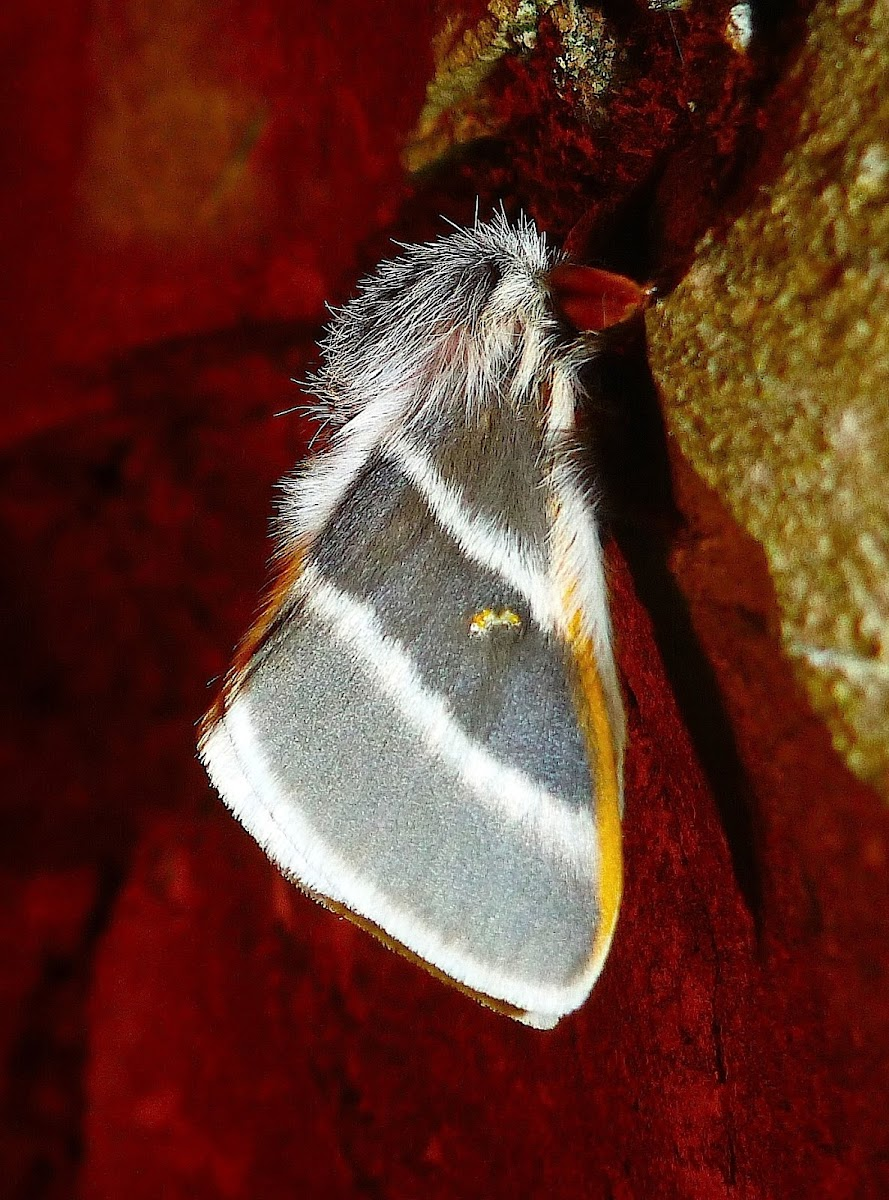
Hemileuca Mania

Yes, Hemileuca mania has traditionally been considered a different species from Hemileuca maia. Automated "correction" software loves to confuse the two, which is typical of automated "correction" software and why we should turn it off. H. maia is very familiar to humans from the East Coast to the Central Plains, from the Gulf of Mexico up into human-inhabited Canada. H. mania is apparently very poorly documented, and it lives in Mexico and Central America. (It's considered a native species, and threatened, in Panama.)

However, the Internet is more informative about this species now than it was in 2013, when I wrote that it had been found in Veracruz and that was about all the Internet had to say about it. 


Photo by Lauren Zarate. Though more gray than rose-brown, it was found in Mexico (clinging to a stone wall, as shown) and does resemble museum specimens of mania. The underside of the wings is pinkish white. This identification has not been verified by a qualified entomologist. When disturbed, the moth not only curled up and dropped to the ground, as if it were still a caterpillar who was protected from falls and predators by its bristles, but also expelled a dark fluid from its back end as if it were dying; but it was only playing dead. Photo essay at https://www.projectnoah.org/spottings/19379290 .

The color of the wing scales varies from rose to brown. Females may tend generally to be more pinkish and males more drab brown, as observed by Dyar n the nineteenth century,,but Dyar had access to a rather small sample group. Museum specimens faded quickly to gray. The band of color with an eye-like spot is visible on this species' fore wings, as on other Hemileucas, but it is said to be subtle in the male. In museum specimens the bands are conspicuous but the color scheme is different; then bands and inner part of the wings are about equally faded, the outer aprt of the fore wings and the hind wings fadee to white. 

It is said to be capable of being a great nuisance, because it eats the native grasses that cattle eat. Eating Hemileuca caterpillars is said to make cows sick. It also eats the leaves of cornstalks in the field. However, it is not recognized as a major agricultural pest. For reasons unknown, mania seems to have some sort of healthy instint to stay away from humans.

Documentation of the early stages of this moth's life have yet to be posted on the Internet. 

A Book I Wish Were More Popular

(I started today's Long and Short Reviews post so late, the only thng to do was to schedule it to go live early this morning.)

Well, I might wish everyone would read Laura Lee Cascada's collection, The Dog Who Wooed at the World, because it has a lot of good animals' stories in it, including our own Mogwai's. 

I might wish everyone would read Wendell Berry's What Are People For?. I do wish that, actually. I wish everyone had the mental preparation to understand that book. It's a condensed read, a sort of summary of everything he'd said in dozens of earlier books; not the last book Berry's written, but the one he wrote in the awareness that it might be the last. 

When the wave of COVID-panic-generated books has broken, I'll publish my big fat COVID-panic-generated book. Then I'll wish everyone would read that. 

Meanwhile, I wish everyone would read the Bible.

My father so often said, "Or the sacred scriptures of whatever other religion they were brought up in. The one I've studied is the Bible but if people really studied any of the other holy books and practiced what they teach, this would be a better world."

Well, that too...but I'm thinking in more of a scholarly sense. I see an unhealthy amount of confusion about the single most essential document in our culture. It's not even confusion about what the writers may have meant by certain words, some of which confusion may never be cleared up in this world. It's a very low level of misunderstanding. Yesterday I was looking up fun facts about a butterfly, and I came to a batch of articles about the "spiritual meaning" of butterflies of different colors. 

"What is the spiritual meaning of a butterfly in the Bible?" 

"Rebirth, transformation..."

Because they undergo complete metamorphosis, butterflies are good symbols of rebirth and transformation to us. To the ancient Hebrews? Not so much. The Bible writers seldom mentioned butterflies, moths, or caterpillars and what they say does not prove that they had even noticed that caterpillars morph into butterflies. They knew caterpillars as pests that could damage crops; they knew butterflies as unclean animals they tried not to touch. The symbol of rebirth, renewal, and transformation in the Bible is the seed that becomes a plant or tree. 

That people have added the butterfly to the tree as a metaphor for transformation may be a good thing. That they've forgotten that the tree was the metaphor used in the Bible seems like an index of how little we know about our culture's roots and base.  

In the past comedians used to joke about things that aren't in the Bible. "What does the nineteenth chapter of Daniel say? A-ha!" There is no nineteenth chapter of Daniel. Today, I suspect, if someone said that to a college class, the students would try to look up what that imaginary chapter says. From this stage it's not very far to the level of confusion in the Republic of Gilead, in The Handmaid's Tale, where people who read English Literature at university might remember that some of their government's favorite "scriptures" came from Marx or Freud, but nobody was very positive about which ones. 

So I wish everyone would read the Bible, in order to know what is and is not in it. 

Wednesday, August 21, 2024

Book Review: The Mystery of Ruby's Sugar

Title: The Mystery of Ruby's Sugar

Author: Rose Donovan

Date: 2017

Publisher: Moon Snail

Quote: "[A] certain person...said that while we're there, we might perhaps be able to carry out an assignment that would help our cause."  

That would be the cause of subverting colonial and/or capitalist enterprise. Ruby and Fina are university students who belong to a "radical," somewhat secret, left-wing group. Invited to display their dress designs to rich ladies who like their weekend work, the girls will be spying on the men in the family, perhaps stealing documents that can be used to hurt the men's business! What fun!

Rose Donovan sent out free copies of an e-book that pretends to be the whole novel but only actually contains the first three chapters. Somehow that seems in the spirit of these treacherous girls. I'm not saying I recommend this book or writer, but this plot may interest somebody Out There--that's your business. I don't judge. Well, I judge the everlovin' daylights out of books, but I don't judge readers.

Tuesday, August 20, 2024

Book Review: Money Ain't Nothing

Title: Money Ain't Nothing

Author: Jason Blacker

Date: 2017

Quote: "I hadn't worked in a while and I sure could use the money."

Anthony Carrick is a burnt-out private investigator. In this short e-book he's called to investigate a suspicious death, uncovers one of those triangles of sordid young lust that get people murdered, and talks the surviving two members of the triangle into a confession by lunchtime. 

People who like Sam Spade and similar fictional detectives might like Carrick; he's a bad example of lifestyle choices that make people "old" before they're forty, but he can turn a phrase. If you like him, he reappears in longer, more complicated stories you can buy.  

Petfinder Post: Not Cats, but Presented by a Cat

As regular readers know, my Queen Cat Serena does most of the things that inspire the animal interview posts at this web site. She is a remarkable cat in every way, and tends to keep her daughters, Silver and Pastel, in the background. But recently Silver took an opportunity to show her stuff. 

Silver is a slim, pretty cat, mostly white with only silver-grey spots, no orange or buff. She is enjoying being an aunt this summer. Sometimes she follows the spring kittens into bad behavior; sometimes she keeps them on the right side of the rules. She is still feeding them the milk her own kittens didn't live to use. She has also chosen a specialized job in the social cat family. The cats' sand pit is regularly cleaned by a chosen possum, and Silver is the Possum Trainer.

A small animal died in the rocks below the road last spring. Dasher Possum stopped dashing around the house about that time and, since sprinting in laps is unusual behavior for a possum, I thought he might have died. Since Silver showed a swollen paw with bite marks on it, I thought she might have killed him. I was glad that these guesses were wrong. Dasher moved up into the orchard, apparently to be further away from a skunk who has taken a great interest in the Vespulas. Silver's paw had probably been stung by Vespulas she swatted; I saw her bite into her paw as if trying to drain the inflammation. So who did die in the rocks? Since digging into the rocks would destroy the road, we'll never know.

The cats are accustomed to having their sand pit cleaned regularly by a possum. They didn't wait long to find another one. I call her Drabble; she's drab-colored, not very eye-catching, but Silver obviously rates her high.

I saw why one evening when I was watching the trash fire burn itself out and the kittens play after dinner. Dayflowers were blooming; I've tried to encourage the less showy native type, and was pleased to see only the native type blooming this year. Jewelweeds that had survived the kittens' onlsaughts were also blooming. The Feral Elberta Peach Tree, having lost the branch that always caught the most light and bore the most fruit, has produced little this year and I've left its fruit for the possum. And there she came, little Drabble, making a wide, careful circle around the three rambunctious kittens. 

Drudge, who is currently the biggest and strongest kitten, bounced out at her. 

"Drudge," I said, "leave that possum alone. It's a different kind of animal from you. Not as clean."

So Drabble completed her wide circuit and approached the place where the cats had lrft a few crumbs on the ground. She looked at Silver as if to say, "May I?"

"Come here," Silver nonverbally said.

Drabble crept up toward Silver,  wary but well trained.

Silver sniffed her breath, keeping her nose about an inch away from Drabble's, slightly higher. "Show yourself to the human," she nonverbally said. "You don't smell very bad tonight."

"Must I?" Drabble nonverbally said.

"If you want those crumbs," Silver nonverbally said. "Go on."

Drabble crept up toward me, obviously working through fear. 

"That's close enough to my human," Diego nonverbally said, bouncing at Drabble.

"Don't be silly," Silver and I said together. Nonverbally and verbally. 

So Drabble ventured within two or three feet from my foot and carefully, with lots of lip action, sucked up the crumbs. 

"Nobody likes us possums," she might have been thinking. "We are the composters who eat their bodywastes, and many living things seem to begrudge us even that. Why is even a human showing so much tolerance toward me tonight?"

Researchers have imagined that, although all possums seem to do, from the human perspective, is creep about at night and eat garbage, they live in fight-or-flight mode and spend much of their lives being afraid of other creatures, most of which are faster and tougher than they are. Even pampered pet possums spend a lot of time finding places to hide. From humans; point of view they don't make good pets; even if they can survive on a diet of food that any other animal wants to think about, they sleep all day, don't want to cuddle, will bite if anyone they don't know gets near them, aren't social enough to have interesting relationships even with other possums, and will eat dung and carrion if they can. (Urban possums are also said to like roaches, as food.) 

"Because of Silver," I said. "If she thinks you're a good possum, you probably are."

I've never seen a possum on Petfinder but here are some adoptable dogs who come with character references from cats. 

Zipcode 10101: Apollo from NYC 


Apollo is thought to be mostly Yellow Lab, not a Golden Retriever. Still a playful pup at heart, he's said to be friendly with everyone including cats, inviting everyone to play and then curling up beside them for naps. He weighs 28 pounds and is not expcted to get much bigger, so he'll be easier to handle than a purebred retriever. 

Zipcode 20202: Henry from DC 


Henry is said to do well with other dogs and cats generally. He's young, and has a high price tag because he comes from an organization that includes basic training as part of the deal. You could get to know him as a foster dog before paying the adoption fee, but look at that beagle face--you'd have to decide quickly. They solicit sponsors to help cover the fees, when possible.

Zipcode 30303: Millie from Colquitt


Millie is said to be good-natured and friendly but not well-mannered. She spent most of her life outdoors and has had very little house training. However, she's been found to get along well with cats or other dogs. The asking price is high but may be negotiable.

Monday, August 19, 2024

Book Review: Play Date in Seattle

Title: Play Date in Seattle

Author: Bella Ellwood-Clayton

Date: 2023

Quote: "Did they call you names again?"

Panda, short for Penelope, gets called names. Because she once wet her pants? Kids who've gone through a few grades together have enough dirt on each other to be able to stop that kind of bullying. So...could it be because Panda's mother has been hospitalized? For the way she reacts to Panda's being bullied, which reminds her of having been bullied...

The way Panda's mother reacts to the bullying is obviously not ideal, but the story's meant to get people talking about things sane people do. And enjoying a revenge fantasy? Tehee. 

It's a short story, meant to call attention to a longer one. Print publishers very rarely bothered to print such a short story as a book, unless it was a picture book for tots. With e-books all things are possible. This would be a good choice for sophisticated teenagers who need a "book" for a last-minute book report. 

Butterfly of the Week: Graphium Adamastor

Graphium adamastor has an English name: "Boisduval's White Lady." It's not white, and obviously only about half of its population can be female. Another species in the same sub-genus, whose wings really are white with black or brown borders, is the White Lady, but that's not much of an excuse for extending that name to a mostly black butterfly. If I were this butterfly I'd prefer to be called Graphium adamastor. 


Photo by Raiwen, taken in Guinea.

Adamastor was a character in European literature of the Renaissance. Harking back to Greek literature, he was called an "untamed Titan." He was also explained as a personification of the Cape of Good Hope. In the first story about him, a poem by Luis da Camoes, he was not unsympathetic to Portuguese sailors; after telling them how he was banished from Greece to the far end of Africa, he stepped aside and let them sail on to India in peace. In what may have been the second, allegedly told by an African, Adamastor was less sympathetic to slave traders and sank a slave ship. Damastos was a Greek word for a tame animal, and a-damastos meant a wild one.

So naturally early naturalists gave this name to African wildlife species, including a dinosaur fossil, and including a white-spotted, mostly black or dark brown, tailless butterfly in the Swallowtail family. The name was also given to a warship, later.. 

Alternative scientific names have been proposed for this species. Those who observe that the genus Graphium is crowded and could be split up have proposed calling the genus Arisbe. (Arisbe is the name of a few minor characters in ancient Greek literature.) An early naturalist proposed calling the species carchedonius (Carchedonius appeared in ancient Roman literature). 

The butterfly is reported from several places in Africa, some widely scattered: "Guinea, Sierra Leone, Liberia, Ivory Coast, Ghana, Togo, Benin and Nigeria; also a subspecies in Central African Republic and northern Zaire, according to the IUCN."The species is not considered in danger of extinction.


Photo from Lepidigi.net.

Each source that mentioned subspecies listed different names and numbers, and none explained what distinguishes the subspecies. Names like dimbokro, guineaensis, and zongo obviously refer to places where the animals were found. 

They live in and on the edges of "dry" forests. Population sizes vary from year to year. They fly slowly but strongly, and sometimes flit above the treetops. They are a pollinator species.

When laying eggs, the mother butterfly looks for curled-up shoots of new leaves and tucks her eggs inside, where leaves will cover them. Eggs are laid on leaves in the genus Annonaceae. 

For the number of citations search engines pull up for this species, relatively little of substance has been written about it. Photos, if available, are usually of dead butterflies in museums. About half of all citations consist of species checklists. Like many Swallowtails this species is at least somewhat sexually dimorphic, but no source pagge had photographs of a living male and a living female. Photos of eggs, larvae, pupae, and host plants were not available, The field appeqrs to be wide open for young people in any of several historically disadvantaged countries to become famous as the first to rea this butterfly and documenti its life cycle. 

Sunday, August 18, 2024

Book Review: The Last Disciple

This one's late because I wanted to find and review another Christian book from the Book Funnel, but I didn't find one in time. So here is a rerun taken from the early posts that have been removed, now link-free.

Title: The Last Disciple

Author: Hank Hanegraaff

Date: 2004

Publisher: Tyndale

ISBN: 0-8423-8437-5

Length: 395 pages

Quote: “Helius—along with Tigellinus—had been a companion since Nero was a teenage emperor, when the three of them roamed the streets of Rome at night to bully and rob strangers.”

2004. Tim LaHaye’s and Jerry Jenkins’ speculative thriller, the Left Behind series, ruled the bestseller book lists. Somewhere a minister called Hanegraaff read the latest volume of Left Behind. “But this is not how the Book of Revelation ought to be read!” he cried. “Mehercure! I must write a novel about the Book of Revelation as I read it!” And, amassing volumes of Roman history, he set about the writing of a novel set in the reign of the Emperor Nero, when John the Revelator was the last living disciple, and the Gospels and Epistles were still circulating as “letters” but not compiled into a sacred document, and fathers could sell their teenage children into slavery as easily as adoption or apprenticeship or marriage, and anyone who annoyed Nero was likely to receive a letter formally advising suicide, and the complete absence of firearms did nothing to stop people stabbing and strangling each other—on an everyday basis, Rome being crowded enough to have a “gay” subculture, which worshipped “gay” deities with Nero’s blessing as long as they recognized Nero’s ancestors as supreme gods...

If you enjoy mentally visiting that primitive urban culture, you’ll enjoy The Last Disciple. Hanegraaff doesn’t lure us in with precious prose but gets straight down to gory action, Roman honor, Jewish law, Christian faith, and the baddies who betray all of them. His characters read the Book of Revelation as a code message but, because this novel was meant to launch a series, they don’t explain all of its mysteries, except to note that NERO CAESAR can, like many other names and phrases, be converted into numbers that add up to 666.

For the same reason, although there’s a lot of graphic violence, most of the people whose enemies leave them for dead will pop up with only minor injuries further along  in the story. We watch fake suicides, a man beaten about the face so he can be executed by proxy, riots that leave blood and broken bodies clogging the gutters. We see people behaving with awe-inspiring courage and with stomach-turning treachery. An old rabbi behaves just like the Good Samaritan, only to be denounced as the one who attacked the victim; we’re not told whether there’s any possibility that the victim believes this claim. A servant of Nero’s falsely claims to be a Christian in order to identify and denounce Christians, knowing Nero to be perfectly capable of denying having employed him as a spy. At least three handsome heroes and three beautiful heroines act out love for one another in classic “Jesus movie” ways...

What you might not like is that there was only one first-century Rome and its history will bear only so much embroidery. If you’ve already read Ben Hur and Quo Vadis and The Silver Chalice and The Robe and I Claudius and a few dozen similar works, there’s a distinct possibility that you’ll be unable to enjoy The Last Disciple for what it is, because unfavorable comparisons will come to mind. My perception is that Hanegraaff is more shamelessly theatrical, less plausible, than other fictionizers of this period. Also, the ethnic, political, and cultural conflicts of first century Rome went far beyond “Jews and Romans” or even “Jews and Romans against Christians,” and while it’s conceivable that a small intimate group of people might have been focussed on only the “Christian problem” at this period, or that an individual character might be a fervent evangelist or fanatical Christian-hater, it’s hard to swallow a large diverse crowd like the cast of The Last Disciple being so obsessed with what was, after all, a tiny minority, not the sole or even primary target of Roman tyranny or Nero’s viciousness.

Nero was one of history’s more baffling characters. Start with his name. It meant “black.” Many Romans had black hair and eyes, as many still do. Nero was not one of those; he was described as having blond, red-blond, or sandy hair and nicknamed Ahenobarbus, “bronze beard.” He wasn’t known for gloomy, mournful “black moods” either. He was apparently intelligent, cheerful, outgoing, and creative, though sadistic and suspicious. His “black” was the cover of darkness for nefarious activities and shameful secrets. How and why humans become as bad as he may have been his darkest secret. Romans experimented with several drugs other than, or often added to, the wine they drank continually. What drugs Nero took will never be known. His was not a normal mind, but whether his pathology was more like Hitler’s or Charles Manson’s or Idi Amin’s will probably never be known either. It’s hard to portray Nero as anything but an embodiment of Human Evil, which was how many of his contemporaries saw him, and Hanegraaff doesn’t even try. If you are going to write about Nero’s era you probably do need to try to imagine how the lousy creep of his era saw himself. One Devil is enough.

Anyway, if not a great novel, The Last Disciple is at least the script for what might be made a great movie.

Link Log for 8.16-17.24

We're still getting the oppressive humidity that precedes the Edge. I hear alarming reports about Hurricane Ernesto. Usually when there's anything to these August hurricane stories it seems to be a long way from where anyone I know is at the time. If this is the year the hurricane approaches any relatives' homes, they're welcome at the Cat Sanctuary. 

Animals 

Despite Charlotte's Web, despite "Spider-Man," a "Family Feud" survey a few years ago found that the usual small sample of 100 men admitted more fear of spiders than they did of death and of most kinds of embarrassment. This fellow in Nova Scotia sets out to debunk some of the fears of spiders that often enter houses. Spider video: 


Politics (Election 2024)

Vice-President Tackypants blames corporate greed for inflation? Yes. Corporations are greedy. Prices double while quality control tanks; whoever, before this administration, heard of salmonella being a regular contaminant in several different brands of peanut butter? You used to have to get it from either infected meat or eggs, or polluted water. Now vegetarians can get salmonella from peanut butter. For which they're paying twice what they paid in the years when peanut butter was safe to give to children. 

(David French says that some prices haven't quite doubled yet. Depends on what you're buying. What used to be in my school lunches was JFG peanut butter, which was sugar-free and tasted like ground-up salted peanuts, every time, because we never let it go rancid, and it also came in quart jars you could scrub and boil and reuse for canning, and my parents paid a dollar at the neighborhood store. Now you can't get JFG any more; all the peanut butter in the stores has that yucky rancid-sweet taste, and a lot of it also contains salmonella, and it comes in single-use hard-to-recycle plastic pots and costs four dollars a pint at Wal-Mart.)

So what was she expecting? Corporate executives are going to say, "By listening to the World Health Organization and panicking about silly little coronavirus, we've worked ourselves into a real economic depression. In order to keep our product reasonably priced for all the people who are out of work and may have lost their homes, all management and higher level employees of our company have vowed to work for the minimum hourly wage until employment and ownership of private houses, with garden space, by young working parents, are back up to a sustainable level." Right. And Tinkerbell really did get well because the children clapped their hands, too.

Clue alert, Tackypants: Government is supposed to apply a check on corporate greed. Through due democratic process, of course, not through "executive orders," but for a start this administration could have been true to its D roots and denounced all censorship that was used to interfere with the democratic process. 


Zazzle

I'm not happy with the site's decision to promote what they think is "more popular" ahead of what you actually are searching for. They hired some brainy little boy with a bizz-ad degree, trained to destroy the friendly promote-one-another atmosphere and turn Zazzle into another outlet for corporate brand junk. So I don't spend time on Zazzle these days. I did go there to design a "Girl Scouts Selling Cookies Welcome" sign, because another blogger said she wanted one. If you want one, too, here's the link:

Saturday, August 17, 2024

Hemileuca Maia: Moth of the Week for 8.15.24

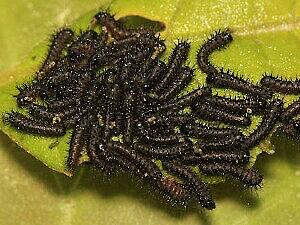
Hemileuca maia, the Eastern Buck Moth, just might be the most hated of all the Hemileucas...because it's the best known. In the Eastern States, although some experts think we may have a half-dozen different species--if they are counted as species--of Hemileuca in the same woods at the same time, most people, including experts, simply call all our Hemileucas variant forms of maia. They are the species originally meant by the word "stingingworm" or "stinging caterpillar," though the other Hemileucas and some other silk moths qualify for those names too.


Photo from the University of Florida archives. Color shadings vary widely; some individuals can be described as black and white, some as soft grey or taupe, but a lighter band across the wings and spots that may suggest eyes are always present. Some individuals lose wing scales and have translucent wings. The wingspan is two to three inches, females usually a little larger than males. Males are more likely to have tufts of rusty-colored fur at the tail end. Young females have an egg-stuffed body shape; males and older females are slimmer. Males have plumier antennae. Both sexes have furry bodies and wing joints.


Photo by Alan Chin Lee. As caterpillars, maia's primary defense is to curl up and drop to the ground with their bristles facing out, As moths, they no longer have bristles, and this behavior is probably counterproductive, but they have formed the habit. This appears to be a young male still expanding his wings, curling up instinctively as he stretches.


Photo by Shannon Schade. Stressed not only by stretching her wings but by being picked up by a human, this female regresses to the curled-up position too, while continuing to stretch her wings and exude her scent "call." The scent organ is visible posterior to--in this photo above--the grey fur on the tail end. Males can smell this damsel in distress a mile away and were probably bumbling through the air, rushing to her rescue, while Schade was snapping the picture.

This is, after all, the genus in which siblings separated after hatching and fed on different plants grow up looking different enough to belong to different species and, often, unable to produce viable mutual offspring. Hemileuca maia can eat different plants and have different looks. If it has access to the same food plants it can look remarkably similar to some of the Western species, or types, of Hemileuca.


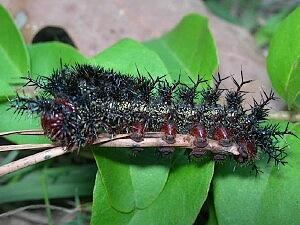
Phoro by Lee Ruth. This is the type I encountered first. It is detested as the "raspberry caterpillar," with reddish and blue-grey mottled skin that can resemble raspberry canes, which are not its primary food plant but which it likes to infest just at raspberry harvest time. Up in the orchard I've checked for sections of brambles stripped of their leaves, found the guilty stingingworm usually still clinging to the plant, and dispatched it with a stick, many a time. They were all purplish, with gray bristles and reddish feet. They were the reason why the siblings and I had to pick raspberries and deliver them to people who would otherwise have paid for the fun of picking their own.


Photo by Nancy Kent. This black-and-brown specimen is common in the Blue Ridge Mountains. Probably it ate cherry leaves as a mid-sized caterpillar. 


Photo by Susan Ellis, showing how different the same type looks from a different angle. 

Then again, at the same time of year, other stingingworms would be wandering about in the woods, likely to be found on any plant, bush, or tree that they had or hadn't been eating. Their color was nearly always black with brown-tipped bristles. On average they were shorter than the raspberry caterpillars, too. Raspberry-color-themed caterpillars stretched out closer to three inches; black-and-brown ones seldom measured more than two. Quite often they got into cherry trees and blueberry bushes. They looked like two different species. They were probably litter mates who ate different things as middle-sized caterpillars.+


Photo by Jgbecnel. Reports of North American caterpillars that were AT LEAST FOUR INCHES LONG!!! usually describe scenes like this. The caterpillar is molting--shedding its older, darker skin and emerging in a new, "teneral" skin whose color may change in the next few hours. It was photographed in Louisiana. 

Then again, in the North Central States, a subspecies of maia that doesn't look particularly "different" is now often counted as a distinct species. Some authorities still overlook Hemileuca maia menyanthevora or list it as a subspecies of maia; an increasing number count H. menyanthevora as a separate species, as will this web site. The Florida subspecies H. maia warreni is also increasingly recognized as a distinct species. 

In addition to menyanthevora, the species names orleans, sandra, and warreni are often considered as subspecies of maia. Peigleri, too, resembles maia and has been listed as a subspecies of maia. But species classification of Hemileucas is, as we have seen, a matter of flux and controversy. Maia and lucina look exactly alike to humans (despite tendencies for maia to be a little larger and lucina to have slightly more translucent wings), but they smell different to each other and are hard to persuade to crossbreed.

For those who were wondering, warreni lives in Florida--the peninsula, not the panhandle--and is able to fly in January. It is slightly smaller than maia and has more pointed wings, and the caterpillars' bristles form a distinctive pattern. Sandra, found mainly in New Jersey but sometimes considered to occur in a long swath south from there, is slightly larger than other maia and has darker, less translucent wings. Orleans lives on the Gulf Coast, is larger even than sandra, and has what some consider distinctly more brown coloring with opaque wings and cream-colored bands. 

Some maia caterpillars are so conservatively dressed, in black and grey, they look as if they might be trying to fit into the crowd at some Ivy League law school. 


Photo by Micah McDaniel. A surprising number of people snap "selfies" with the stingingworm that just stung them, often apparently because they picked it up. Duh! The first rule of not being stung by the little monsters is not to touch them. Their feet don't sting, but as they waddle over a human hand the bristles are likely to bump the skin.


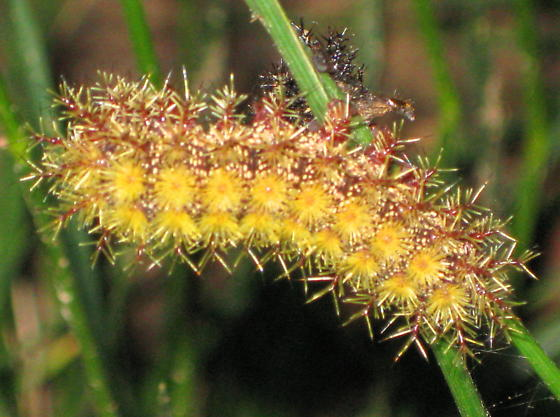
Photo by Mudgiecrabshabistan, taken in Florida. Some have a color scheme based on gamboge, with orange-toned skin and lurid yellow bristles. (This color scheme may be peculiar to warreni; later in the year after this post's first appearance, this photo was added to Inaturalist's page for warreni.)


Photo by Jakemccumber. In this family, orange and black caterpillars show complete freedom from color prejudice.


Photo by Prestonjones31. This green color is uncommon but I've seen it in Virginia.


This madly colorful specimen (click here for larger, more detailed photos: https://redandthepeanut.blogspot.com/2011/09/buck-moth-caterpillar-hemileuca-maia.html ) was found in Ohio. I've never seen one like that. I linked to the blog post about him in 2013 and it has, like my 2013 post, been among the very few blog posts Google still allows people to discover when searching for the topic. 


Photo by Joyce Bonner. Found in eastern Virginia, this is yet another variant form of maia. I've never seen this form in real life.


Photo by J.R. Baker. From a distance it looks white; close up, it's still possible to see that the skin is black with lots of white spots. This pale form was photographed in North Carolina and is another form of maia I've never seen n real life.


Photo by Aaron Brees. This is another common type of maia that I've never seen, but that many sources describe and photograph.

Photo by Brantport14. This one's plaid, with lengthwise and crosswise stripes mixing to form new shades of color. It may be sad--it's certainly blue--and it may be mad, possibly because it's too fat to walk very competently, and sometimes big fat caterpillars fall out of their trees. One minute they're stuffing their fat faces and the next minute they're falling into an unknown realm they've never been able to see. And, if they happen to be stingingworms, turning all their bristles out in order to land on them...quite possibly down the back of someone's neck.

Despite their mad variety all maias have one thing in common: They tolerate dampness better than the western Hemileucas. They can live and thrive and multiply east of the Mississippi River. They are vulnerable to fungus infections; more caterpillars survive in dry seasons than in wet ones. Still, local populations survive wet years. Their western look-alikes are unlikely to survive a wet year in the East.

The size and the bristles tell us the main thing we want to know about maia. That is that it needs killing. Not, of course, by poisoning the land with chemicals, which has made even feeble little nuisances like the codling moth and the corn earworm into major pests. In the Eastern States one is seldom very far from trees that supply good stout sticks. Take a good stout stick, take a long look at a Hemileuca caterpillar, and instinct will guide you to do the right thing. 


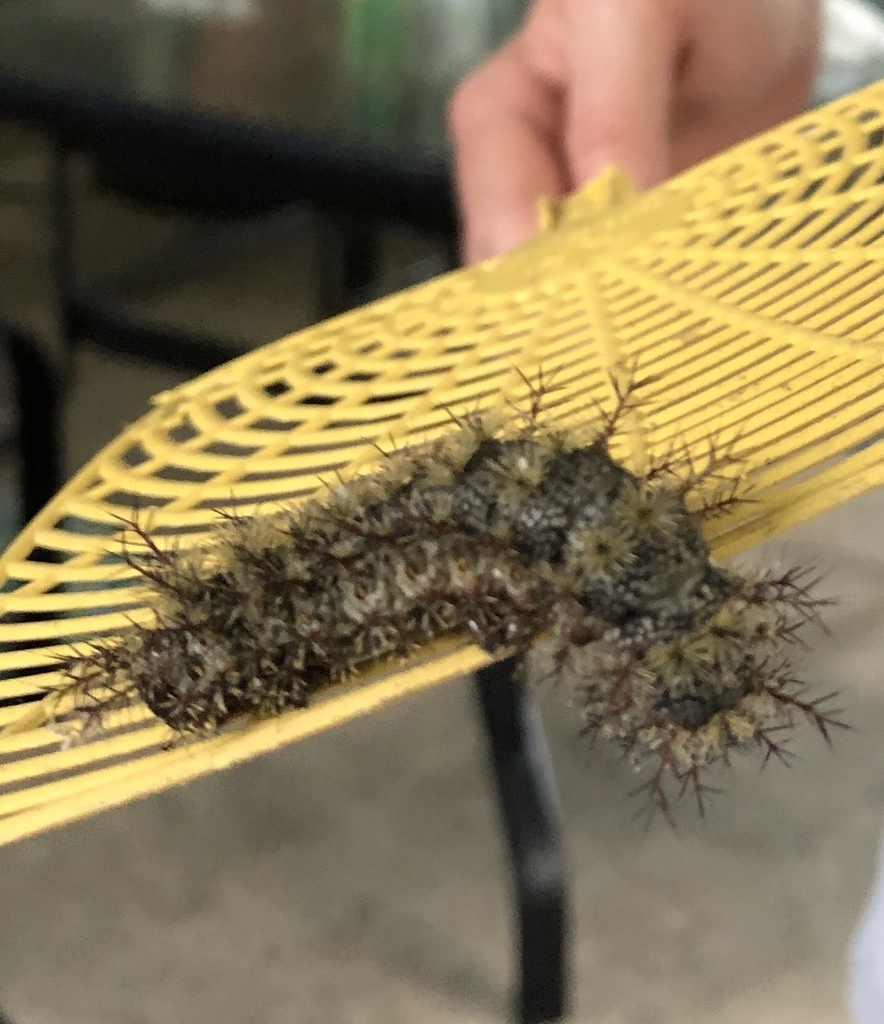
Photo by Sbwear, showing an ineffective method of population control. Hemileucas' bristles are solid enough that that floppy plastic flyswatter will bounce off. You want a sturdy stick, thicker than two fingers. If the caterpillar is crawling in soft dirt or leaf litter, use the stick to carry it onto a smooth flat surface where it won't just sink into the duff. 

To know Hemileuca maia is, for rightminded people, to loathe it. Nevertheless, in Maine, some "wildlife" lovers wrote of threats to maia as if they would have objected to the species' going extinct:


I don't think there's much real hope, but local populations where I live have gone extinct before and are extinct now, and nobody misses them.

Many of the fun facts about maia below were collected by Professors Schowalter and Ring of Louisiana State University, who wrote a pamphlet about this species to help a community particularly plagued by it. I contributed to "Know Your Pest" leaflets on this species years before the LSU pamphlet was written; their document is much newer and contained some fresh new facts. It can be downloaded and printed as a PDF:


In addition to applying heavy enough pressure, from sticks or stones, to crush the caterpillars, another method of control is collecting the moths. Maia adults do better at avoiding humans than some of the Hemileucas do, but if you can find a scent-calling female and tie her on a thread or cage her in a small mesh box inside a big mesh box, you may be able to collect several males. A collection of maia pinned in rows in a box may interest a local school or museum. If not, they burn well.


Photo by Sdoss56. The moth behind the screen is a young female, wings no doubt modestly covering her pulsating scent gland. The three males are all hoping to be chosen to help her unload her burden of eggs. A person who still held a grudge against last summer's stingingworms (this is November in Alabama) could thin the local population by picking off those males and killing them.

More efficient means of control, of course, come from natural predators. Natural predators are usually abundant where their prey species are abundant--provided that nobody has tried to "control" the unwanted species by spraying poison, from which the nuisance species population always rebounds faster then the predator species do. The primary natural predators on Hemileucas are small--tachinid flies, which are just notably smaller and differently colored than house flies, and tiny wasps. These little animals are able to lay eggs in between the caterpillars' bristles. Despite their gregariousness Hemileucas are not built to groom each other's skins, so the microscopic larvae burrow right into the skin and devour the inside of the caterpillar. 


Photo by Juliezickefoose. We don't know whether the bird or its young will eat the caterpillar, nor whether they'll be sorry, but we know the bird killed it.

Wasps and stinkbugs are occasionally able to kill and eat the caterpillars, and birds and mice sometimes eat the moths, but what seem to get Hemileuca numbers down are the little tachinid flies, braconid wasps, and perhaps a few other species that parasitize large caterpillars. A study on Cape Cod found significantly lowered maia populations around power lines with correspondingly higher rates of parasitism by an introduced tachinid species.


Photo by Theo_Witsell. This caterpillar has been parasitized. It's still crawling through one day at a time. It can still sting, but it won't become a moth.

Young caterpillars are very vulnerable to an infection called nuclear polyhedrosis virus or NPV. Older caterpillars have more resistance to this virus.

Then of course there's the fungus infection deliberately introduced in some parts of the Eastern States to slow the spread of the invasive nuisance Lymantria dispar. ("Spongies," from the look of the egg clusters, is now preferred to "gypsy moths" or "gyps.") Hemileucas are very vulnerable to fungus infections. While other native species have been decimated and been sorely missed--Monarch butterflies, Luna moths, and other popular favorites are vulnerable too--it has been pleasant, for summer after summer now, not to see a single Hemileuca. 

How do we keep Hemileuca populations low? With maia the secret seems to be limiting the proportion of oak to other trees. As climax forests grow up in oak, or when suburb dwellers plant an oak tree on every lawn up and down the street, Hemileuca populations increase. Other trees found in climax forests in the Eastern States attract their own pest species, but few of these are as obnoxious as stingingworms. Most varieties of maia lay their eggs on the uppermost twigs of oak trees, where the caterpillars live in clumps and eat their way through their first three caterpillar skins; then they disperse, and what they eat seems to determine the size and color they achieve before pupating. 

What if you want your local population not to go extinct? First of all I recommend being very quiet about this. Humans don't like stingingworms so, if you do, questions about your real species identity will arise. However, humans may respond more favorably to an effort to conserve a clump of bog beans or an oak tree deep in the woods where nobody has ever WANTED to live, work, farm, etc. Like the mosquitoes that benefitted from efforts to stop draining all the swamps and conserve some natural wetlands, a few Hemileucas may be tolerated so long as they don't spread out from their habitat or make themselves conspicuous when humans visit it.

Pesticide spraying and forest fires are two factors that have very mixed effects on insect populations. Some plants, including the oak trees maia eats, refoliate more aggressively if they have managed to survive a fire, and maia grow faster and stronger on this new growth. Nuisance species other than the target species are often killed by direct exposure to pesticides, but as nuisance species usually became nuisances by being hardier and reproducing faster than their predators, they rebound and become more serious nuisances after spraying...Hemileuca maia populations really exploded, all across the Eastern States, during the years when "safe and effective Roundup" (glyphosate) was being sold for all farm, lawn, garden, and road verge "weed" control. This trend eventually flattened out and, in some of the Eastern States, germ warfare against Lymantria dispar has devastated Hemileuca maia populations.

In places where people feel deeply attached to their old oak trees, as with the live oaks in New Orleans, people just have to accept a trade-off. All those picturesque live oaks fill up with Hemileuca maia in the spring, and so long as people want to cherish those trees, they are advised to carry umbrellas when walking under trees that are likely to rain stingingworms.

Its typical color pattern is one of the subtle, not quite "half white," gray-based schemes for which the genus is named, and it was recognized early enough to be named after a goddess known to have been actually worshipped--Maia, the spirit of springtime, from whom we get the name "May." 

The moths were named "buck moths" by deer hunters who encountered them in buck hunting season. They belong to the silk moth family but, unlike the bigger silk moths who rest with their wings spread out parallel to the surface, the Hemileucas fold up their wings as the Noctuids do, reducing their size and presumably their appeal to hungry birds and mice. They have gray or brown and white wings and often have black, white, or brightly colored fur on the body. For silk moths they produce remarkably little silk; most Hemileucas, like maia, don't even spin cocoons.

Maia is most easily distinguished from lucina, artemis, nevadensis, menyanthevora, and several other species by its instinctive behavior as a young caterpillar. Hatchlings normally prefer the kind of leaves on which they will grow best, and though these types may survive on one another's food, maia are most likely to thrive and grow up when they can eat oak leaves. Black cherry, willow, birch, and poplar leaves are sometimes also eaten. Raspberry,  blackberry, and blueberry are not primary food sources, but stingingworms often nibble on them while wandering about looking for a place to pupate. At this age they are large and voracious enough that a nibble may strip leaves from a foot or two of berry bush or cherry tree during the days when humans are picking berries and cherries. However, in some studies, about 95% of caterpillars who ate oak leaves lived to pupate, and about 5% of maia caterpillars who ate other kinds of leaves did.

Adult moths don't eat; they have no mouths or digestive organs. They live on fat stored as caterpillars, and don't have much of that. (Egg-stuffed females can look fat; males, and females who have laid most or all of their eggs, look skinny.) Fat is stored mostly in the thorax and lasts them a week, if that. 

After pupating for a few months in loose dirt or leaf litter, the adult moths eclose usually in October, sometimes November in the South. Some believe that a few each year remain in pupation through one winter and emerge as adult moths next fall. 


Photo by Mgochfeld. This newly eclosed female will be much prettier in a few hours, when her wings have expanded. Newly eclosed males look thinner but not more attractive.

They don't have much time to waste on unnecessary flight, and fly by day, resting at night and not fluttering around lights. Males fly further and faster, tracking females by scent. They're known for flying "erratically" as they try to follow scent trails through gusty winds. Females look for adequate space for their babies to hatch and grow, but living in the tops of big trees means they don't have to fly very far. When several oak trees grow close together the female can spend most of her time, in between unloading each brood, resting and hiding from predators, and more eggs are successfully laid. When oak trees are widely separated females lead a riskier life and presumably produce fewer eggs.

They identify one another by scent. Humans don't smell their scent, but laboratory tests have identified three chemical compounds that must be combined in a precise proportion to attract male maia. Synthetic scents can be used to trap male moths and prevent them reproducing, just as the natural scent of a trapped female moth can do.


Photo by Aaron Brees. Although they don't form pair bonds or seem to recognize each other after mating, Hemileucas often mate face to face and spend time, before and after the act of egg fertilization, cuddling and enjoying each other's company. Sometimes one moth even enfolds the other between its wings. (Most moths try to keep their wings separated while mating.)


Photo by Crx2aj3. The rusty tail tuft is more common on males; here's proof that it can appear on females, too. This young, egg-loaded female is just starting to lay her eggs.


Photo by Tom Murray. It's estimated that each female moth lays about 150 eggs, typically about half in the first brood and two or three smaller broods later.

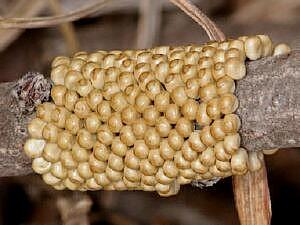
Like other Hemileucas, the female moth lays a batch of eggs in rings or spirals, their sides touching, around a twig. Caterpillars hatch about the time new oak leaves start growing--March in the South, May or June in the North. 


Photo by Tom Murray. Not all of them will live even long enough to grow out of their first caterpillar skins, but maia does produce large litters. Hatchlings seem to feel safest when touching a sibling. Their bristles maintain the amount of air space between them that they need; they don't sting each other. 


Photo by Maurabarry. Is a procession forming? When they have to travel any distance maias may march in a procession, like European processionary caterpillars, one caterpillar's head touching another's tail; one caterpillar becomes the leader, and losing that caterpillar throws the others into confusion for a while, until they pick a new leader and resume their procession. Even after reaching sizes and appetites that motivate them to spread out so that each one can strip a different branch of the host tree, when it's time to leave the host tree some maias will line up and move into the unknown in the security of a single-file line. They don't know where they're going and the line may form a curve, but they seem to have regressed emotionally and be seeking the old comfort of blindly following a sibling. (This is not behavior I've seen; it's documented in places where dense oak forests allow this species to form dense populations.)


Photo by Ahalbroo. Processionary caterpillars are notoriously dumb animals, sometimes used as a sort of definition of mindless behavior. These maias don't seem much brighter than their European counterparts...but maybe parading in a circle serves some purpose for them other than getting anywhere in particular. 


Photo by Grahamgerdeman. These little stingingworms are going somewhere. Not that they necessarily know where.

Hatchlings have long straight spines, which are hollow and brittle and route venom up from venom glands under the skin. Older caterpillars develop long branching spines. (I once counted the spines on a raspberry caterpillar I was drowning in alcohol. It had sixty-three. Each of those sixty-three spines does about as much damage as a bee sting, though fortunately people seldom touch all of them.) Some maias eventually develop flattened rosettes of bristles. The more bristles touch your skin, the more painful the sting will be; rosette-bristled species like Automeris io were reported by a volunteer to cause more pain than branching bristles of which only one tip would normally puncture the skin.

Being stung by a stingingworm has been described as anywhere from "mild irritation, like touching nettles" to "pain causing nausea or fainting." The area stung and the individual's reaction to insect venom determine how unpleasant the experience is. Even non-venomous hairy caterpillars or, for that matter, short cut ends of your own hair, will raise a brief yet miserable rash if they get down your neck on a hot day. Extremely sensitive people could go into anaphylactic shock in  reaction to maia stings, but this rarely happens. A study of "caterpillar envenomation" in Louisiana in 1987 found that 112 people sought medical help for reactions to caterpillar stings. When the caterpillars were identified,  49% were Hemileuca maia, 22% were Megalopyge opercularis, 16% Sibine (or Acharia) stimulea, and 11% Automeris io. None of the patients went into anaphylactic shock. They were successfully treated by patting the skin with duct tape to remove any bristle ends from the skin and applying ice. 

As with all insect stings, it's important to remove any part of the sting from the wound. A volunteer called Diaz intentionally left maia bristle tips stuck in his skin for ten days. He reported that these tiny bits of bristles continued to irritate his skin, causing pinpoint "hemorrhaging," until after ten days he gave up and removed them.

Weather conditions that favor high rates of survival in Hemileuca maia also seem to favor high population levels for two non-venomous (though hairy and prickly) caterpillars, Orgyia leucostigma and Malacosoma disstria. Both of these species normally live in treetops and do no harm to humans, but can become nuisances when population levels are high. They, and also H. maia, occasionally defoliate much or all of a large tree. Trees are prepared to survive one defoliation in spring, whether due to frost or to animals eating leaves. Only if one tree is defoliated twice in the same year is the tree in any danger. Fruit trees that looked bare in May may refoliate and produce fruit in June.

In two or three months, again depending on environmental factors, the caterpillars are ready to pupate. In New Orleans, where many of these caterpillar have spent their whole lives near the top of a live oak tree, they may walk down the tree for the first time in a ragtag procession. In many places the caterpillars disperse long before they pupate. In any case they hide under an inch or two of loose soil and/or leaf litter; the final caterpillar skin sloughs off and the pupa lies still and tries to look dead for a few months. In the South pupation may begin in May; in the North caterpillars may still be crawling and eating in August.


Photo by Lacy L. Hyche. Hemileuca pupae can be recognized by being found close to the bristly cast-off caterpillar skin, which usually decays slowly because the bristles still contain venom. 

Usually in October, sometimes September, sometimes November, most of the spring caterpillars will complete pupation and emerge as moths. They crawl up from their shallow burrows as soon as their legs are functional, while their wings are still crumpled stubs, and spend a few hours hoping nobody else sees them until they look like moths. They can't fly until their wings are fully expanded and solidified, which makes them vulnerable, like the young ones caught by humans at the top of this page. They are now defenseless, and can safely be petted if humans want to torture them. (But beware; touching or being touched by a moth leaves traces of its scent on you, and other moths will follow or even search you, trying to find what smells to them as if it might have been their beshert.) 

Then the wings reach their full size and the moths' blood starts pumping through their tail ends, the females' scent glands start "calling," and the cycle starts again.
Friday, August 16, 2024

Things That Aren't So Scary Any More


If frightened by dogs, grow bigger than they are,
If worried by wasps, learn to make them your friends.
If bothered by bees, then work for a beekeeper.
If socially insecure, start your own trends.

If you think you look freaky, some see it as sexy.
If you can't swim, dog-paddle around till you can.
If you can't win the game for your team, deride team sports.
Youth's and childhood's fears soon give way to a plan.

Though sooner or later all girls are molested,
We now make molesters pay dearly, in blood.
Though even rich White people live with oppression,
No one can make anyone stay in the mud.

No, I don't "scare easy," nor expect that you do.
No one lives for fifty years if bound by fear.
But there's still a cobweb that fetters my arms, when
I fear speech or action might harm someone dear.

(Fact-based, but not all my own story...Fear of insects and spiders was taught to my brother and me as children. When we were teenagers I became a wasp whisperer, and he became a beekeeper's apprentice.)