Showing posts with label name. Show all posts

Tuesday, February 6, 2018

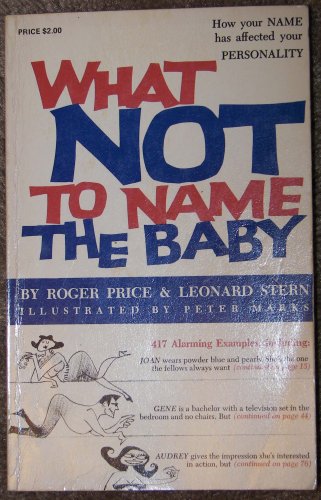
Book Review: What Not to Name the Baby

Title: What Not to Name the Baby


Author: Roger Price & Leonard Stern

Date: 1960, reprinted 1973

Publisher: Price Stern Corporation

ISBN: 0-8431-0047-8

Length: 118 pages of text and cartoons

Illustrations: cartoons by Peter Marks

Quote: “This book will, if you approach it with an open mind, a pure heart and a dry martini, enable you to understand the hitherto mysterious and connotative effects of Names and to start your child off in any direction you choose merely by naming it correctly. Fair enough?"

Fair enough...except that the authors weren’t making a serious study of the psychosocial effects names have on people; they were, after all, the inventors of Mad Libs, and their goal was to pair names that were popular at the time with snarky descriptions of personality types. A reasonably relaxed person shouldn’t need a martini to get a lot of chuckles out of this book.

They play fair. The names “Roger” and “Leonard” get their share of sarcasm. “In the 1920s the name ‘Roger’ was identified almost exclusively with stuffy little boys in comic strips and Our Gang comedies who wore thick eyeglasses...at the age of nine I was wearing eyeglasses...if I had been named Nick, I’m sure my eyes would have been as sharp as an eagle’s.” “Leonard and Leon are good card players. They’re both successful, Leonard be­cause he is smart.”  You’re not supposed to be convinced. You’re supposed to be amused. Most of the descriptions aren’t too flattering...Leonard is smart enough to be a good card player, not a good writer, business executive, lawyer, banker, or politician.

Part of the entertainment value this book has, fifty years after it was written, is of course working out which influences on pop culture changed the images different names have had. Price and Stern obviously associated the name “Albert” with Einstein; people my age associated it with “Fat Albert.” Price and Stern also associated “Cathy” with the sickly heroines of Wuthering Heights rather than the “Chatty Cathy” toys, and associated “Veronica” with characters played by Veronica Lake more than with the rich brat in the Archie comic books...and so on. A large portion of the names Price and Stern associated with active adults are, not surprisingly, so far out of fashion that present-time readers may not be able to think of any real-world users of the names except “Someone’s Grandpa or Grandma.” Tracing the historical influences on this book could be a pleasant way to pass the time with your grandparents.

It won’t be as obvious as you might think. I’m still trying to figure out where, in 1960, they dug up two images to go with the name “Roy”...and neither one was “Trigger’s Human.” And then, “Lucille usually looks like she’s smelling something...Lucy still wears a page-boy hairdo. She is wil­lowy.” Wouldn’t you have thought that, in 1960, either Lucille or Lucy would have sounded like the name of a curvaceous comedian with red-blonde hair? Did the Lucy we all loved ever wear a page-boy hairdo? And then, in 1960, did there seem to be any evidence that pop culture’s best-known Art (Linkletter) was “secretly a beatnik”? Did I just come along a few years too late? Would any older readers like to share the stories I obviously missed?

On the other hand, Grandma Bonnie Peters' husband would have agreed, while living, that Price and Stern were right about  “Bonnie.”

Anyone could write his or her own version of What Not to Name the Baby. Substitute names currently in use for names that no longer suggest anything to you. My entry for the name “Roger” might be something like, “People who named their sons Roger were probably impressed by World War II hero Rodger Young. A man who is named Roger was probably born in the 1940s and  might have grown up to be the sort of geezer who sees one of your friends’ dark complexion and immediately launches into a 20-minute reminiscence about every African-American he’s ever known, without even giving your friend a chance to explain that s/he happens to be Indian.” Your entry for “Roger” might be completely different, but, because of the historical trends, the majority of people’s entry for “Roger” would yield a sort of consensus that most men named Roger are now senior citizens...and that’s about as much truth as this sort of book ever contains.

But it's funny--in the sort of wholesome-as-you-want-it-to-be way Price & Stern's "Mad Libs" and "Droodles" were funny--and it's becoming a collector's item. A local reader bought the copy I had, after I posted an earlier version of this review, for just $1 in real life. On Amazon this web site can currently find more copies for less than $25 (the person who posted a nice clear picture of the cover wants top dollar for that copy), but cannot guarantee how long we'll be able to sell this book for $10, plus $5 per package for shipping and $1 per online payment. At least seven more books as skinny as this one will ship in a $5 package.

Sunday, August 6, 2017

Book Review: The Book of Bible Names

Soon to Become A Fair Trade Book


Title: The Book of Bible Names

Author: Pamela L. McQuade

Date: 2011

Publisher: Barbour

ISBN: 978-1-61626-20-5

Length: 153 pages

Quote: “For every person named in the King James Version...you'll find...the number of men and/or women by that name; the number of times that name is mentioned; a brief biography for the most prominent individuals; related scripture references (one for every person by that name); name meanings, if from the Hebrew or Greek.”

“Name meanings” are of course a source of endless, though seldom angry, controversy. With a name like “Abraham” we're on fairly firm ground: Ab raham could also have meant “father of compassion” or “father of female body parts” or, improbably but not impossibly, “wandering Brahmin,” but in the Bible we know it means “father of a multitude” because Abraham reported a vision that explained his name that way.

What about “Barak”? Forms of this name are found in Hebrew, Arabic, Amharic, Swahili, and all languages into which the Bible and/or Koran have been translated. It's not the most common name in any country, but it's found all around the world. It's related to a batch of Hebrew, Arabic, etc., words that all relate to the concept of a flash of light, burst of energy, show of divine power, in some way. Words in this group include ordinary words used for things like kneeling or bowing in prayer, a flash of lightning, or an elder's blessing. So when you look up names like Barak, Baraka, or Bereket in different “dictionary” lists you get one-word translations like “lightning” (as in this book), “blessing” (as in Dreams of My Father), “prayer” and many more, and if your native language does not cluster these ideas together you might wonder what on earth all these dictionary writers think they're talking about. Ex-President Obama's first name is relatively easy to link to a single idea, however disparate the possible English translations may seem.

Then there are the names the ancient Hebrews gave to foreign people. One of the foreign kings who demanded tributes that oppressed ancient Israel appears in the Bible as “Chushan-Rishathaim.” Chushan may not have been, and Rishathaim almost certainly was not, what his parents called him. Rishathaim is a Hebrew word translated as “of double wickedness.” “Delilah,” which may be related to Hebrew words meaning “languishing, voluptuously swooning, sighing, wheedling,” or “hair,” or “poor,” sounds suspiciously like a nickname acquired after the events in the story, but she was foreign, so who knows what her original name was or meant, or whether it sounded like “Delilah.”

Then there are names, and words, that have ambiguous meanings. Sar is a masculine noun translated by “prince, lord, champion, war chief.” Sarah is the corresponding feminine noun, and sarai is an adjective form. We know, because the Bible mentions it, that in the case of the Bible character who used this name the little pen stroke that distinguished “Sarai” from “Sarah” was important. Sarah was the boss; Sarai had not yet been recognized as the boss and was merely bossy. In other cases we don't have this information. “Rosh” as a word is often translated as “first, leader, beginning” (as in Rosh Hashanah, beginning of the year) but “Rosh” as a name is translated, in The Book of Bible Names, as “to shake the head”--also a Hebrew word.

So, the study of name origins is not an exact science. Even when the original meaning given names had for the individuals' parents has been known, it's often invited puns and variations. Elizabeth's and Zacharias' families didn't say “'John,' or 'Jochanan,' meaning 'God's gracious gift,' is an inappropriate name” (apparently very few people in ancient Judea said that) or “'John' is an overused name” (it was), but “None of your close relatives is called John.” For them, as for many Americans, given names weren't understood as having dictionary-type meanings of their own so much as identifying a child with an older person the parents wanted to honor. The only way people knew what their name really "meant" to their parents was for their parents to tell them.

This may explain some Bible names, which, if they seem to have an obvious meaning in Hebrew, seem to have one few people would have chosen: “Buz” is translated as “disrespect,” “Tola” as “worm,” and “Ispah” as “he will scratch.”

If you're a fellow Names Maven, The Book of Bible Names is a treasure, listing all the names of obscure Bible characters that no one seems to have wanted to honor after the characters' own time, with at least possible explanations for nearly all of them.


If you're not, The Book of Bible Names will be a useful reference book, listing each time a character's name is used in the Bible...in stories, in genealogies, in prophecies, in odd fragments of text.

You can still buy new copies from the publisher on Amazon, actually for less than the minimum price for Fair Trade Books. Kudos to Value Books for that. Use that book image while you can. The number of new copies available on Amazon is limited, though, and if this book doesn't go into a second printing you may want to buy it as a Fair Trade Book: $5 per book, $5 per package, $1 per online payment, from which Pamela McQuade or a charity of her choice will receive $1. You could fit at least twelve copies of this little book into one $5 package, maybe more, but this web site would prefer that you mix up other Fair Trade Books and allow us to support more living authors (or their charities). Click on "A FAIR TRADE BOOK" (below this paragraph) to open the last few books by living authors this web site has discussed, or you could just tell salolianigodagewi @ yahoo which living authors you would prefer to support. (This web site discusses recent books when we've received copies, as in the case of The Book of Bible Names, for resale, but Fair Trade Books are normally books that are no longer available from the publisher under the original publishing contract--our goal is to encourage writers that have lost support from publishers, not to sabotage the publishers that are continuing to support books.)

Sunday, January 6, 2013

What Sort of Name Is "Lingamfelter," Anyway?

Someone actually asked that question about the unusual name of Virginia's Delegate Scott Lingamfelter. I checked my name database; it's too unusual to be listed. I'm guessing that it derives from the words lingen and feld, which appear in various forms in several northwestern European languages (including "field" in English), and means "people who lived near an uncultivated field, or a field of heather, which was the predominant wild ground cover in some parts of northwestern Europe." I sneaked a peek at Delegate Kilgore's yearbook; Delegate Lingamfelter has a northwestern European sort of face.

More information about Delegate Lingamfelter and his background would be welcome here. We think he's definitely a Delegate to watch.

What about your name, or the name of someone you want to give a personalized gift? It's probably in the database. Ask Saloli. A plain old printout will cost $1 plus shipping; a card with a pretty background will cost $5, or more, depending on size.