Thursday, August 8, 2024

Hemileuca Lex: Post for 7.18.24

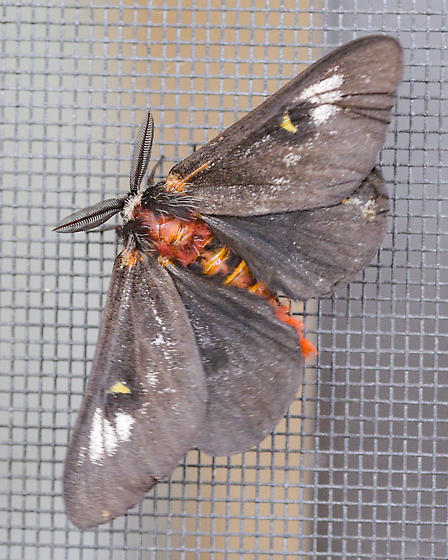
Like H. larex, Hemileuca lex was recorded as a species in the nineteenth century. The naturalist who named it was called Druce. He was probably remembering that the Hemileucas were traditionally named after major goddesses. The list of major goddesses known to Europe at this period was short, and Druce had undoubtedly remembered that, in addition to worshipping their ancestral spirits collectively as the Lares,  the Romans also worshipped abstract ideals--often "personified" in images or words as dignified, motherly women--such as Lex, "The Law." From the genitive form of lex, legis, we get words like "legal" and "legislature."  

Mr. Druce sent back to the Entomological Society only one specimen of Hemileuca (he called it Euleucophaeus) lex, a male from Durango, Mexico. Right away some people said it was the same thing as H. tricolor, and some said it was very similar to H. oliviae. The study of H. lex as a species has progressed very slowly, although it's still listed as a species and has been further documented. Its habitat along the Mexico--New Mexico border has helped it remain obscure. It likes to stay high and dry, not at the peaks of the Sierra Madre, but high up in their foothills.

It has been called the New Mexico Range Caterpillar. Its food plant is the black locust tree. Caterpillars have been reported to be able to eat other things, raising the question whether, if they do, they grow up looking like either oliviae or tricolor, and, if so, whether they're accepted as oliviae or tricolor by moths clearly identified with those species.


Photo by Lidize, taken in Queretaro, Mexico.

Moths have soft, subtle color patterns, heavy fur capes on the thorax, and an egg-stuffed body shape if young and female. Their colors vary from gray to light brown to rich redwood brown. Some show bright red hairs on the abdominal segments.

Same moth, wings folded, exploring Lidize's hand:


I'd prefer to see actual measurements.


Photo by Coletoobservador, San Cristobal de las Casas.


And Huracan in Fraccionamiento del Santuario found both the resemblance to the more vividly marked H. tricolor and the tendency, shared with other Hemileucas, to curl up their bodies as they did when they were caterpillars. It's not at all an effective survival move for the moths. This raises the question to what extent the caterpillars are aware that curling up with their birstles out turns them into formidable weapons. Their bristles protect them from stinging one another. The stingingworms don't necessarily know how venomous they are.

This species remains under-documented on the Internet. Yahoo reports about 23,000 occurrences of the phrase "hemileuca lex" but shows that most of them are on lists. Even Spanish Wikipedia and Naturalista.mx lack specific information about this species. 

If scientists agree to accept a DNA-based working definition of "species," there are only half a dozen distinct species of Hemileuca, and lex isn't one of them. Still, as a distinct type, it deserves to have its life cycle documented...though the current lack of documentation of its life cycle suggests that at least it does a good job of avoiding humans.Avoiding humans seems like a very good trait for a Hemileuca to have. 

Link Log for 8.7.24

Hurrah! All those book reviews have been retyped into Blogspot; they'll appear in a chronological sequence with the missing articles. 

Phenology 

Steve Milloy presents a particularly pertinent global climate fact. I'm sorry he's started doing talk videos now, but he's older than he looks and he does keep them short. (But this is a nag: people who can still see the letters on the screen should be posting printable words.)

Wednesday, August 7, 2024

Funniest Advice I've Received

Prompted by Long & Short Reviews... 

It's not really funny, but the most ridiculous advice I've received recently has come from the Appalachian Power Company.

APCo has installed "smart meters." Nobody really likes them but, in a rural area like mine, people think about those poor old meter readers floundering on our icy banks in winter, overexciting the dogs some of us keep, being panicked by the other animals whose company some of us enjoy, and, y'know, if a chip in the meter can deliver the same reading of kilowatts used to the company, it's not as if we ever enjoyed subjecting the meter readers to All That.

But these "smart meters" have some vague idea of what kind of device is plugged into each circuit and they can report to the company...

Actually they could have reported to the company, in my case, "Only the office circuit has been consistently active since the smart meter was installed. Old, oversized refrigerator and deep freezer, both of which the company promised to haul off, pay for, and help replace with a decent one-person fridge, neither of which the company has ever had the gumption to touch. Toilet and water heater, plugged into inactive circuits, running on solar power only. House is several times more 'energy-efficient' than what company has been calling 'efficient homes.' Company can either admit company has something to learn from the writer known as Priscilla King, or not presume to advise anybody about 'energy-efficiency,' to avoid public ridicule," if these meters were actually very "smart."

But they're not. They are remarkably thickwitted pieces of spyware. 

So in some months, like this one, I get pieces of junkmail--at my own expense mind you--advising me to save energy by setting my air conditioner to a higher temperature. (Air conditioner? ??? Where? There's one on the porch but it was bought for resale and I'm not sure that it's ever actually run...) 

"Smart meter" reckons 40% of my electricity bill has been spent on "cooling." The Lasko fan has been running almost continuously for a few weeks, this being what is known as high summer, but seriously? It occupies 12% of the active electrical sockets, which is to say one socket. It draws fewer kilowatts than the desktop computer, its monitor, and the laptop computer--separately--and they're all plugged in more of the time than the fan is. The fan is not a solid-state appliance that sucks energy when it's not running; the computers are. Going by the difference between what even the 250-watt electric heater did for the bill in winter, and what the Lasko fan does for it in summer, I think the fan is to blame for maybe 5% of my electric bill. Though each computer and the monitor has its own little internal fan, and I suppose running those for "cooling" purposes does run up the bill in summer.

"Smart meter" also had some smartypants ideas about how to make the water heater more efficient than it is on solar power alone. 

I think there might have been a few more tips, even more irrelevant, if that one hadn't made me fall about and cackle like Candidate Dowdypants. (I try to laugh as long and as loud as possible, for health reasons, thank you very much.) Then I said to myself, "Self, you sound like a person who has never even learned that trousers are supposed to reach the tops of the shoes! Get a grip!" I got a grip on something--I suppose it was the junkmail--and thought soberly about the fact that, in previous years, when people have received these letters of commendation for low consumption of electricity, they have mysteriously been billed more per kilowatt-hour next winter. When I remembered that I had been reading junkmail, all that remained was a crumpled wad of sweat-drenched paper (I had not been holding it directly in front of the Lasko fan, which is aimed mainly on the desktop computer, pampering the venerable thing--the desktop computer I'm using today is the one my late husband built in a college workshop). 

I think APCo needs the advice I usually give writers who are tempted to try using so-called artificial intelligence: Don't

Link Log for 8.6.24

Google 

Has Google been a monopoly? Close. It's not that Google stores data about who searches for what; knowing that people who search for "Supremes music videos" also search for "Shirelles music videos" does nobody any harm. (Of course, if your searches betrayed any great interest in disgustng diseases, illegal drugs, possible arguments for defense if convicted of public indecency, etc., you probably had enough sense to do them on a public-access computer while not logged in to any Google account you had.)  

No, but it's the way Google has been handling searches lately that annoys the daylights out of people who were paying attention. At first you could type in a single search term and actually get only a handful of results. I forget whether it was Google or Ask Jeeves that once yielded four online mentions of "Zambia" around the turn of the century. Then the Internet filled up with content, and clients paid for content that was "search engine optimized" according to various rules, and finally Google was in a position to use a site owner's credentials as a major determinant of what shows up at the top of a Google search.

So far, so good. But then the site owners got greedy. "Force traffic to the top of the search," they demanded. "Make it harder to scroll down through all 50,000 results. Don't show people all 50,000 results! The top hundred should be good enough!" 

As I've been doing those updated moth articles, I've been greatly annoyed by this. For better or for worse, an article I wrote more than ten years ago, listing all 23 of the species of Hemileuca I found online at that time, mentioning that although web pages had been set up for some of those species they'd never been filled in with any information, really was one of the most informative articles on the Hemileucas at that time. It's still in the top 100 search results for some of those moths. Which, when you consider that the algorithm that originally put it in the top 100 apparently counted how many different ways the word Hemileuca was used in sentences, and that what I had to say, at the time, about Hemileuca dyari was that no information about it was available, is pathetic. Because, as I go back and research these moths on todays more informative Internet, much more information is out there. There've actually been over 70 species names in the genus Hemileuca; several have been lumped together as subspecies or mere local variations, and now, of course, Tuskes and Collins have explained why DNA studies make a case for counting only six distinct species of Hemileuca. And one of those six looked similar enough to another that nobody even bothered to mention it as a subspecies, fifteen years ago. And now there are live photos of H. dyari, and H. lares, and so on. But the new algorithm blocks personal blogs from the top 100, so Google is still steering traffic to an old outdated article and refusing to direct any of that traffic to any of the much better ones I've been able to write since then.

Meanwhile, where a search for Hemileuca diana pulled up about a dozen search results Back Then, it pulls up thousands of results now. Some of those results are garbage. Desperate junk sale sites often stuff their home pages with random keywords, suggesting that nobody at the site actually reads English, in hopes of attracting a few looks at what they're selling, which is likely to be "looks just like louis vuitton bags/" Those are easy to spot. Then there are the sites that sell arts'n'crafts with motifs inspired by nature--any time you Google a moth, butterfly, flower, even a snail species, you're likely to get results for moth-motif fabrics or stick-on tattoos or not-trying-so-hard-to-look-like-Louis-Vuitton handbags. Those are also easy to spot. Although the Hemileucas are reasonably showy moths, some beautifully subtle and some psychedelically gaudy, searches for them don't yield as many sites tryng to sell dead bodies as searches for butterflies do. But I am interested in reading, citing, and linking to pop culture phenomena like someone's having composed a long instrumental piece dedicated to a butterfly species, or someone's blog post about having found a moth resting on a window screen. I do not want to be limited to some tiny fraction of what's out there. That is not making the search results better.

So, what else is out there? Yahoo has often offered more search results than Google. Bing usually offers less, and although I never asked Google or Yahoo to pay me for searching, it also annoyed me that Bing used to promise to pay people for searching and then conveniently lose their account data when the time came to pay up. Bing should sink in a pit.  I've seen no evidence that Yahoo can be forgiven for destroying their regular users' free e-mail accounts in an utterly insane fantasy that that would motivate anyone to pay for e-mail--the attraction of e-mail is that it's free of charge, funded by ads--but I have to admit Yahoo search results did a lot for some of the moth and butterfly articles at this web site.

Then there's that list of browsers that promise that they don't filter results, don't collect data, etc. I personally don't give a flip about Google collecting my data. I do nothing online that needs to be hidden; I search for data about things I'm writing about, and I search for the lyrics to music videos friends post if I want to sing along, and that's just about all of it. The newspapers would be welcome to publish it if they'd pay me. (LOL.) But, do the allegedly uncensored browsers show more photocopies of crumbling library books, more private blogs and poems, more unexpected gems like Sargent's links of butterflies to goddess archetypes? Hah. They don't censor because they "search" Google. They consistently yield not even Google's top 100 search results, but more like Google's top 50.

I've complained about this to Google. If there are 50,000 results, show me 50,000 search results, I've said. Result? Google has stopped displaying the total number of search results. Google still does a little digital slap in the researcher's face where they say that they've omitted some results as being repetitious, although their Top 100 results usually include at least five duplications of at least five pages, and "If you like you can repeat the search with the omitted results included." Which then yields an abridged, not expanded, version of the results they showed the first time. 

That's the kind of hubris that gets companies declared monopolistic in court.


So long as there is effectively no way to search beyond Google's top 100 or Yahoo's top 500 results, and now that many topics yield more than 50,000 results, a lot of relevant content--e.g. the more authoritative, better researched, more up-to-date articles that Google refuses to allow to replace that long-ago study of 23 Hemileuca species--is effctively being suppressed, never to be discovered by people who may be looking for it. And I know firsthand that that content is NOT being suppressed because it was published by neurotics who don't want strangers reading what they've published, or because it's a mess of random English words stuffed into the home page of a junk sale site, but because the people doing the newer research and better informed writing are not PAYING TO BE in that top 100 search results from companies that have paid Google to "FORCE" traffic to them.

(Not that I seriously think the efforts to "FORCE traffic" are being made by INaturalist. I think INaturalist, Funet, and other natural science sites are perhaps having their numbers inflated by algorithms demanded by "celebrity" and "latest trends" sale sites. But the legitimate science sites need to demand that the search engines stop suppressing unpaid content from search results.)

I'd like to see Google survive this, and the first step in their survival strategy should be to announce that they're aware that suppressng search results has been harmful and that they will never, never, never suppress all 500,000 search results, if anybody is really willing to search all the way through 500,000 results. Taking payment for putting sponsored links in the top 100 is no crime, and should only ever hurt the sites that make such payments, so long as researchers have full access to the other 400, or 900, or 499,000, or however many sites we are willing to read.

Politicians Who Don't Have Enough Sense to Be Very Nice to Bloggers

Do not have enough sense to live, as pollies. Are not viable. But Mean Girl McDowdypants does prove that it wasn't Joe Biden's age, as such. She can sound as incompetent, if not more so, and she's not even all of sixty years old yet. Video documentation:


Senator Kaine played by the rules and was nice to this web site, so we're nice to him. Dowdypants thinks she can get away with anything'cos she's going to censor the Internet, hahaha, wahahaha, yeehahaha, careful she doesn't fall off the chair--how many alcoholic drinks has she had so far today?! I want to see D voters recognize that Robert Kennedy caaaares about their precious handouts, the only thing most of them have voted D for since the Carter Administration. Make it happen, Gentle Readers. I want to see Dowdypants lose with a vote count last seen in a year when we had only fifteen States. 

Book Review for 7.18.24: Books for Benjamin

Title: Books for Benjamin

Author: R.G. de Rouen

Illustrations: watercolor paintings by Uliana Barabash

Date: 2022

Publisher: R.G. de Rouen

ISBN: the e-book shows ISBN's, but they're illegible

Quote: "Benjamin...would rather read about adventures in a giant peach than eat one."

"Bookworm" is a nickname, usually for a person who reads or collects books, but also for any of several insects that eat paper. None of these insects is a worm, scientifically speaking. Some are beetle larvae, one is a moth larva, and some don't even have a wormy shape, like booklice (a.k.a. bark lice) and silverfish. Booklice actually eat mold, and the damp wood or processed wood fibre on which it grows; some other paper-eating insects also eat only the wet, moldy, or otherwise decaying parts away from books. The insects that eat vegetables mostly belong to different biological "families."

But in this thoroughly unscientific fable, Benjamin Bookworm leaves a family of "worms" who eat rotten vegetables and, after some mishaps, getsinto a library where he can live on air and read books for the rest of his days. He moves to the Library of Congress and is givent he job of stamping his smiling face on books next to the date of publication to remind himself which books he's read. If you doubt this, just look in a book and see the sidewise smile beside the...

At least the writer explains what the copyright symbol really is, at the end.

I chortled. This is not a book I'd want to read to a four-year-old every night for a year, but it is the sort of thing that belongs among the free-reading books at the back of a primary school room, or int he school library. 

Probably a perfect aunt would not buy this book for, or recommnd it to, children who use their high tolerance for "worm" stories to gross out friends or family members with lower tolerance. A surprising amount of this web site's current content reflects the fact that I've never claimed to be a perfect aunt. 

Book Review for 7.17.24: Every Witch Way But Meow

Title: Every Witch Way but Meow

Author: K.E. O'Connor

Date: 2022

Publisher: K.E. O'Connor

Quote: "She was a wonderful witch. Almost my equal, just without a tail."

The Magical Misfits series is about a lot of fabulous and/or mythical creatures, the rational ones not necessarily in human form, the lower animals not necessarily four-legged either. Juno (in this case Juno of Avalon), the narrator, is a demigoddess in cat form, which allows her to communicate clearly with only one human, Zandra. Zandra's mother, Adrienne, became a mother as part of a long pattern of behaving like an irresponsible spoilt brat; in this volume she's disappeared from her latest residence in Crimson Cove, leaving enough debts to explain her disappearance to anyone but Zandra. Zandra goes to Crimson Cove and is offered a job in a bookstore right away but, since she's not a real book person, Juno steers her to the position of animal warden. She's off to catch a pack of babboas...whatever they are. The book doesn't really explain. Maybe that comes in the next volume.

This short-novel-length "book" is clearly part of a longer story arc, the Amazon favorite model of five 30,000-word novelettes that together form one 150,000-word blockbuster, sold separately or together. It's all one big situation comedy. If you think this kind of adventure is funny you'll want the whole series, or long novel, whichever you call it. Promotional material attached to this e-book specifies that in some of the five volumes humans will be murdered. Solving that mystery will be part of Zandra's quest to understand Adrienne.

I laughed, and I'd probably remember the series and buy a copy if I found a copy of any or all of the Magical Misfits Series on sale in aid of a good cause. Then again I feel no particular compulsion to buy the whole series, right away, from Amazon.

Tuesday, August 6, 2024

Book Review for 7.16.24: Murder at Stirling Castle

Title: Murder at Stirling Castle

Author: Sophia Adams

Date: 2023

Quote: "Her blonde hair, with not a strand out of place, was up in a loose bun like many of the ladies wore."

To have "not a strand out of place," wouldn't hair have to be described as up in a tight bun? I think it's possible that parts of this novel were written by ChatGPT.

Then there's the old feudal spirit. 


There's a real Stirling Castle. It belongs to the royal family of the United Kingdom, none of whom currently live there. It's not owned by a mere earl or baron. 

In the fictive world of this novelette, however, Stirling Castle belongs to a "lord and lady" who live there with their son, and the villagers who are invited up to help with a special dinner party, like Aggie the baker, are terribly feudal about showing due respect for their beloved local aristocrats. In view of how the plot develops, Adams' intention may have been to say that this love for the relics of the feudal system is misplaced. To this American reader it just seems bizarre...how can people respect the wholly fictional owners of a place that's not actually owned by such people?

So I found it hard to suspend disbelief in this one, but Aggie and her pet magpie put an unusual twist on the trope of the female sleuth who's attracted to the real police detective. There is that.
 

Butterfly of the Week (7.15.24): Salvin's Kite

From the fact that it was named after a living man, Osbert Salvin, rather than a character in ancient literature, we know that this butterfly is somewhat rare and was discovered only recently. It is uncommon in Central America, from Mexico to Belize. It may be most common in Guatemala. (Nobody seems positive about this; in fact some sites disagree about where to look for the butterfly.)

Most Kite Swallowtails are recognized by having some combination of dark and pale stripes. The pale color may look yellow, white, green, or blue, depending on the light and the condition of the wings. The dark color may look black or brown. Salvini is recognized by having more pale and less dark color than the other Kites have. It can be called a white butterfly with narrow black stripes. The upper wing surface is white with narrow black borders and one narrow stripe crossing the tip of the forewing; the underwings show two narrow stripes, one running together with the border. Some sites list "Albino Zebra" as a nickname for this species.


Photo by Markg, who notes that it was taken in Belize in May.


Fair use of photo by Rich Hoyer at https://birdingblogs.com/2010/richhoyer/mayan-mexico-%E2%80%93-a-taste-of-the-tropics , where he mentions that, even in the present century, this may have been the first photo of a living salvini ever published. Photos of this butterfly remain hard to find.

Females are thought to be larger than males. The wingspan of a male museum specimen was recorded as 3.6 inches.


While a few of its haunts are known well enough that some tours list it as a species tourists are likely to see, its life cycle remains undocumented. Typically male Swallowtails spend much of their time sipping water, clean or polluted, at puddles and females spend more of their time finding suitable places to lay their eggs. The scant documentation of this species suggests that its behavior pattern is typical, but nobody is certain about this. 

Link Log for 8.5.24

How pleasant to be able to share a few links again...

Animals 

Rich variety of moths, big and small. It may help to look up the actual sizes; photos tend to let each moth fill the space available, when that space may be twenty times the moth's size, or a quarter of it.


Identity 

I don't think this man should be in the United States, if that's how he feels, anyway. If he's posting from a Muslim country, organizing a group of American Muslims to emigrate there, that's all right. But let's just say--people around the world risk their lives for a chance to "become American." If you do not like being American, for mercy's sake, get out of this country and let one of those people take your place. 

He's right about one thing, though. Although we are meant to be able to take pride in our physical ancestors and enjoy their cultural traditions, religious identity does need to come first. Our allegiance to God, by whatever name we know, is more important than our allegiance to any flag or any nation for which it stands. We should be Christians or Jews or whatever else first, Americans or Canadians or whatever else second.

In every nation's recent history there are always plenty of things to make people exclaim, "My country, right or wrong...when wrong, to be put right." It's not necessary to go back to so-called legacies of slavery or colonialism or blah blah from centuries ago. Within the last ten years we will find much that needs to be put right. This web site has said much in praise of the legislative work of men who are justly honored for what they've done in Richmond and Washington, and yet, although Terry Kilgore, Tim Kaine, Mark Warner, and Morgan Griffith, any or all of them, would be in a position to strike down any so-called "right to spray" in the face of clear evidence that poison spraying is being deliberately used to injure human beings, none of the four has stirred a wing or opened a mouth and cheeped. (Yes, that elaborate way of calling them chickenhearted has a Biblical precedent: Isaiah 10:14.)  They all have the status and the authority and the support of their constituents that they would need to stand up to Bayer. What they all lack is the fortitude. And, yes, that is an abuse of Americans, against which we can and should draw moral support from our fellow believers in all times and places. 

Anyway, whatever you may feel called to work on...as the old bumper sticker motto goes...put your heart where you choose to live, or get your burro out.


Immigration

What shall we do with a lazy immigrant? I don't know, I've never seen one. I've seen the kind that work through unbelievable physical disabilities. I've seen the kind that go to day labor sites and figure they'll learn English on jobs, starting with the kind where people point and shout at them until they figure out how to say things like "We load couches for shipping." Actually, when people aren't feeling desperate and overcrowded and therefore prejudiced, I suspect most immigrants self-select for willingness to work hard and be good neighbors. Daniel J. Mitchell claims to have found evidence that lazy ungrateful immigrants exist, shaped by government handouts, in some parts of Europe.


Magazines

Why blogs are better than commercial magazines! Don't look back!

Monday, August 5, 2024

Book Review for 7.15.24: The Recipient

Title: The Recipient

Author: Shail Rajan

Quote: "Just another one of the reasons I love living in Sycamore Ridge!"

There is probably an actual book by this name somewhere. What I received from Book Funnel was one of those cheeseparing "first few chapters of a book" messes, and in this case it's messier than usual. On page one a man is apparently about to be hit by a truck while talking on a cellphone at the intersection. On page two, "Six Years Later," nobody seems to be missing him. So, did he survive, and is he the man with the same given name and a different family? Or what? Then there's a shy, scruffy man who's attracted to a take-charge-chic yuppie woman who's improbably attracted to him too, and there's a realtor, and there's a burnt-out, drugged-out musician, and more. 

A person who had nothing else to do might, after reading this muddle, buy the full-length book to see if these people ever interact with one another and form a story. I have several other things to do. 

Book Review for 7.14.24: Storm Crows

Title: Storm Crows

Author: Erik Christopher Martin

Date: 2023

Publisher: In a Bind

ISBN: 978-1-9612155-01-6

In nature it's not really uncommon for smaller birds to "mob" crows and jays they suspect of having evil designs on their eggs or young, nor for crows, jays, and smaller birds to "mob" hawks. The facts that most birds respect each other's territorial rights, most raptors don't eat other birds (and most of the ones who do don't live long), and most raptors are dangerous only when they can seize prey from above and aren't very strong fighters otherwise, make it unusual but not extraordinary to see little warblers chivying big red-tailed hawks or even ospreys. Owls, who don't see well in bright light, are often punished for preying on other birds by mobs of angry little birds.

The first time Erik Christopher Martin observed this behavior, though, it impressed him enough that he went home to write a book-length fable about some crows who organize a campaign to protect themselves and smaller birds from predators.

The fable is not specifically religious--Martin imagines that crows visualize God as "Corvus"--nor is it very scientific; Martin didn't know that the larger raptor, of a pair, is the female. Most hawks are about the same size as crows, despite having longer wings, bigger talons, and sharp carnivore beaks. The hawks who are half again the size of the crows, in this story, must be imagined as female red-tails or goshawks. 

One piece of anthropomorphism in this story really is supported by science. Crows have been known to use simple tools. In real life they're not known to use hard rocks to break through sandstone, but if the right crow happened to need to break through sandstone, who knows--it might happen. 

But basically this is a fable about teenagers, visualized as birds. Three couples leave a tough gang and fend off the gang's enforcers by building social bonds with adults.  What they believe about Corvus may not be closer to any human religious doctrine than to any other, but faith in Corvus is part of their story. It's a nice story with a mostly happy ending. 

Book Review for 7.12.24: Crime, Clues, and a Curious Fat Cat

Title: Crime, Clues, and a Curious Fat Cat 

Author: Lizzi London

Date: 2023

Quote: "Stacey noticed a customer over in the coffee corner...didn't even appear to be reading the book on her lap."

And "Sleuthy Stacey" just knows that that means something mysterious is going on. But it's a cozy mystery. Is the nice hotel maid really stalking the nice hotel guest? Could there be a valid reason?

I don't particularly like the idea that the cat is the reincarnation of the aunt from whom Stacey inherited the bookstore, but if you don't mind that sort of thing and enjoy a nice cozy mystery with strong hints of sequels, prequels, and romance in the air, this book is for you. 

Hemileuca Lares (Post for 7.11.24)

Hemileuca lares is still poorly documented online.

When the second page of a web search for this species turns up a post I wrote, many years ago, that said  that web pages have been set up for the species but not filled in with information, you know the species is still very poorly documented.

A few new web sites for moths have been set up in the last few years, such as the various INaturalist pages, some of which include Florjaramillo95's three-photo study of Hemileuca lares from 2022.


As shown it's a small silk moth of a rather pretty light brown color. Like other Hemileucas it doesn't eat, but lives entirely off the fat its body was able to store as a caterpillar. The thorax is fat and furry; the abdominal section, which in a silkmoth is used entirely for the reproductive parts and eggs, can look fat on an egg-loaded female, thin in males and older females.

It's found on the Mexican side of the desert, in places like Sonora and Durango. What it eats is unknown; it doesn't seem to be common or economically important enough for anyone to have tried to find out. People don't even complain about the caterpillars, probably because, when they're in this moth's habitat during its active season, their main concern is getting to somewhere else more supportve of human life.

Is it a true species? Who knows? Who cares? The Hemileucas are moths that defy our preconceived notions of what defines a species. They can look and behave like different species when they are in fact litter mates that grew up in different environments. Nobody seems to have researched whether lares is capable of crossbreeding with any other species or type of Hemileuca.

Lares was named, not after a goddess as such, but after the collective of household ghosts most Roman families offered food and wine. It was one of the last species named according to the traditional rule of naming the Hemileucas after spirits some ancient people actually worshipped. It was named and described by a naturalist called Druce in 1897. Funet.fi, which is usually good for storing digital images of the first description of a species, lacks copies of Druce's monograph or of the naturalists' annual report that cited it. 


Did Druce draw this picture, still the only picture of H. lares most web sites have if they have one at all? It's a drawing, not a photo, with the emphasis on showig the subtle shadings of color and wing structure that show it's a Hemileuca. This image appears on several web pages now. I ganked it from an INaturalist page but it's also in use at Wikipedia and other science sites. The Entomological Society admitted that all they knew about this species was what they could see by looking at this one specimen, a male, collected near Durango. They thought it "should be between mania and hualapai," but admitted they didn't know enough about those species, either, to say whether that evolutionary theory about lares had any base in fact.

There are specimens of H. lares in IBUNAM, the Mexican natural history museum, but not in many other museum collections.

People who are seriously interested in the ecological and economic concerns of northern Mexico might want to read this digital book, which Google says mentions Hemileuca lares somewhere, probably on a list.


I'll admit I didn't want to put enough time into this article to find out what the author says about lares, which is clearly not the primary topic of the book. The main fact I take away from a search of what's known to cyberspace about this moth is that this is a species, or type, it would be really easy for someone to study in a serious scientific way and become famous.

Book Review for 7.11.24: Red Rider

Title: Red Rider

Author: D.A. Randall

Quote: "I gripped my crossbow as I approached the tavern, ready to fight whatever wolves I found inside."

Little Red Riding Hood is growing up. Having bribed the woodcutter to teach her to fight, she's still lost her parents prematurely--before they could teach her most of the things a Basque-French peasant maid would be expected to know--because the local werewolves held a grudge. Now she's The Red Rider, armed with silver-tipped arrows that kill werewolves at a touch, out for werewolf blood. Old enough to have a boy friend who's still a friend, staunch and true if not quite as brave as she is. It's going to come down to hand-to-hand combat with the monstrous alpha werewolf of the pack.

This is one young adult novel that's romance-free. Of course, that's because it's book one of five complete short novels. Red, also known as Helena, is only sixteen; Pierre is a child. There may well be a romance in volume 4 or 5.

As fresh takes on old fairytales go, this one's not up to Pamela Dean's standard, nor yet C. Gockel's, but it's a nice twist anyway. 


Sunday, August 4, 2024

Book Review for 7.10.24: Single Dad Boss

Title: Single Dad Boss 

Author: Daisy Flynn

Date: 2023

Quote: "I needed to take sensible action quickly, or this delay could ruin my career."

Natalie's famous for giving relationship advice on television, but her own love life is dysfunctional. She had a not too recent fling with her supervisor at work. She knows the romance is gone, but he manages to surprise her, anyway, when her car breaks down on the way to work, she manages to walk in only two minutes late, and oh that's no problem, Natalie, you were fired already. Pink slip on your desk this morning.

So she might do worse than accept some help from her brother's best friend, even though he wasn't very gracious about rejecting her help when his wife died....

Couldn't the author have found a more believable name for this hero than "Sebastian"?  Has any English-speaking man used the name "Sebastian" in this century? Aren't these characters supposed to be American?

Well, if the only fault I find with it is the hero's name, you know it's pretty good within its genre. The only suspense lies in finding out how long they'll take to admit they want to marry each other. The child is actually believable. If you like to savor memories of love letters, weddings, and honeymoons, this book is for you.

Book Review for 7.9.24: The Widower's Nanny

Title: The Widower's Nanny 

Author: Bella Greene

Date: 2023

Quote: "I don't like the idea of having a nanny, but my mother could no longer do it."

The speaker is a thoroughly spoiled rich boy, accustomed to living with a house full of domestic help. What he doesn't like is  having to rely on one of them to supervise his daughter. In view of the qualifications, including the personal charm, of the nanny his mother picks for him, there's only one way to cope with the situation. After a week of family camp with his blonde but adorable six-year-old, he's sure.

This is a sweet romance; we know the widower and the nanny will be married by the end, but we're spared most of the details beyond the conversation where they admit they find each other attractive. As a marital aid it's conducive to sweet, wholesome memories of the early stages of readers' own romances. 

Book Announcement: Space Is No Longer...

It's so new it won't even paste up on my Bookshop page yet, but yes, you can order Linda Goudsmit's book from any bookshop. Some may get it faster than others. 


All books still on Ingram are supposed to be accessible through Bookshop, but it may take another week. 

Now, I'm back to the next butterfly...can you believe, the computer I was using for everything but the Internet died of apparent heat exhaustion early in July, so I had to go back and spend time retrieving the list of butterfly species? A new butterfly should be here soon, anyway.

Sunday Post: If You Love Your Neighbor As Yourself...

To love my neighbor as myself
Is not to love his wicked ways.
If I'd done what one neighbor's done
Kindness would end my wasted days.

Few neighbors are as bad as that.
For many, love's to leave alone,
Reduce the stress of crowded life,
Let names and business be unknown.

Love's not emotion, but an act.
What act is that? Ask the one you love,
Stop squirming, face the dreaded fact;
By grace, distaste we rise above.

What people want won't always be
The thing that serves their Highest Good;
But if it's not wrong in itself
We can show that we've understood.

One wants an odd job, one a sale;
One wants a rootstock from your rose;
One wants your porch light off at night;
One wants to buy some of your clothes.

It can't be done all at one time,
Yet'twould not take a lot of labor
For most of us to make progress
Toward real love of every neighbor. 

Book Review for 7.8.24: Quality Service

So what's the deal with these out-of-order book reviews, someone asks. Gentle Readers, from mid-June to the first of August, a piece of the wiring in the Internet connection here was apparently completely fried. It seems all I've been getting here is wireless connectivity, all along, but the wi-fi has been broadcasting to the screen porch on which I sit from a physical device wired into a room inside the house, and that device had to be written off as storm damage. I was able to read Book Funnel books and view some low-bandwidth, non-interactive web sites, but nothing interactive or audiovisual. No Blogspot. No e-mail. No comments on other people's blogs, if the blog pages opened at all. 

I typed the reviews of the Book Funnel books into a Net-free computer, and am now recopying them into Blogspot and posting them every few hours until they're all up.

Title: Quality Service

Author: Beth Dolgner

Date: 2022

Publisher: Redglare

Quote: "What you need is a new husband, so you won't have to hire another assistant."

Emily's not ready to start dating again. She still has a cozy little bed'n'breakfast place whose main attraction is being located near a cemetery and haunted by friendly ghosts. In this short story, Emily identifies a particularly helpful new ghost and finds out who she was.

As regular readers know, I belong to the faith tradition that teaches that "the dead know not any thing" about the living, but that the vivid memories we have in which our dear departed seem to be reminding us of the things they really did and said are a good thing. I believe that memories of my husband guided me in disposing of his personal paraphernalia, but that that will be good, no doubt amusing, news to him if I remember to tell him about it in Heaven some day.  So I don't believe there's any reality in stories like this one. Then again, I seem to have a very weak or missing neurological network for perceiving what people who perceive them call "spectral" things. So who knows.

Whatever you believe, this is a nice, short, cozy, well written story intended to sell you on a series of longer novels in which ghosts will tell more complicated tales and Emily will undoubtedly find a new husband. Emily is too young and cute to stay a widow for long. 

Saturday, August 3, 2024

Hemileuca Juno (Post for 7.4.24)

Moths in the genus Hemileuca were traditionally named after goddesses until the list of goddess names from ancient European literature ran out. Hemileuca juno is a largish moth that seemed to rate a major goddess's name. 

Juno was another ancient "goddess" name that at least reflected an interesting process of ancient thought. After the Romans started learning to write from their Greek slaves, Juno was identified with Hera, the cheated, mistreated, longsuffering "Queen of Heaven." Before that, however, juno seems to have been an irregular variant form of genius. It may not always have been thought of as a feminine form, which would normally have been genia, but it came to be used as one. All places, people, and even interesting things (streams, hills, trees, bridges, government offices) were thought to have spirits; if they were masculine the word for their spirit was genius, if they were feminine it was juno. So Juno could mean any woman's individual personality, spirit, talents, as well as various forces of nature to which people prayed. Prayers, offerings, and shrines honored Juno of Money, Juno of Fig Trees, Juno of Birth, and on and on--even Juno of Ribbons, in charge of holding Roman robes in place, or not, and thus of helping newlyweds build intimacy..


Photo by John Ashley, who says this one perched on his screen door for two or three days before emitting her mating "call" or scent, as Hemileucas do, and being surrounded by four or five males. Female Hemileucas don't usually wait that long after eclosion, so this might have been an older individual seeking a second mate, as the hardier ones do. She might have needed a few days' rest, after unloading her biggest batch of eggs, to feel that the second batch were ready for fertilization. The males would probably have ignored her if a female who had never mated before had been "calling," pumping out scent. Probably, on that day, none was. 

These moths are found from El Paso, Texas, to Sonora, Mexico, with the majority of photos available online coming from Arizona and New Mexico.  California is outside their normal range but, in the early twentieth century, they were found in San Diego County. Given the close genetic relationships among the Hemileucas, it's possible that the reason why H. juno has been rarely reported from California is that living conditions there cause these highly variable moths to look more like one of the "species" types that are normally found there--that the differences are not "true species" differences, but are produced when genetically similar moths live in different places and eat different food. It may be that environmental conditions in California cause H. juno to grow up looking like griffini or electra. Some researchers now think that only six Hemileucas have enough different DNA to be called distinct species.

Like other moths in this genus, Junos fly in the daytime and are sometimes counted as butterflies. Wings are softly colored, anywhere from light gray to black, and are usually folded  Some sources mention that females are more often black and males light gray; others document that color is not a reliable guide to sex for this species--some females are light and some males are dark. Enough of the moths look blackish that "Black Buck Moth" is sometimes listed as this species' (or type's) English name.  


Photo from EncicloVida.mx, showing how much some individuals' wing markings can look the head of a bird-eating animal.


Mason_S documented the other extreme of the color scale. This mostly white juno was found in Arizona.

At some angles the broad-shouldered body shape and tightly folded gray wings give these moths a resemblance to annual cicadas, although there's no obvious biological reason why a moth who may at least be distasteful to some predators would benefit from resembling an insect that even some humans will eat. Bodies are furry and often show bright colors. Humans don't seem to smell them, but they communicate with one another by scent. Of the distinctive scents that identify a Hemileuca's species, age, sex, and place in the mating cycle, chemical analysis has found traces of chemicals humans describe as "fresh, clean" scents among the chemicals we don't notice at all.

Females average slightly larger than males. Each forewing is between one and one and a half inches long, giving a total wingspan of typically 2.5 to 3 inches. 

Silk moths don't live long as moths. While other moths and butterflies can at least drink liquids, the silk moths have no mouths at all. They live on the food and water stored in their bodies, and they don't store much. For animals that get all their body's fuel from stored fat, male Hemileucas have a skinny body shape. Females look much thicker when they are full of eggs; after laying their eggs they look thin too. They do not always live long enough to off-load all of their eggs.


Photo by Mason_S. Does Juno's face remind you of a longhorned cow, too, or is that only me? 
Such fat as these moths do store up to live on is mostly on the thorax; the abdominal segments store the eggs and reproductive system. 

In conservation terms the species is considered "not rare or in immediate danger, but with some cause for long-term concern." Part of that cause for long-term concern is that humans aren't likely to miss a local population of Hemileucas if the local population is wiped out. Some people like the moths, or have a religious belief that we are meant to conserve all of God's creatures. Nobody likes young Hemileucas, which are commonly called stingingworms. Caterpillars are usually seen as hapless, helpless, if repulsive little animals but Hemileuca caterpillars are commonly described as "hateful," "vicious," and "evil."  

Or just as predictable pests that recur every spring: 


To be fair, most caterpillars don't seem to see far enough ahead to be able to see a human as a single living thing; Hemileuca caterpillars who drag their stinging bristles under the edges of people's clothes probably think they are exploring some sort of tree. When they're falling they curl up with their bristles out in order to land on their bristles. They know that predators don't want a mouth full of bristles. It's not certain whether they know their bristles are venomous. Each caterpillar's bristles protect it from being stung by its siblings' bristles or crushed or crowded by its siblings, even when they look like a solid mass of bristles all lined up together. It's hard to say whether they know how nasty they are.

Whatever their intentions may be, they certainly are nasty. Contact with the little monsters can cause itching, bleeding, swelling, and rarely, in a few vulnerable individuals, anaphylactic shock. If you are one of the vulnerable individuals, you probably are in the habit of carrying an Epi Pen, and should use it if a stingingworm makes contact with you. Others who first notice that they are in the vicinity of a stingingworm when it gets down their neck, inside their boot, etc., find some relief in applying ice and/or baking soda to the rash. Running sticky tape over the skin can remove any tips of bristles that may be stuck to or in the skin. Some people find additional relief in a nice trip to the mall, some in swearing, and some in putting a stingingworm in a small bottle and slowly pouring in alcohol until the animal stops quivering. 

Most people can tell by looking at these caterpillars that not touching them is a good idea. If you want to reduce the local population, a heavy stick or stone is good. Ignore any sales pitches for Sevin Dust. It can have a gratifying immediate effect on one generation of caterpillars, but as it also affects their predators, after one or two seasons "pesticides" always produce larger populations of unwanted species. This "Vicious Pesticide Cycle" is what made some normally uncommon species with low natural viability, like the codling moth "worms" in apples and the earworms in corn on the cob, into major pests. 

Some sources say that chickadees and sparrows eat baby Junos. Most of the predators on most stingingworms are smaller than the caterpillars are--tiny wasps and flies that can slip in between the bristles and lay eggs on the caterpillars' back ends, from which tiny maggots will hatch and parasitize the caterpillars. Every little bit helps. We never want to harm anything that eats stingingworms.

Nevertheless Junos have their admirers. They've been featured on record album covers...


In Neo-Pagan lore, they've been identified with Medea as a "vengeful" archetype, perhaps because the color pattern of black with accents of dark dull red suggested the image of vindictive thoughts like smoldering coals. That's in an unfinished, not properly published, document by the late Theodore Sargent. Ancient Pagan lore came from cultures where people had limited experience of the world, where they seem to have recognized only a few local species of flowers, birds, butterflies, etc. Sargent's vision was to expand this to reflect contemporary Neo-Pagans' ability at least to Google all the species on Earth. Neo-Pagans often refer to archetypes and images from around the world, and Sargent wanted to link each one to a specific species of plant and of moth or butterfly. H. juno was the only one of the Hemileucas he had placed on his list.

Moths normally fly in November but may be seen any time between September and December. Typically they eclose (emerge from their cocoons) early in the morning, mate by mid-afternoon, and lay the first batch of eggs in the evening. Males fly to where they smell a female and compete for her favors, apparently by grabbing at her or crowding up close to her until she makes a move toward one of rhem. After mating females fly about for a few minutes, presumably just to ripen the eggs if they are perched on a host plant but feel a need to fly anyway, and then place their eggs in a cluster on a twig. 


Photo by Cwmelton, who notes that it was taken in Arizona, in November, about 4200 feet above sea level. 

Most moths and butterflies probably mate only once. Those who are fortunate enough to live so long will mate again if they can; by the second day of a moth's life it is "older," and less desired as a mate, because fewer eggs will be produced and fewer of those eggs will hatch, but some silk moths mate three times or more. Moths don't expect any loyalty from their mates; if they have the opportunity to mate more than once, both males and females will prefer a younger mate/ It was not Hemileuca juno moths some researchers tested by saturating an object with the scent of a virgin female moth and watching male moths make fools of themselves, drooling over an object that didn't even look like a moth and ignoring a few actual older female moths...but probably most moths, including the females, are about that stupid.

Despite this lack of loyalty and commitment, Hemileucas are "cuddly" moths. They hold no records for snogging time--some of the bigger silk moths spend whole days cuddling--but they do spend time touching, smelling, and looking at each other before and after the act of egg fertilization. Couples often spend as much as an hour just enjoying their mates' company. Sometimes they mate face to face around a twig, the bigger moth tenderly enfolding the smaller moth's wings between (usually her) own. Mating side to side, not showing predators when they're in a vulnerable position, is perhaps typical for this species.

When the eggs hatch, next April or May, the baby caterpillars seem instinctively to know that staying in a cluster works for them. Their bristles maintain a good healthy distance between them without doing them any harm. 


Photo by Bob Barber, New Mexico, April 2006.  To them the feeling of a sibling's bristles against their own is probably comforting. They've got one another's sensitive undersides. Barber calls attention to the fact that these Junos seem to be sticking together into their fourth instar, by which time other Hemileucas would have gone off to seek their fortunes. 

Newly hatched Juno caterpillars are black. The red warts and rosettes appear later, and increasing amounts of white spotting gives them more of a grayish, bark-camouflage look as they grow bigger. They can look very similar to mesquite twigs. As a caterpillar H. juno can easily be a major nuisance--well camouflaged, covered in venomous bristles, with the flattened rosette shapes that allow the maximum number of bristles to stick in the skin of whatever the caterpillar touches. 


Photo by Bob Barber, who found it in New Mexico in May. https://bugguide.net/node/view/281210

So long as nobody tries to "control" these horrid creatures by spraying poison on them, they don't seem to overpopulate or do much damage to tree populations. They normally eat mesquite and usually leave food crops alone. They may also eat locust tree, paloverde, or cottonwood foliage; at least people have reported seeing them nibbling on these leaves. It's not clear whether they can survive on these alternate diets or, if they do, whether they will look like juno. It is known that some Hemileucas will grow up with a radically different look, and their ability to mate and produce offspring may be affected, if their diet is changed. Juno larvae who grow up to look like junos, mate with other junos, and produce healthy baby junos, eat mesquite leaves.

Just before pupation, caterpillars often explore plants and trees they don't eat, which are places where their predators are less likely to look for them. This is when stingingworms typically invade gardens and orchards. They spoil the fun of picking fruit, and they don't even eat fruit tree leaves. 

By the first real heat wave of summer they start to pupate. Unlike some of the Southwestern Hemileucas, they are said to spin cocoons, though, like those other Hemileucas, their pupation survival strategy seems to be to lie on the ground among the leaf litter and hope that nothing else notices that they are alive.

Most spring caterpillars will eclose in the fall, living six to eight months altogether, but (for no obvious reason) some Junos stay in the pupal stage for two years...or three or even four. These individuals may just be the type who want to be different. They probably also keep the family alive through years of unfavorable weather, and may improve the gene pool by carrying genes through a few extra generations. Like human eccentrics who "always want to be 'different'," they are probably more useful to their families than their families know.

Book Review for 7.7.24: Octave of Stars

Title: Octave of Stars

Author: Zephyr Thomas

Date: 2022

Publisher: ZMT Books

ISBN:  979-8-218-13164-7

Quote: "His palm might have scalded anything he touched."

Ash is a nice Christian college boy (specifically a Catholic) who just happens to have the superpower of Fire. As a restaurant cook, he can always brown things just right with his bare hands. He can do other fiery things, too; while practicing he incurred criminal charges for accidental arson. Ash is lucky to have found a flatmate, also a good Catholic, who has the superpower  of Water. People think they're a couple, but they're not; their relationship is still about finding how their powers work together. For one thing Cascadia rigs up a thermostat on Ash's bed to make sure he doesn't burn down the building in a dream.

So naturally, when Cas disappears, Ash starts looking for her. While tracing her he just happens to meet people who have superpowers of Light, Air, Seed, and other forces of nature. It turns out that Drake Frost, who has the superpower of Dark, has invented an energy prism that he claims will power the world forever, but a few of these "Stars," people with superpowers, will have to be sealed inside it for at least ten years, which they may or may not survive. 

The challenge is of course for the eight "Stars" to defeat Drake without harming anybody. They're all good Catholics; they don't want to be violent. Special effects for the potential movie include awesome visions and slapstick comedy scenes. (Not harming people does not rule out spanking them.) 

Readers will learn a fair bit about Catholic prayers and beliefs, while enjoying a uniquely wacky and delightful fantasy adventure, if they read this book. 

Book Review for 7.5.24: Braving Stars

Title: Braving /Stars 

Author: Amy Michelle Carpenter

Date: 2020

Quote: "There was only one step between me and my wildest dreams."

In this series of short stories we meet some of the people from the other planets that keep a friendly eye on the "younger" civilization of Earth, and the humans who see and interact with them. The aliens who've been preparing to spend time on Earth look almost like humans, but with orange skin tones and long flexible noses, so...odd-looking, freakish humans. 

It's unreasonable to expect a recommendation of a book based on only "sample stories"; writers who want good reviews, or star ratings, need to send out complete review copies. We're told that there will be a sweet, idealistic, age-appropriate relationship between an alien girl and a human boy. What I received tells me nothing about what Carpenter considers age-appropriate. I'd guess that, at the age the characters are, they converse and tell people they're friends, but I don't know that. Some writers think it's appropriate to put detailed information about where babies come from into books marketed to children.

Anyway, if the premise of alien observers of human civilization passing unnoticed on Earth appeals to you, this collection probably will too. I think Zenna Henderson did it better, though.

Book Review for 7.4.24: Death on the Doorstep

Title: Death on the Doorstep

Author: Alisha  Kay

Quote: "You can cast a bewitching spell on him, to make him do your bidding."

Well, it's different from your usual romantic comedy or mystery. I'm not even sure which it's meant to be. What I received is probably a small part of a longer book, although it's not explained as such.

Anyway, Sitara defied her conservative British Indian parents to marry a White man, a good friend from school. Eighteen months later he told her he "was in love" with someone else and wanted a divorce. Sitara moved out at once, but her feelings are still doing a slow burn when her parents invite themselves to spend Christmas break with the happy couple (Sitara never bothered to explain to them about the divorce). The two young women shamelessly fight over a man who doesn't sound worth that much of either woman's time. 

When Sitara walks through the instructions for a relatively sweet and simple spell, burning a letter in a lavender candle, there's a chill in the room. She sees the other woman...or does she? Has her husband's new wife committed suicide on the doorstep?

That's as far as my "book" goes. Would you ever pay for a book marketed with alleged free copies that break off after chapter three? I don't recommend it. If Alisha Kay wants to send an actual book, she can hope for a better star rating than this one's earned.

Friday, August 2, 2024

Friday Poem: If You Love Your Neighbor...

"If elected, in the first 100 days, Kamala Harris promised an Australian-style recall of all firearms in America."--News item.

Well, I don't drive. I take no handouts. Burn 
Rather than dump. Sometimes I used to sing
In aid of urban missions. I did learn
Commandments as a child. Still new days bring
New challenges in service of True Love.
We hear Mean Girl McDowdypants proclaim:
"The Constitution? What of it? Above
It, I am. All firearms I'll simply claim!"
I seem to see a street lined with young men,
Lying where they fell when shot through the back.
Crows, gulls, or pigeons make wounds bleed again.
They are all colors, but three-fourths are Black.
On a less grandiose scale I saw such things,
The harvest that the long-sought gun ban brings.

If Dowdypants ever made good her boast
I do not say she'd ever be forgiven.
Leave that to grandparents who've lost the most.
I doubt there will be dowdy pants in Heaven.
Let love and pardon wash the gutters down.
Let hope and pity enshrine those young men.
(How many'd been kissed on the innocent down
Of their soft cheeks? How many fathers, then?)
For gall, for hubris, for mere bigotry
McDowdypants has earned some sort of prize.
Could one love oneself, having done what she
Has done? Would one be ugliest to one's own eyes?
Love for McDowdypants? I think what's meant
Are prayers that she may earnestly repent.

But, love for those who've waited long to see
"A woman President! Jamaican, too!"--
I'm sure some of that still remains in me.
I'm sure some of it still remains in you.
We need not even ask their vote on Rice,
Though she was fact where Harris is the sham,
Though she was brave and loyal, at a price,
And was a class act; Harris is a scam.
We think our sense of presidential sort
Ought to rest on things weightier than size,
But, for a President, Rice was so short...
We do not hate. We do not scream "All lies."
The only way we can get through the labor
This Admin's left behind, is love of neighbor.

Book Review for 7.3.24: To Become a Witch

Did one piece of electronics really solve the connectivity problem? Will these book reviews post? Let's find out...

Title: To Become a Witch

Author: N.Z/ Nasser

Date: 2023

Publisher: Hanora Sky

ISBN: 978-1-915151-26-1

Quote: "[M]y sisters and I hiked the steep trail below the caves."

Three never-married sisters are frequently harassed and expect rudeness from men, in their small town in India, but their lives haven't been so terrible...until a family pet leads them into a cave where they discover powers through contact with an ancestral stone of magical power. But in this short story, we see why the series of longer stories is going to be about two sisters fighting an enemy group for the stone. One sister makes some selfish choices. Nothing so terrible that, in real life, she couldn't choose differently tomorrow--but magical realms don't always offer as much hope as real life does.

None of them is or will be a witch in the sense that Britain and its Colonies once used that word as a criminal charge. Their culture is different. They don't have the Old British Religion to practice nor the Christian judgment that the Old British Religion was satanic. What they're doing is pretty transparently a metaphor for claiming their legitimate property and power as older women in their own Indian culture. That kind of behavior gets labelled "witchy" and "crazy" there, too. In the Indian fantasy kingdom, it's not even labelled; it's attacked by armed troops.  

Are small acts of selfishness all that dangerous? How much do you want to know about this fantasy series, or the reality from which it grew?