Sunday, June 11, 2023

Book Review: It Must Have Been an Angel

Title: It Must Have Been an Angel

Author: Marjorie Lewis Lloyd

Publisher: Pacific Press

Date: 1980

ISBN: 0-8163-0363-0

Length: 144 pages including endnotes

Quote: “We hesitate to speak of angel hands being lifted in our behalf.”

Funny things happen where Seventh-Day Adventists cluster. The Adventists, who like to think of themselves as sober rational people if they do take the Bible almost literally, have noticed this for a long time. Their religious tradition explains all the weird coincidences in their lives. They are taught that we walk among angels and devils—spirit beings created to serve as God’s messengers, sometimes capable of channelling their messages through living creatures, but essentially pure spirits that communicate only thoughts, without the feelings, needs, or ages of bodies.

Maryland’s scenic, historic Sligo Creek Park, which looks strangely familiar to many first-time visitors because it’s where so many images of Heaven or Paradise have been drawn, is also one of the more dangerous places in the United States. Rich celebrities live and walk there. They attract predators. If Adventists believed ghosts could exist, they’d have to imagine that the Sligo Creek is haunted by several, of which the best known recent one would be Chandra Levy.

Walking along the Sligo Creek on the way home from work one night, I was accosted by some young men in a car. It was the early 1980s; the idea of “showing all those little nuns at that nursing school What It’s All About,” “It” meaning the male body, still had some currency at the nearby public college; some boys had attempted to kidnap a girl I knew slightly. I’d refused to be terrorized. So these guys were shouting above the noise of their idling motor to me, I was ignoring them, and up came a dog, a black retriever whose legs were just about as long as mine. I’d seen it, or some dogs that looked like it, while walking with the two smaller retriever-mix dogs from the boardinghouse on weekends, but it had never approached me; at most it might have sniffed at the dog walking with me. Now, though, it shoved its head up under my hand, and “Nice chest” was followed by a soberer “Nice dog,” and the car roared away.

For Seventh-Day Adventists, the fact that I knew more than one ordinary natural dog that looked like that one, and the idea that angels can direct animals to carry out God’s will, are perfectly compatible. So are, say, the fact that another student happened to be a terrible driver trying to steer an old wreck of a student-priced car through ice and snow, and the idea that demonic attacks can add further distractions to a recipe for disaster like that. The natural and the supernatural are more like overlapping dimensions than like mutually exclusive categories.

If you share that idea of the natures of space, time, and spirit beings, you might want to read this collection of some of the Adventists’ all-time favorite angel stories. (Most Adventists prefer not to give air time to demon stories, although people who believe one probably believe the other kind.) Sometimes natural explanations for the events described come to mind; to Adventists that doesn’t rule out the possibility of angelic influence, too.

During Alaska’s 1964 earthquake, their Senator’s wife and children were left scrambling around strange, unstable ground that used to be their home. A stranger dropped a rope to help them scramble up a new cliff, and, since one of the children didn’t have a jacket, wrapped his jacket around the child. Then suddenly they looked for him, and he was nowhere in sight. They never saw him again.

During Kenya’s revolution a teenager didn’t want to join the unchristian Mau Mau. With threats and even blows, the gang forced her to watch her friends’ initiation, when suddenly a voice whispered to the girl and hands helped her crawl out through a hole in a wall. She knew better than to spend much time looking for the owner of the hands, but later she went back to the building and looked for the hole in the wall. From the outside she could find no trace of it.

In Germany, a Christian fleeing from persecution hid behind an outbuilding for two weeks. He had been able to take a loaf of bread along with him, and a hen strayed in from a nearby farmyard and laid an egg where he could get at it, every day. The day the soldiers stopped looking for him, the hen stopped coming, and he also came to the end of the loaf of bread. So he went on his way in peace, feeling encouraged by the combination of minor miracles that had kept him out of prison.

The natural does not exclude the supernatural. Angels, themselves, are not imagined as having bodies we can see. They are, however, thought to be able—sometimes—to influence the behavior of living creatures that have bodies.

In a few of these stories the angels seem to be illusions, perhaps enhanced by the guilty conscience of an enemy intending to attack. People plotting crude, violent acts have confessed to Christian missionaries: “We decided not to attack you. We surrender. We can’t fight all those guards of yours.” “What guards?” The missionaries seemed to have no idea whether converts had volunteered to guard their missions, or the attackers had seen a vision of men who were not physically there.

In more of them the angels seem to be people (or animals) following an impulse to do something that makes it possible for them to help someone else. The impulse, or “message,” is all Adventists believe we normally perceive of the angels. Angels are credited for the otherwise unaccountable impulses that help some of us avoid or overcome danger, for ourselves or for others.

In some Adventists’ recounting of angel stories, as in some included in this book, what appears to be an ordinary person standing beside or in front of someone to offer help, then fading behind or stepping around a corner, “And when I looked, there was no one there, no footprints, and I never saw him again,” is thought to be a visual effect produced directly by an angel, without a human actually being involved.

In many of these stories, however, the angels are credited for the supernatural inspiration that seems to have been necessary to direct or correct the actions of a natural human being. In the final story in this book, a former Christian who had backslidden so far into sin that he’d become a violent criminal, possibly impressed by the courage of a pastor who says his prayers and goes to face the evildoer, suddenly feels compelled to repent of his sins and be a Christian again.

In some of the other Christian traditions from which some of these stories come, people say, “Anyone can ‘be’ the angel who ministers to you. You might even ‘be’ the angel who ministers to someone else.” Adventists, who tend to be offensively zealous about saying things the right way, are quick to say that they don’t believe any part of a human ever can be an angel. Adventists believe the Bible clearly states that angels are not the spirits of departed mortals, though many Adventists believe that one particular angel is assigned to watch over each mortal, and some interpret a verse in the book of Acts as teaching that an individual’s guardian angel might carry news to others about that person. (When Peter knocked at the door of a house where people thought he might be dead, they thought “It is his angel” come to deliver a final message.) Nevertheless, as so often, they find themselves quibbling about the right words for a belief they share with the people with whom they quibble. They would agree that any of us can be inspired by an angel to minister to someone else.

I am not dogmatic about angel lore. The New Testament’s words for spiritual “messenger” and “message” are closely related, easily confused, so you have a verse that clearly describes how Christian teachers should behave “for the sake of the message” being translated as “the woman [teacher] ought to have [the outer signs of) authority on her head, because of the angels,” giving people bizarre ideas about angels being a kind of animal that might try to build their nests in women’s long hair. I don’t know whether St Paul believed that bats do this (mostly, it seems, they don’t), but I’m sure he knew the difference between angels and bats. In most places where English Bibles have “angel” they could have “message,” and even when they describe angels appearing like people or animals, it would make sense to understand the word translated by “angel” as meaning “the one with the message.” So, do angels or devils have any individual personal existence? I don’t know. There are things the human mind is not able to know. Does the Bible give individual names to angels, or are words like mi kha El, "who is like God," gaveri El, "strength of God," and lucifer, "light bearer," merely job descriptions? Who knows?

I do know that, whatever Christians may believe to be “really true” about angels, or whether they are able to accept not knowing the truth about angels…people of faith quite often do experience unaccountable impulses to do things that help one another. Most of this help can be seen as altogether natural, its improbability written off as chance or coincidence. I do believe that, as in the Adventists’ worldview, the natural and the supernatural do not exclude each other, but may coincide.

So, should you buy Mrs. Lloyd’s little book in order to learn how to be or be guided by a an angel to minister to someone else? Of course not. No book and no fellow mortal can teach anyone that. All Mrs. Lloyd seems to have intended her book to do is explain through examples what Adventists believe about angels.

If, on the other hand, after reflecting on these angel stories you sincerely pray for a chance to minister to somebody as an angel, then…who knows. 

Friday, June 9, 2023

Web Log 6.8.23

More writing than surfing was done today...

Censorship 

Why can't we just go along with it, write things the sponsor/censors don't hate, and take the ever shrinking wages the censored media dole out to us? Because, even if your life and your heirs' lives seem to be in no immediate danger from glyphosate, earning a living from writing things the sponsor/censors approve is not a right livelihood. This quote seems apropos, and Black Americans, especially, need to realize that I'm not taking it as far out of its original context as the sponsor/censors want them to believe. If the forces of tyranny achieve the revolution, or "Great Reset," of their dreams, it won't make much difference to the prospects of any given ghetto youth that the ghetto can be racially integrated. Do we want all to be slaves together, or do we want all to be free together?

"

To accept passively an unjust system is to cooperate with that system; thereby the oppressed become as evil as the oppressor. Non-cooperation with evil is as much a moral obligation as is cooperation with good. The oppressed must never allow the conscience of the oppressor to slumber. Religion reminds every man that he is his brother's keeper. To accept injustice or segregation passively is to say to the oppressor that his actions are morally right. It is a way of allowing his conscience to fall asleep. At this moment the oppressed fails to be his brother's keeper. So acquiescence-while often the easier way-is not the moral way. It is the way of the coward.

—Martin Luther King Jr, "Three Ways of Meeting Oppression" in Stride Towards Freedom (1958)


" 

Quoted at https://howtomeowinyiddish.blogspot.com/2023/05/oh-brother.html . People bring all kinds of good things to that site. I'm going to set a rule and limit myself to one link per day.

Psychology 

Advocates of censorship need to keep this in mind. The censorship on Twitter definitely makes me feel hated. Unwelcome. Unloved. And what effect does that have? Does anyone seriously think it makes me think "Oh, I want to comply so that Twitter will love me"? Hah. I think, "What a hateful corporation Twitter has grown into!" I feel motivated NOT to do anything that would boost Twitter, like visiting the home page and inadvertently opening an advertisement and encouraging one of those loathsome sponsors. So I don't see tweets from e-friends. Well, that's the way Twitter has decided to be, everybody screaming "Read or buy or watch or listen to MY stuff, ME first, ME ME ME," nobody respectfully listening to other people or sharing their interests or becoming friends. I don't feel friendly when I'm on Twitter, these days. I feel positively hostile. Because I'm under attack. I miss going to Twitter to encourage other people and cheer people up--remember #ChooseCuteness? But when people are told they're "low quality" (meaning, in this case, "one of those low-quality people who don't provide phone numbers for corporate representatives to call them while they passive sit back and absorb corporate garbage"), they're being told not to be friendly; nobody wants "low quality" friends. So, go ahead and be hostile, right Twitter? Real people, back when real people mingled and had fun with Twitter, always used to complain about the hostile trolls. New Twitter's policy breeds hostility, so it's likely to bring out more trolls. 

I have no idea what it would take to fix this. Me? I don't know--people who miss the cheerful, cute, funny tweets and the support for THEIR tweets can always try plying me with hundred-dollar bills, printed books, and dozens of tweets like "Attention @TwitterSupport! We miss our dear friend and encourager, the kind, patient, cheerful @5PriscillaKing. Please go out of your way to ENCOURAGE this fine lady to return to Twitter and encourage us again." Like weekly, for as many months as it takes the message to get through those thick corporate heads.

Or we could just find an alternative to Twitter. Somehow I don't think Gettr is going to be it. I know for sure that TruthSocial won't be. An alternative to Twitter worth mentioning should be 100% free to users, 100% private (don't even mention phone numbers, and leave it to the police to trace physical addresses if criminals use the system, which is desirable because it helps the police stop crimes being committed; you want people who intend to beat up smaller kids, rob banks, etc., to use the site to share whatever idiotic plans they have). Bigger photos are fine for those who want them, as long as there's also an option of showing no photos until someone clicks on them. And the terms of service should spell out very clearly that the solution to false information is accurate information, that users of the site control what they see by choosing whom they follow or block, and that if they don't like what they see they can always use CTRL+W to close the tab. 

Zazzle 

Mine: 


Not mine: 


Book Review: The High Graders

Title: The High Graders

Author: Louis L’Amour

Date: 1965

Publisher: Bantam

ISBN: 0-553-24744-1 (for the eighteenth reprint edition)

Length: 168 pages

Quote: “There was no mistake, then; but how in the name of truth could a peace-loving man like old Eli wind up in a grave on Boot Hill?”

That’s what Mike Shevlin has come to Rafter Crossing to find out. When he’s also hired by a bright, pretty heiress to find who’s stealing ore off her ranch, that helps him considerably. Need I mention that the two mysteries will be connected, and that Mike will solve them by shooting a lot of baddies who’ll never be missed?

That summary describes the plot of several western novels so, for those wondering whether they’ve read this one, I’ll add that it’s the one with the fat and lazy baddie in it. As we’ve all seen happen so many times, baddies lose the ability to fight when they look at characters played by James Arness, Lorne Greene, John Wayne, et al., but this one is so dissipated he wouldn’t be able to shoot it out with a character played by Peter Lorre.

But who reads Louis L’Amour’s westerns for the plot? People collect them; they read them as the books on which their favorite movies and TV shows were based. I only bother to describe the plots to cut down on the wanna-be-joke reactions like “I thought this was going to be a nonfiction book about how to get into the right sections of those required courses they make you take in college,” which probably was funny in 1965. Don’t use it now. L’Amour’s reputation is too well established.


Petfinder Post: Mixed Breed Dogs

Long rant...if you're in a hurry, scroll down to see the dogs.

Twitter just gets more annoying. Is it ever due for a replacement. I don't hang out there any more but I did use the Twitter button to post Zazzle merch, today. Twitter didn't even get the pictures right. I posted the same pictures on Gettr; they did, but nobody but some TV talking heads' automated feeds was on Gettr so I don't expect the pictures were seen there. I know they weren't seen on Twitter because, in the place where the Zazzle picture should have popped up in the Twitter stream, what I saw was a dog picture.

It wasn't a good dog photo, aesthetically. It was one of those snapshots where a small camera, probably a camera-phone, was used to snap a large dog whose head was much closer to the small camera than the rest of it was, so what showed on the screen looked like some sort of alien life form whose open mouth could easily hold all of its hind section. Nevertheless, there was something indefinably attractive about the dog.

Not that she was an especially pretty dog. She appeared to be a mix of brown-and-tan-marl Australian Shepherd and bull terrier. Still, the marl coat caught the eye, and the dog had lovable puppy-dog eyes. Even with her mouth hanging open, she looked as if she might have been about to drown somebody in drool, but not bite. 

Well, you know how it goes. People who have no idea what they're going to do with puppies allow their dogs to have puppies anyway. Then they dump the puppies at shelters that are still pretty fully stocked with last year's puppies. Then horrible things happen to last year's puppies. They might be gassed, or used in medical experiments. If shelter staff really had compassion, they might be released to permanent homes with poor people, free of charge, but that seems to be rare.

To be fair, a dog that is part Oz and part bull terrier is going to need a considerable amount of food, a firm hand, and fairly long brisk walks. If her needs aren't met and she runs away, it's not just a matter of "Oh the poor little stray, how can she survive." She's most likely to forage in garbage cans but she might attack someone for food the person was carrying...

Still, shelters are their own worst enemy when it comes to finding homes for all the shelter animals. "Fill out an application online," many shelters say, "to meet the animal." Hello? People are going to tell all the burglars and identity thieves in cyberspace where they live, in real life, just to meet an animal? They'd do better to ask people to "Schedule an appointment," or just walk into the shelter and see who's there, and make sure people are seriously interested in an animal before they ask any questions. And, if they're really serious about placing animals, it'd be better to collect information through conversation with a prospective adopter, not writing anything down until money changes hands and the shelter staff can reasonably ask adopters to sign an agreement that, if things don't work out, they can bring the animal back. At no time during this conversation should a prospective adopter who may be sensitive about such things feel that shelter staff are trying to control the conversation. It's the animal who's "applying for a job." Adopters should feel the shelter staff's gratitude. It would be an improvement if shelters offered screening and counselling for nannyism.

I'd like to see a law that, if there is any chance of a healthy animal being killed, the shelter must advertise it free of charge to anyone who chooses to adopt it. There is no way to guarantee that things will go well with anything we do in this world. Some shelter staff may need counselling about how to "let go and let God." The only thing the shelter can reasonably do, if some family member who was not consulted about the adoption hates the dog, is to have generous return policies. 

Anyway, I read that this lovable-looking dog was scheduled to be killed "tomorrow," as of the fourth of June. Hello? It was the eighth already. I automatically tweeted, "If she's still alive, can you talk the shelter into giving her another week? My adorable adoptable dogs post goes live at 8:30 tomorrow morning." 

I gave the Twit two hours and checked again. No response. Twitter was "filtering" my tweets. Not even because I'm being censored, but just because I'm a private individual who's not paying to have my tweets "promoted." For those who've not visited Twitter lately, the new system tries to make sure we all see about 25% frankly paid ads of no interest to us whatsoever, about 50% tweets from businesses, and 25% or less tweets from private people. The people you visit Twitter to check in on may be tweeting every day but months will go by between sightings of them on your home page, because from Twitter's point of view tweets that aren't selling anything are "low quality." So the woman's lucky that a few people finally saw her urgent message, about the dog being killed "tomorrow," on the Thursday after she'd tweeted on a Monday.

Very likely the dog's already dead. Blame the censorship.

"Can't you, can't I, can't we just band together and pay for Twitter to work for us again?" I suppose you could, if you're foolish enough. I don't theik that's an option. Twitter's motivation for shutting up its actual users, the basis of its claim to be a "social" medium, is to offer the corporate sponsors something more like the TV experience they prefer, where they get to dictate the content of the boring little shows they allow to run for a few minutes before they scream their sales pitches at us, and we get to sit there and wonder why we feel so discontented. That's not the Twitter experience you or I or anyone wants; that's not worth paying for. If you want to pay for a commercial spot on television, I say pay for a commercial spot on blinking television. But I don't even watch television if I can avoid it.

Twitter served businesses well for a long time when it was honest and unfiltered. Everyone interacted in real time. An occasional commercial tweet popped up here and there on people's home pages, which was not ideal but bearable. Otherwise everyone interacted on the same level. That was the talking point people used to get me to join Twitter, originally. "You can follow and tweet to movie stars, the President, anybody! Sometimes they'll even tweet back! You can get into a conversation with just about anybody in the world. It's craaaazy!" And it was. And it worked. Businesses for whom it worked were businesses that paid someone to tweet back to the random people who tweeted at them. These businesses followed their customers, so customers like me were motivated to follow them. Everybody was winning except Twitter--because when companies as big as General Mills and Toyota and Microsoft were getting the kind of genuine endorsements that influence audiences that are fully conscious, where is the incentive to keep producing and blaring out the kind of commercials that target audiences that have passed out drunk in front of the teevee?

But now Twitter's problem is that you can't have Twitter without the alert, mostly affluent, mostly educated, mostly just-barely-right-of-center, mostly young or youthful adults, audience interacting with one another. On social media, if there's a hierarchy of any kind, it needs to be the reverse of the one on television. On social media, individuals rule. Movie stars and the President rule more territory than most people, but on social media a bored kid in the back of a fifth grade classroom rules and a huge corporation drools. In order to maintain access to the kid's attention, and pocket money, the corporation has to study his content and interact with him on the level he sets, posting "Wow!" when he posts a picture of the doghouse he built and so on. The corporation has to work to earn the right to show that kid an occasional message like

"Sugar Puffs for one and all!
Make you bounce right off the wall!
Rot your teeth, and out they fall!
Your false teeth will look better!"

Original Twitter had real social value. I thought its primary value was in fast, open-access emergency communications: While the heavy snow that had been forecast turned into heavy rain, people were tweeting things like "This road's flooded" and "Lights are on again on this street" and "Tracy, why don't you spend the night with us?" 

But Twitter soon showed more potential benefit to humankind than that. Glyphosate Awareness got a few popular food companies sensitized so that Zatarain's rice, Planters peanuts, M&Ms, Jif, and a few other brands became safe to eat. President Trump used Twitter to assess audience reactions and know exactly how much boorishness was making him seem like "one of the guys" to fans, while milking the elitist bigots' reactions to the fact that Trump's not a gentleman--showing that, if his critics were gentlemen, they weren't the nicest kind. People used Twitter to find lost pets, or find homes for shelter pets.

No more.

The woman who tweeted to a mutual e-friend about the dog's plight probably mean that the dog would be killed on Tuesday. The friend might, like me, have thought the post's appearing later than Tuesday meant the killing had been delayed. Likely the dog was killed on Tuesday.

Which means that, although my reply, if it came after the dog was dead, might have aggravated the woman's pain, she's likely not to see it before next Monay. 

It doesn't take very much of that to destroy trust in Twitter, and the game will then be over. 

I only hope some smaller site is prepared to take over before Twitter completely self-destructs.

</rant>

Now today's actual dogs:

1, Zipcode 10101: Fergie from New York City 


Placed in a shelter as a puppy, poor Fergie has spent about a third of her life expectancy in shelters. She's had some training. She is described as good with other dogs and children but, especially as a puppy, apt to be overexcited if there are too many of them or they get too  hyper. Her ancestry is thought to include German Shepherds and Labrador Retrievers. She will need a big secure yard, a lot of food,a nd a lot of exercise. Fergie is originally from Alabama.

2. Zipcode 20202: Minnie from D.C. 


Like my Minnie cat, she started out mini-sized but didn't stay that way. She was last weighed at 44 healthy pounds. It's not known whether she was the smallest of a large litter but, when rescued, Minnie was undernourished and scared of things. In foster care she's said to be becoing less fearful and more playful. She's had some basic training, too.

3. Zipcode 30303: Bailey from Atlanta  


Just seven months old, he seems to be getting basic crate and litterbox training. He seems to be a fast learner. His foster family say he likes other dogs, and they want him to be adopted by someone who's had some experience training puppies. 

Thursday, June 8, 2023

Web Log 6.7.23

So what was I doing all day? Playing instant-message tag with two clients at the same writing site, coping with a power outage, reflecting at some length on the need to move beyond "grids" but not writing anything new on that topic...

Poetry 

Hibah Shabkhez considers the feelings of grasshoppers:


Evan Williams reflects on how deadly boring a really homogeneous neighborhood would be:

Mark Warner's Progress Report

From U.S. Senator Mark Warner (D-VA):

"

Friends,Often, the news just shows you the flashbulb moments, like when a bill is finally signed into law. When a tragedy first begins to unfold. When a huge gaffe is made. You may not hear as much about the progressive improvements brought to you by Congress. I want to take a moment to check in with you about our bipartisan infrastructure law. Over the past year and a half, the law has paid dividends for Virginia.For those struggling with the cost or accessibility of internet coverage, the law has lowered internet bills, and you can see if you qualify for a rebate here. It’s also expanding broadband, as Virginia is using funding to create a strategic plan to get coverage to more homes. Once that plan is completed, there’s more money available to enact it, getting more Virginians high-speed, accessible, and affordable internet.Drank water recently? Virginia is receiving $46 million to remove lead pipes and lower lead levels in some Virginia drinking water. Virginia also got $22 million to reclaim abandoned mine lands, which will limit acid mine drainage in local water while also revitalizing mining communities.For those that use public transit, we’ve made wide-reaching investments in transit systems across the Commonwealth. In Northern Virginia, you may have heard that the Metro recently opened seven new stops in six months… a pretty remarkable pace. This follows a guaranteed eight-year investment in WMATA. But it isn’t just NoVA that’s getting cash… smaller communities across the entire Commonwealth – from Staunton to Bristol to Lynchburg – are getting guaranteed funds to improve their systems.For air travelers, we’ve seen scads of investments in improving airports. From smaller ones like Luray Caverns to the most busy – Dulles, Norfolk, Richmond, and more – airports across the Commonwealth are getting funds to expand and make overdue upgrades.For those interested in equity and urban planning, the law secured grants for Richmond and Hampton Roads that will begin to reconnect two historically Black communities displaced by the development of the interstate system. You can learn more about these investments from this 13 News Now reporting.To be frank, there’s a lot more things I could list here… huge across-the-board investments in road and bridge quality, coastal resilience and flood mitigation, electric vehicle infrastructure, and more… but I don’t want to write you too long of an email. If you’re interested in learning about more of the successes from this law, check out my webpage here, which compiles some graphics and press releases about what this landmark law has accomplished.If you want to get in touch with me about infrastructure or another issue that is important to you, you can reach out to me using the form on my website. You can also stay in the loop by following my Instagram, Facebook, and Twitter. I look forward to hearing from you.Sincerely,

[nice signature graphic Google doesn't like] Mark Warner

"

Book Review: The Obama Diaries

Reclaimed from Blogjob...

Title: The Obama Diaries

Author: Laura Ingraham

Date: 2010

Publisher: Simon & Schuster

ISBN: 978-1-439-19751-6

Length: 350 pages plus 19-page index

Quote: “These diaries were my way of pulling back the curtain on Barack Obama’s Theater of the Politically Absurd…informed by actual events and, on many occasions, by the main characters’ own words.”

In other words, they’re satire, in a form that’s traditional in the United States but a little too close to the target for some other cultural traditions. In this book Ingraham intersperses her own commentary on the first two years of the Obama Administration with mock quotations from the diaries of the President and Mrs. Obama and several people who worked with them. No attempt is made to give them individual writing styles, but the mock quotations are set in display fonts. Sections purporting to reflect the thoughts of Rahm Emanuel contain lots of those characters from the top row of the keyboard that are most often used, these days, to slip vulgar words through family-filter software.

Nobody has ever accused Rahm Emanuel of being nice, so I’ll accept the claim that his private thoughts are full of boringly repeated obscenities. I don’t know the other people satirized in this book, so I’ll waive all right to comment on the book’s claim to show us what they’re really like; Ingraham has probably met them. In commenting on this book I’ll have to stick to (1) its success in presenting facts, (2) its assumptions about readers’ memory of facts that may be omitted, and (3) its comedy value.

The Obama Diaries succeeds in presenting the facts most of us remember from the regular news media. This book is a recap containing little fresh journalistic work, although it does cite more sources than any one individual is likely to have read/viewed alone. (There’s a long list of acknowledgments in between the text and the index.)

Most of the facts in this book deserve to be in a book. However, when a writer whose own hair is obviously brightened for the cameras tries to suggest that an older person’s hair concerns show vanity, who exactly is being satirized?

And is it really a fact that no twenty-something has ever lived through experiences that anyone wanted to read about? Considering that Dreams of My Father is not so much about Barack Obama himself (only a few quick, blurry bits of his résumé are thrown in at the end) as about growing up in one of the most far-flung families on Earth, with four ethnic identities, four step-parents, and a half-sibling on every continent, I don’t agree that the President’s first book shows a huge amount of vanity. The President and Mrs. Obama don’t seem to suffer from any deficiency of self-esteem, but why should they?

Facts that are discussed in the book include the Obamas’ unpatriotic sound bites, their non-churchgoing, their daughters’ enrolment in the Sidwell Friends School, the bank bailout, the tax rebate, the health care bill, the President’s nicotine addiction, the question of whether the President’s parents were “really” married, the global extended family, Mrs. Obama’s problems with her vegetable garden, the naming of the First Dog, the unpopularity of Obama-care, the President’s failure to attend the funeral of the President of Poland, the inconvenience a presidential motorcade always presents to the neighborhood (is this really the first time Ingraham’s noticed?), comments reported on the President’s dealings with other heads of state, the First Lady’s breaches of formal diplomatic etiquette, the question of whether the Obamas talk too much about their family life, and the President’s reactions to critics when the media has reported any. And more. (Interestingly, the question of where the President was born had not been made an issue in 2010.)

The Obama Diaries occasionally falls below its own standards by overlooking information readers are likely to have.  The question of why Obama seemed to pick on Sarah Palin, rather than on older Republicans or Tea Partiers, arises in this book. One reason: Palin really was more outspoken, more rural, and more real than some Republicans like. Another reason: Palin’s anti-Green arguments embarrassed some Republicans, e.g. Michael Savage, whose idea of “being conservative” did embrace conservation of the environment. But there’s also another reason: Palin was, like the Obamas and Ingraham and me, born in the early 1960s. Most active politicians were still “elders” to the Obamas; Palin is actually a bit younger. In that sense, she was fair game.

Then there’s “the most offensive example of the Obamas’ self-indulgent vacationing…when the White House announced that the First Family would head home to Chicago , on May 27, 2010, for the long Memorial Day weekend. This meant the president would skip the tradi­tional wreath-laying ceremony at Arlington …As this incident unfolded the President was coming under intense criticism for his handling of a catastrophic oil spill…” Where did Ingraham go during the Gulf War? I wrote home (from Pittsburgh): “The President has advised all non-essential personnel to leave Washington, after sending our relatives to war. Taking his own advice, he has gone to Kennebunkport.” If the presidential vacation during a time of criticism was tacky, it was not unprecedented.

Then there’s a quote from Ingraham’s fan mail, “an e-mail I re­cently received from a listener, Kevin,” to the effect that “we [haberdashers?] may totally disagree with your [President Obama’s] agenda, but we could at least respect you a tiny bit if you wore a tie.” Fashions change. I for one am glad to see fashion evolving away from useless, uncomfortable decorations. People our age don’t need to burn the neckties and high-heeled shoes Grandma thought people needed to wear to remind themselves that an occasion was special; we can simply recognize them as fashions from fifty or a hundred years ago that, if worn by us, remind everyone that an occasion is silly, like a Halloween party. But surely, if Kevin is old enough to miss neckties, he’s old enough to remember that proper letters to the President were written or typed on good stationery, addressed privately to The President, The White House, Washington, headed with “Sir,” and closed with “Yours faithfully, Kevin Smith,” or whatever his name is—not e-mailed to third parties, and not signed with a given name only. Without the etiquette that went with them, why would anyone want neckties?

The Obama Diaries scores high on comedy appeal. What the First Family’s “dog and veggie show” needed was good clean jokes about it. Ingraham provides those. Mostly she does it in a gentle, I’m-a-mother-too sort of way; no really nasty stuff about the First Daughters’ adolescence, and only one short, family-filtered riff about the President’s parents. If Ingraham doesn’t seem able to find words like, “Go, girl! Give us something to aim for!” at least the catty jokes say that for her.

More often, there are satirical images of “Rahm [Emanuel uttering a vulgar word] every five minutes to keep [Senator Harry] Reid awake,” Desiree Glapion Rogers pouting that “I am the real First Lady! Only far more alluring,” and foreign politicians not being “motivated by their personal opinions of Barack Obama any more than…by their feelings about blue­grass music.”  And then there’s that Kevin character. If you’re using a daily dose of laughter for pain control, buy this book.

I enjoyed this book thoroughly, and recommend it to readers from all political parties. My reservation about this book is the same reservation I had about Ingraham’s first book, The Hillary Trap.

While The Obama Diaries is at least about the public policies of an individual, The Hillary Trap was to an even greater degree about the ideas that had failed to serve Ingraham’s and my slightly older fore-sisters, the left-wing feminists. Because it used Hillary Rodham Clinton as an example of a woman for whom ten specific left-wing ideas hadn’t worked, The Hillary Trap sold well to one political coalition during one year, was written off as Clinton-bashing by everyone else, and was forgotten next year…and the book deserves more careful reading than that.

The Obama Diaries is more topical, but here too, there’s a fine line between skewering people’s mistakes and skewering people. Plenty of political satirists specialize in skewering people. Ingraham has a more substantial talent for analyzing ideas. My feeling is that publishers encouraged her to use a few jokes that should have been donated to Ann Coulter. Maybe that was what it took to reach the bestseller lists, but I think Ingraham had well and truly “arrived,” even in 2010, and could have afforded to take the high road.

The bad ideas of the administration remain to be bashed. I’ve been in the bashing business since 2011, and I’ll be the first to say that Ingraham does the job better than I do. There is some good solid idea-bashing in The Obama Diaries, enough to make the book more relevant today than much that was written about the news in 2010. There is more satirical comedy about individuals, and although those jokes are still funny, their personal focus has given The Obama Diaries a shorter shelf life than Ingraham’s talent really deserves.

Posted on September 7, 2015 Categories A Fair Trade Book, Book, Humor Tags Obama administration

Accentuate the Positive

Months ago I submitted this to an essay contest. It wasn't chosen as the best essay in a competition open to the entire English-speaking world. It is, however, good enough to post here...

The Best Writing Tip: Accentuate the Positive

Even the word "positive" is problematic in English. Favored by people with a weak grip on reality, it's used as if it meant "nice." Since it actually means what's there, occupying a position, in some circles "Tracy's positive" means that Tracy has cancer, or perhaps has AIDS.

I've heard "Accentuate the positive" used in counterproductive ways. "Write things that make people feel good"? How does anyone know what will make anyone feel good? As Douglas Adams observed, the sentence "Ravenous Bugblatter Beasts make a good meal for tourists" is more pleasing than the sentence "Ravenous Bugblatter Beasts make a good meal of tourists," but in the long run the tourists will be better pleased by the sentence that is accurate.

"The subconscious mind does not understand the negative. Say 'remember' rather than 'don't forget'"? Who knows what the subconscious mind understands, or what it means to say that the subconscious mind exists, but sometimes our minds forget one thing in order to remember another thing.

No. Although it is easier to describe things in terms of what they are, sometimes we understand things better in terms of what they're not. An Australian Robin is a red-breasted songbird like an English Robin, but it's different from the English Robin because...

I read several confused and confusing discussions of the rule, "Accentuate the positive," before I started thinking seriously about improving my articles. Funnily enough, when I thought about improving my articles, "Accentuate the positive" leaped into mind.

It does not mean avoiding negative sentence construction.

It does not mean never describing what people wish were not there--the pollution in the water, the murders of prisoners who were never even accused of anything that might justify their being in prison, the beast that may eat tourists.

It does not even mean limiting your attention to what is currently there. You might want to help contractors visualize an old house you're renovating with double-paned windows, modern toilets, and a wheelchair-accessible entrance.

It means focus on what I want to place, or posit, in attention.

For about a year, my Glyphosate Awareness Newsletters discussed new evidence of glyphosate's harmfulness and the progress of lawsuits against chemical companies. I became increasingly bored writing them, and readers did not become more interested in reading them. A very astute reader took a look at my overall Twitter "metrics" and suggested, "Why not study the animals that are affected by glyphosate?" Probably all animals are adversely affected by glyphosate (dogs were chosen for toxicity studies because they're the least adversely affected animal that was available).

I started writing about animals that live on or in the plants glyphosate is being used to kill along road verges. In a few weeks I had a contract to write articles about butterflies for a science supply store, and friends were lobbying the US Congress for federal protection of, primarily, the Monarch butterfly. Monarchs are found in almost every part of North America at some time of year; they're pollinators, and they share habitat with almost every other North American butterfly.

Glyphosate's effects on humans are things people avoid talking about. "I break out in an internal rash of bleeding ulcers--how do you react?" wouldn't be polite conversation even on The Far Side. But people can talk about protecting the habitat of pretty butterflies. That's a positive image to keep in mind.

Whatever we write, from an office memo urging staff to check spelling to a novel about world hunger, is more compelling if it evokes a positive image in our minds.

Wednesday, June 7, 2023

Web Log 6.6.23

I just don't get as much news as I used to. Let's just say I will never pay for any news media that are suppressing information at the behest of Bayer, Lilly, and Merck, so farewell the Washington Post, the BBC, all the US broadcasters, Twitter...and I never have trusted Fox the same way, nor do I trust Gettr.  

So it's just the fluff, the bare minimum of world news the little local paper can afford to print, and what youall tell me. The poem, for instance. I had not heard about the Odisha train wreck.

Books 

For those who liked Headspace...JD Edwin e-mailed recently, sent a copy of a friend's book, and hinted that she'd be pleased if (as a sort of book-birthday present) Headspace got 200 favorable Amazon reviews. It's close. Can you push it over the 200 mark? 

I'd love to do my bit. In fact I think it's sort of ridiculous that my longer reflection on Volumes 1 & 2 of the Headspace Trilogy is live on StrangeHorizons.com now, but I don't have a pithy review of either book showing on Amazon. And why is that? Money, as usual, of course. Even if I had $50 to spend on books (which I'd like to do, to encourage other writers) I wouldn't be able to spend it in the way Amazon insists on. There's a work-around, though: Anyone else who is planning to buy $50 worth of books on Amazon, including a copy of Headspace (to send to someone else) and a copy of some other book on my wish list (to send to me), may do so while logged in to my account with a temporary password. Amazon demands a purchase with a credit or debit card; it doesn't require my credit or debit card, which is good because I don't have or want one. That will unlock a whole batch of Net Galley reviews onto Amazon, also, and possibly some Goodreads reviews. (And if it doesn't, and you are another writer who wants more Amazon raves about your book, yes, I'll write new ones. Amazon reviews are for books or Kindles I received through Amazon or Net Galley, only. If you want to increase demand and get your Kindle book printed, here is your chance!)

Ooohhh! I just saw that Amazon's giving away free copies of the audio version, for those who listen to audio-books. Run don't walk!


Poetry 

It's not "Inglish." It could easily be British or American English. It's the philosophical tone that tells me it's Indian. 


Zazzle 

Mine: 


Top Ten Older Books More People Should Read

Not sorry I'm late; I wanted to see what at least the British participants in the Long And Short Reviews link-up would list. (Why the British ones? asks a reader who has not yet drunk per coffee. Because daytime starts earlier there, so they've had a chance to post their lists.)

Excluding them from this list, I warmly second recommendations for:

Woman on the Edge of Time by Marge Piercy (recommended by Lydia Schoch)
Ring of Bright Water by Gavin Maxwell (recommended by Tanith Davenport)
1984 by George Orwell (recommended by George L. Thomas)
The Diary of a Young Girl by Anne Frank (recommended by George L. Thomas)
The Chronicles of Narnia by C.S. Lewis (recommended by George L. Thomas)

I think our time has moved on from needing to reread Horton Hears a Who, the Seuss book with the Grinch in it, to needing to reread Yertle the Turtle. We could stand to revisit The Sneetches and The Lorax and Oh the Places You'll Go too, and somebody should be reading Hop on Pop and One Fish Two Fish Red Fish Blue Fish to every five-year-old, but what we desperately need as the Eurotrash make their plea to revive the feudal system is Yertle the Turtle. We need to reaffirm that the constitutional system of checks and balances was meant to limit the concentration of power in any individual's hands, NOT to aggravate it by setting up an "educated class" as an anointed, closed circle. 

I say this as an old-line Virginian: We need to affirm that although it's a good idea for those in power to be intelligent individuals with some education, access to positions of public leadership must be kept open to any intelligent individual who is willing to get an education--whether by having relatives who can get person into a big-name university, or by reading books from public libraries in the evenings when other laborers watch television. Yes, President Trump did abuse the privilege of issuing executive orders. So did President Obama. So did President Biden. We need to reaffirm and strengthen the requirement that important decisions be made primarily on the state level and, when on the federal level, by a consensus of elected officials from every state. We need also to affirm that elitist bigotry is (a) the root cause of most actual incidents of racist and sexist bigotry, and (b) more harmful than either, and (c) un-American, and (d) grounds for deportation of foreigners who babble about it, and (e) grounds for revoking the business license of corporations who attempt to arrogate it unto themselves. 

We need a policy like, "The Lilly corporation bribed newspapers to suppress accurate reportage about which drugs are involved in homicide-suicide cases. The Lilly corporation's, and the newspapers', right to remain in business shall be conditioned on their compensation of all survivors of homicide-suicide incidents and their front-page apologies to the said survivors, for as many days as there have been survivors and/or victims--which shall include the transfer of three-quarters of their stock to the said survivors. With due gratitude that their penalty is merely financial, as their offense was not." 

Anyone who is "educated" only far enough to claim that "the science" consists of studies funded by corporations that yield product-friendly results, and try to censor away the hard evidence that their products may be harmful, has been overeducated for per intelligence and should be publicly paraded as an example of why we must not, ever, entrust anything to an "educated class." At the very least, those who clutch their pearls and wail "But there are differences!" need to be reminded that we need morally educated leaders rather than academically educated ones, and the beginning of morality is that those who do need to be excluded from actively making decisions--very small children and the mental equivalents thereof, convicted felons, people who are completely cut off from reality--must be given priority consideration by those making decisions for them. But people who are competent to do jobs and pay taxes should be making decisions, about anything they may do that does not materially harm a complaining victim, for themselves. Nannyism, a pathological urge to make personal decisions for others, needs recognition as a major mental disorder.

The family-friendly metaphor for this type of policy is admirably told as the fable of Yertle the Turtle. So that's one of my Top Ten Older Books More People Should Read.

Should a Seuss book really be at the top of the list? Why not? Every list has to begin somewhere. This list is not final. It's a list of some twentieth century books that stand out in memory; not in the exact chronological order in which I read them, but reflecting that order. I might think of a different "top ten" on another day. Today I excluded books about religious practice, writing, knitting, music, and other interests everyone doesn't share from the list, and tried to pick books that could be valuable to anybody. 

1. Yertle the Turtle by Dr. Seuss, or alternatively, for those who need it spelled out for grown-ups,

2. The Vision of the Anointed by Thomas Sowell

3. What Are People For by Wendell Berry

4. The Last Word: On the Gentle Art of Verbal Self-Defense by Suzette Haden Elgin

5. Freedom of Simplicity by Richard J. Foster

6. How Children Learn by John Holt

7..Back to Eden by Jethro Kloss

8. The Hillary Trap by Laura Ingraham

9. The Handmaid's Tale by Margaret Atwood

10. My Year of Meats by Ruth Ozeki

Book Review: The Ivy Tree

Title: The Ivy Tree

Author: Mary Stewart

Date: 1961

Publisher: Morrow

ISBN: none

Length: 223 pages

Quote: “I said, abruptly, and a good deal too loudly, “Look, you’re making a mistake! I don’t—” “Mistake! Don’t try and give me that!”…[H]e looked thoroughly dangerous. His astounding good looks, oddly enough, helped the impression.”

Mary Grey from Canada has no idea why, when she comes to Britain, she is immediately claimed as a long-lost friend by the astoundingly good-looking (to her) Irishman, or why he and his sister believe she could safely impersonate their runaway cousin to help them get their share of an estate. So she says. About halfway through this novel of topophilia and romantic suspense, as the narrator, she’ll tell us what she…knows, or learns, or remembers. Whatever.

The part of this story you’ll find easy to believe is that the author known as Mary Stewart loved the hilly, chilly strip of Britain known as the Border between England and Scotland, ancestral home of the breed of dogs known as Border Collies. There’s one of them in the first scene of this book, and some sheep, chickens, and a cat family, but the starring role for an animal goes to a horse.

Beyond that…I’ve read stories of the Border country that I liked better than this one; Joan Aiken’s If I Were You, in which a writer knowingly impersonates a distant relative just to get the chance to live and write there, leaps to mind. Whose relative Mary Grey turns out to be, in The Ivy Tree, is harder to suspend disbelief about. A story like hers is hard to tell in a way that has any credibility at all. For me, Stewart fails. I don’t mind novels where the narrator doesn’t know exactly what’s going on, at the beginning. It’s harder to like a novel where the narrator turns out to be a liar.

But it’s a nice, clean romance with lots of pretty scenery. Murder, fornication, and adultery are only hinted at, never explicitly presented in the present tense; apparently, despite several characters coming close, nobody actually commits any of them. After some perilous adventures, a happy ending is achieved with hardly even any profanity. Therefore some readers will like The Ivy Tree.


Tuesday, June 6, 2023

Web Log for 6.5.23

There's no link log for the fourth of June because it was the kind of day nature clearly intended us to spend gardening, not computer-ing. The Internet can always wait. I started collecting these links shortly after midnight.

Demographics 

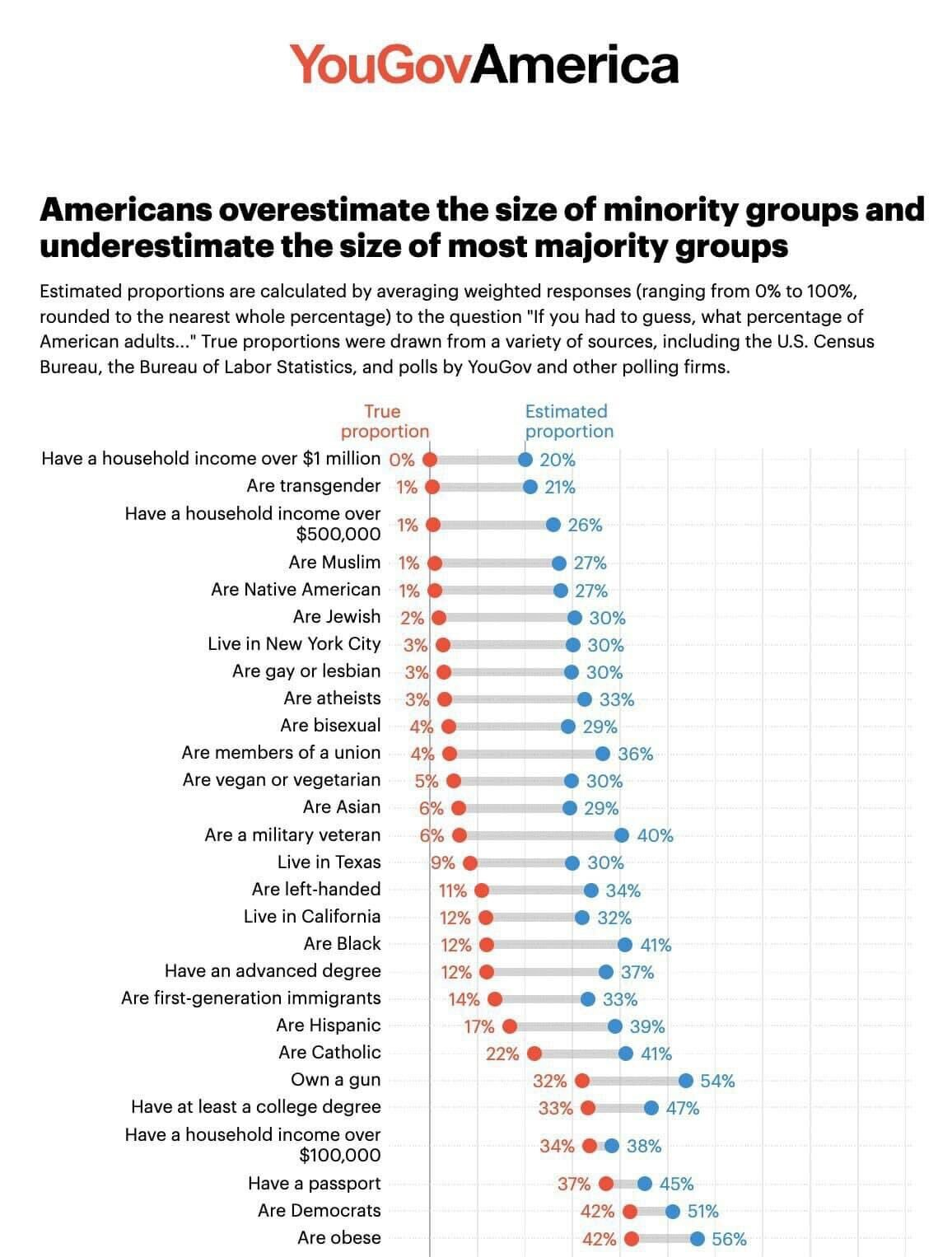
Blowing away some widespread clouds of confusion (click to enlarge the image): 


They're not saying that 51% of Americans identify as Democrats. They're saying that 51% of Americans who identify as members of minority groups that "need" special protection also identify as Ds. 

Glyphosate 

Formal study quantifies something we knew ten years ago:


Green 

As mentioned before, I think USPIRG's war on plastic is a safe, fluffy issue to let students doing their first grown-up jobs discuss with strangers. They're not making a dent in plastic use, and wouldn't make much of a dent if they did motivate some sub-segment of some industry to go back to using paper, glass, or metal. We're stuck with plastic for better or worse. And we wanted biodegradable plastic, so is it news that biodegradable plastic tends to, like, biodegrade? 

But there may be hope for a world where the only way the surplus population can have all the stuff we think we need is for most of that stuff to be made of plastic. 


Fair disclosure: I've not looked up the substantial information...yet. I will be looking. For now, I'll just say that the meme is Out There, and it has plausibility because you see these things sprouting where ashes that include burnt plastic have been dumped. 

Poetry 

So far, this essay on what constitutes truly daring art has attracted at least two subversive, transgressive poems in the comments. 


Psychology 

This is cruel, but true...


Obviously, Democratic Party membership does not cause the pattern of insanity that produces homicide/suicide. Drugs do...some street drugs that have passed through the "experimental" period and now appeal only to the suicidally stupid, and some prescription medications that are still given to bored kids and women who don't get enough exercise. People whose minds are in that sort of place tend not to fit in with the N.R.A. So there we are. 

Technology 

This is good news; we need something similar in Virginia.


Zazzle 

Mine: 


Not mine, but if you use these links the Save The Butterflies campaign gets more money:


Book Review: Maladaptive

Title: Maladaptive 

Author: JD Edwin

Date: 2021

Publisher: Story Cartel Press

Length: 220 e-pages

Quote: "I walk out of every movie theater already rewriting the film I’d just watched in my mind.' 

What if Yoda was a spy for the Empire? What if 1984 ended with Winston saying "Bleep have I left to live for, anyway?"? What if Rhett Butler got as far as the front hallway before running back screaming "Wait! I take it back!" That's one way to find plots for stories. Some plots work better when tweaked; some are just different; some fall apart. 

J.D. Edwin plays with plots. What if superheroes are real, but they're not conscious of how they morph from their mundane identities into their superhero or supervillain selves? What if an autistic child's limited understanding of a few crucial words could save the world? What if the sweet girl working the concession stand really were a sweet rather than a real girl? Maladaptive is a set of answers to this kind of questions.

It has recurring themes. There's a circus that has redeeming social value. There are Grim Reapers, apparently different ones. There are people with superpowers, and people trapped in strange games, and characters who use numbers for names, although none of those stories seems to take place in the world of Headspace. 

This book is the work of someone who makes up lots and lots and lots of stories, and writes out the best ones. As a result, the first words I wrote down after finishing the final story were "Dang, she's good." 

The difficulty in writing about this writer's stories is keeping out the spoilers. So I'll stop writing about Maladaptive now.

Instead I'll say that after expecting to see the "Games Theme" at strangehorizons.com in November or December, it's a relief to see it live in June. My thoughts on the trilogy that's scheduled to be complete this summer are at http://strangehorizons.com/non-fiction/headspace-and-master-of-the-arena-by-j-d-edwin/ .

Bad Poetry: Delusions

Next to the day when a patient actually died, the most melodramatic day in my not-if-I-can-help-it home nursing career was the day a patient had a psychotic reaction to a change in medication. The patient's husband couldn't imagine how a doctor could even think of his sensible wife as psychotic. "She is having delusions." 

"What are you talking about?"

"Delusions, sir, means that she believes things that aren't true."

"Believes things that aren't true? Why, then, tell me who's not having delusions?" The old gentleman started listing public figures who were in the news that year. "Do those two serial divorcees believe that whatever they have is a marriage, or ever will be? Does that candidate believe he has a chance to win the election?"

The patient stabilized in a few days and went home, practical and wise as ever. In a week or so I was free to go back to the city and take care of business, and there I wrote a song about delusions. I've sung it different ways, reflecting different news stories, over the years. The verses below stick in my mind as having seemed relevant in most years.

See the famous aging actress getting “married” once again.
Do you believe she’s ever going to stand by just one man?
Do you believe he wants more than her money and her fame?
Do you believe she can even remember her new “married name”?

Delusions, oh, delusions, we all have them, yes we do.
Delusions, oh, delusions—I believe that I can sing.
Delusions, oh, delusions, we all lose contact once in a while.
Turn on the news and wonder if “reality” means anything!

See the eager college student burn the candle at both ends:
Class overload, work overtime, two jobs, clubs, church, and friends.
By senior year, in coffee this poor child has lost all hope.
Another kid says, “Friend, I know where you can get some dope."

Delusions, oh, delusions, meth-heads don’t know they’re addicts too.
Delusions, oh, delusions, and I don’t know that I can’t sing!
Delusions, oh, delusions, we all lose contact once in a while.
Turn on the news and wonder if “reality” means anything!

See the crowd of unknown “hopefuls” trying to run for President.
“Political experience”—did they ever know what that meant?
Do you believe any of them think they’ll have a chance to win,
Or are they trying to spoil the race for someone who is “in”?

Delusions, oh, delusions, everybody has a few.
Delusions, oh, delusions, whoa! I believe that I can sing!
Delusions, oh, delusions, we all lose contact once in a while.
Turn on the news and wonder if “reality” means anything!

See the topical folk song writer sitting in this hotel room.
Can you believe she thinks a song will help dispel the gloom?
Can you believe she thinks that facing reality does any good?
As delusions go, that’s not so bad; I’d believe it if I could.

Delusions, oh, delusions, everybody has a few.
Delusions, oh, delusions—do I believe that I can sing?
Delusions, oh, delusions, we all lose contact once in a while.
Turn on the news and wonder if “reality” means anything!